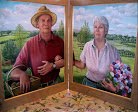
Sunday, 10 August 2014

For Lygia Waller, 25 January 1923 - 3 August 2014

This address was given on Saturday 9th August 2014 at Killodiernan Church of Ireland at the funeral service of my cousin by marriage Lygia Janina Waller nee Bansinska.
It was a great privilege to be asked to lead the service. A lifelong Roman Catholic, it was her expressed wish that her funeral should be in Killodiernan and be ecumenical. Fr John Slattery and Archdeacon John Hogan from Puckane & Carrig Catholic parish, and family friend Rev Felix Stephens OSB, as well as Church of Ireland Rector Canon Marie Rowley-Brooke also attended and took part in the service.

We have just heard the Beatitudes, the opening section of Matthew’s Sermon on the Mount.
They are radically counter-cultural. They were when Jesus spoke them, and they remain so today. Surely poverty and grief are not things anyone would wish to be blessed with?

Now is not the time or place to try to expound them, though their paradoxes do repay much pondering and meditation. Rather, let me try to relate the first two beatitudes to the Lygia that we knew and loved.

‘Blessed are the poor in spirit, for theirs is the kingdom of heaven.’
Lygia was a fortunate woman. She was brought up in comfortable homes reflecting the status of her father Eugene Banasinski, a Polish diplomat. He and her mother Kira, though, had both experienced being refugees with nothing in a foreign land. And Kira is celebrated in Poland today for her work with Polish refugee children. After marrying Hardress, the rootless life of an army wife must have been difficult for Lygia at times, but with his rising career came a comfortable life and many opportunities for exciting travel and appreciation of art, which she developed into her own career as a picture restorer, trained in the Courtauld Institute. I can testify that she enjoyed with relish the good things of life that came her way. I can’t conceive that she ever felt poor.

But Jesus is not talking about material poverty here. To be ‘poor in spirit’ is surely not so much about what you may or may not have, but about what you desire. For all the comfort she enjoyed, Lygia was not consumed by desire for wealth or possessions, material things – what mattered to her were qualities like beauty and honesty and kindness.

A life-long Catholic, Lygia was not conventionally pious and was seldom seen in any church. When religion came up in conversation with me, as it occasionally did, she used to joke, ‘You know, I think I’m more a Buddhist than anything else’. Buddhists, I understand, believe that desire for material things is a poison that brings suffering - it must be avoided to achieve Nirvana, release from suffering. It seems to me that as she aged, and particularly after Hardress’s death, Lygia began quite consciously to give material things up, to live more simply, to enjoy the present moment. So perhaps she was only half-joking about the Buddhism!

But the way I see it is this - she was cultivating being ‘poor in spirit’, in the sense Jesus meant it. Let us pray that she is now experiencing the blessings due to the poor in spirit in the kingdom of heaven.
May she rest in peace and rise in glory!

‘Blessed are those who mourn, for they will be comforted.’
Theologians debate what this means, but today let us take it as a simple promise by Jesus, that those who mourn will be comforted.

To mourn, to grieve for lost loved ones, is part of the human condition. Good mourning, giving time to attend to grief, is hard work, but it allows us to come to terms with loss. Over time the good memories of loved ones emerge from the pain of losing them. We are comforted.

Lygia had her own share of grief, but she did not allow it to consume her – she kept her mourning quite private. Each anniversary of Hardress’s death, she would ask to be taken to Cloughprior, where we will shortly take her body, for me to lead some simple prayers. There she would spend just a few minutes remembering Hardress and her much loved grandson Ed, and laying flowers on their graves. I feel sure these little formal acts of mourning gave her comfort.

Afterwards, Lygia being Lygia, she liked to be taken for a jolly good lunch with a glass or two of wine somewhere nice, and she would be the witty good company all her friends enjoyed.

Today, Jocelyn and Tom, Alex and William grieve for a mother, a grandmother and a great-grandmother. And Lygia’s many friends are grieving too. Let us pray that they will be blessed with good mourning, and that they will receive the comfort promised by Jesus for those who mourn.


Sunday, 27 July 2014

The Kingdom of heaven

An address given at Templederry and Killodiernan on Sunday 27th July 2014, the Sixth after Trinity

Today’s reading from Matthew (13:31-33, 44-52) is about the Kingdom of Heaven.
Now that’s a pretty heavy topic, so let me begin with a joke. It made me laugh – and perhaps it will you too.

A diocesan reader dies and is standing in the queue to enter the Kingdom of Heaven. In front of him is a rough looking guy with a leather jacket, jeans and tattoos, effing and blinding away. St Peter addresses this guy, "Who are you, so that I may know whether or not to admit you to the Kingdom of Heaven?" The guy replies, "I'm Jack, a flippin taxi driver from flippin Moyross." Saint Peter consults his list. He smiles and says to the taxi-driver, "Take this silken robe and golden staff and enter the Kingdom of Heaven." Now it's the diocesan reader's turn. He stands erect and booms out, "I am Joc, a diocesan reader who has faithfully preached God’s word for many years." Saint Peter consults his list. He says to Joc, "Take this cotton robe and wooden staff and enter the Kingdom of Heaven." "Just a minute," says Joc. "That foul-mouthed taxi-driver got a silken robe and golden staff and I get cotton and wood. What’s going on?" "In the Kingdom of Heaven we work by results," says St Peter. "While you preached, people slept; while he drove, people prayed."

But the Kingdom of Heaven isn’t just a laughing matter. In Matthew’s Gospel it is a central part of Jesus’s teaching. At the very start of his ministry Jesus proclaimed, ‘Repent, for the kingdom of heaven has come near’ (Matt 4:17). And when Jesus sent out the Twelve he instructed them, ‘As you go, proclaim the good news, “The kingdom of heaven has come near”’ (Matt 10:7). In Mark and Luke Jesus uses ‘the Kingdom of God’ to mean the same thing. As Christians we must take it seriously.

So, just what is this Kingdom of Heaven, or Kingdom of God? As a skillful teacher, Jesus uses parables based on everyday experience to teach those who follow him. I think he wants his disciples to work out the truth for themselves, not just learn it parrot fashion without properly understanding it. So he gives us clues in parables about the kingdom of heaven. We are meant to think about them deeply, and surely to share what we find between us.

So let me reflect a bit on what I find in these parables.
The parables of the mustard seed and the yeast tell us how the Kingdom of Heaven grows.
o   God does not bring the Kingdom of Heaven into existence suddenly, fully formed, in a kind of spiritual ‘big bang’. Rather it grows organically, bit by bit, just as the tiny mustard seed grows almost imperceptibly into a tree, or a tiny quantity of yeast works to leaven a loaf.
o   Sometimes it may seem as if nothing is happening at all. Then suddenly we notice a new shoot bursting, or the dough expanding. And when we come back later we see whole new branches, or the dough rising above its container.
o   The Kingdom of Heaven really has come near, it grows all around us, and if we search we will find it.

The parables of the hidden treasure and the pearl of great value tell us what it feels like to find the Kingdom of Heaven.
o   It is like a farmer finding treasure in a field, or a merchant the most perfect pearl. When they find it they joyfully trade everything else they value to obtain it.
o   We are so used to calculating what a thing is worth that it is hard to imagine something that is beyond price. Yet there are some things that are worth infinitely more than money or possessions. The Kingdom of Heaven is literally priceless. To live as part of it, by its values, as it grows, will bring us more real joy than anything else possibly could.

The parable of the net tells us what happens if we don’t live by the values of the Kingdom of Heaven.
o   We live in a world full of people of every kind, good and bad, just as the sea holds fish that are good to eat and not so good. But it is not for us to decide which is which. Just as in the parable of the tares we heard last Sunday, it is for God and his angels at the end of the age to separate the evil from the righteous.
o   God’s generosity is stupendous, isn’t it? In God’s creation we have been given enough and more than enough for all to flourish, both the good and the bad, the wheat and the tares. If you pull out the tares, you damage the wheat too. If we exclude those we don’t like from our community, we impoverish it and ourselves. And I don’t know about you, but I’m not entirely certain whether I am wheat or tare – or most likely a bit of both.
o   Our task is to seek out the Kingdom of Heaven, to help it grow, and to live by its values. But part of these values is to be inclusive and leave judgement to God.

So far, so good. But these parables don’t by themselves answer one crucial question, I think.
It is this: How are we to recognise the Kingdom of Heaven when we find it?

I think the Lord’s Prayer fills the gap. Jesus teaches us to pray to our heavenly Father, ‘your kingdom come, your will be done, on earth as it is in heaven’.

We can recognise the Kingdom of Heaven because God’s will is done there. And Jesus shows us how to discern God’s will. To find the Kingdom of Heaven is to align our will with God’s will. The Kingdom of Heaven works like this:
o   When any one of us does God’s will, in no matter how small a way – when we do what is right, or don’t do what is wrong - the Kingdom of Heaven grows accordingly. It is a bit like Pinocchio’s nose in reverse – in the children’s story, remember, his nose grew longer every time he told a lie.
o   When we experience the life and growth of the Kingdom of Heaven we feel a joy which encourages us to change our way of life for the better. That is what it means to repent.
o   We live more as part of the Kingdom of Heaven, we do more of God’s will, and we become better people. Our example may inspire others to do so too, and the Kingdom of Heaven grows some more.
o   Finally, at the end of the age, God’s angels will have less work to do to separate the evil from the righteous, there will be less weeping and less gnashing of teeth.

That is how God saves us through Jesus.

To finish, let me return to the joke I started with.

It is fanciful and childish to imagine St Peter at the gates of the Kingdom of Heaven when we die, checking in a ledger whether we are good enough to get in. But the joke does get one thing right - the Kingdom of Heaven is about results – the results of doing God’s will. We enter the Kingdom of Heaven when we do God’s will.


So, let us pray to our heavenly Father that through the teaching of our Saviour Jesus Christ, we may discern God’s will and follow it, so that the Kingdom of Heaven may grow, and we may know its joy. Amen.

Sunday, 22 June 2014

Fearlessly do what is right

An address given At Templederry, St Mary's Nenagh and Killodiernan on Sunday 22nd June 2014, the 1st after Trinity, year A

Today’s reading from Matthew’s Gospel (10:24Matthew 10:24-39 is strong meat, isn’t it!
When I first read it I said to myself, ‘Joc, you really can’t preach about this!’ How could such dark stuff about conflict, violence and death be appropriate for a lovely summer’s day? A day of joy, as Caleb & Laura Clarke bring their daughter Amy to Killodiernan to be baptised. And a day of fond farewells to Bishop Trevor and Joyce this afternoon in the Cathedral in Limerick.

But then I re-read it, I thought about it some more, and I realised that I have no choice in the matter – it is my duty to wrestle with it. That is what the Lectionary is for – to make preachers like me focus on passages from scripture they might prefer to avoid. As Jesus said, ‘What I say to you in the dark, tell in the light; and what you hear whispered, proclaim from the housetops’.

First, what is the context of the passage?
Jesus is briefing his disciples - the Twelve - as he sends them out two by two on a ministry training exercise. He is sending them out on their own for the first time to imitate his ministry, to proclaim the good news and to heal the sick. He has just warned them what they must confront: ‘See, I am sending you out like sheep into the midst of wolves; so be wise as serpents and innocent as doves. Beware of them, for they will hand you over to councils and flog you in their synagogues; and you will be dragged before governors and kings because of me’.

Who are these wolves? Jesus as always is entirely realistic about the world – it is full of people consumed by evil motives. People like the Pharisees, who Matthew tells us criticised Jesus for healing the mentally ill, whispering about ‘By the ruler of the demons he casts out demons’. Beelzebul is the Aramaic name of the ruler of the demons, the devil. If the Pharisees and people like them attack Jesus and call him Beelzebul, what will they do to his followers?

So, in the first half of the reading Jesus seeks to reassure his disciples.
Three times he tells them not to be afraid of such people – they may kill the body, but they cannot kill the soul. Instead they should fear God. Now, if we disobey God, if we blank out our God-given conscience, we lose our soul, we lose our integrity as human beings made in God’s image. And that is worse than death.

Shakespeare expresses the same thought in Hamlet, when he puts these words in the mouth of Polonius as he says farewell to his son Laertes, ‘This above all: to thine own self be true. And it must follow, as the night the day, thou canst not then be false to any man’.

Jesus reminds his disciples that God is like a loving Father who values them. ‘Are not two sparrows sold for a penny? Yet not one of them will fall to the ground unperceived by your Father. And even the hairs of your head are all counted. So do not be afraid; you are of more value than many sparrows.’ What a lovely image.

And Jesus promises solidarity with his disciples in the face of persecution: ‘Everyone therefore who acknowledges me before others, I also will acknowledge before my Father in heaven’.

Jesus is surely teaching his disciples – and through them us - an important lesson, which we must in turn teach our own children. It is this: each one of us must be fearless in doing what we know is right, because each one of us is loved and valued by God.

At the Baptism in Killodiernan the address ended with this:
Let us pray that with the help of Caleb and Laura, and her Godparents, Amy will learn this lesson and learn it well. 

May she and Sarah-Jane, and all the children here, grow up ‘wise as serpents and innocent as doves’ to overcome the wolves they will encounter in the world!

In the other churches it continued s follows.

But what of the second half of the reading, with its apocalyptic tone?
Matthew has already told us that Jesus taught his disciples in the Sermon on the Mount to turn the other cheek in the face of violence. How then can Jesus now declare: ‘I have not come to bring peace, but a sword’?

Jesus continues, quoting from the prophet Micah: ‘For I have set a man against his father, and a daughter against her mother, and a daughter-in-law against her mother-in-law’; and one’s foes will be members of one’s own household’. Micah is writing in the 8th Century BC about the corruption of Jerusalem, lamenting the collapse of traditional Israelite values and foreseeing the city’s eventual destruction.

No doubt Jesus’s disciples understood the reference to be to the corruption of their own time. And they probably realised that for them to be true to the values Jesus taught them and leave home and family to become itinerant preachers - would inevitably split their families.

Notice that Jesus, following Micah, is talking about conflict between generations – sons against fathers, daughters against mothers. We all know, don't we, that children always cause their parents grief by their behaviour. And parents are always scorned by their children for their comfortable hypocrisies. I think Jesus is making a general point, relevant to every time and place: young people, in order to be true to their own conscience and to God – to be true to their own selves in Shakespeare’s sense - are bound to behave in ways that hurt their parents.

And this is right. Because Jesus claims his disciples for himself before any family ties, and calls them to follow him no matter what pain and suffering it causes: ‘Whoever loves father or mother more than me is not worthy of me; and whoever loves son or daughter more than me is not worthy of me; and whoever does not take up the cross and follow me is not worthy of me’.

Are we prepared for this? 
We must become so. Loving parents must let their children go to grow as individuals, informed by their own sense of right and wrong - and loving children likewise their parents. Our Christian hope is that their relationship with God through Jesus will deepen and broaden as the Spirit leads their journey as disciples - because ‘those who find their life’ – those concerned only for their own life - ‘ will lose it, and those who lose their life for (Jesus) sake will find it’.

And let us pray that young and old we may all be ‘wise as serpents and innocent as doves’ to overcome the wolves we encounter in the world.


Sunday, 25 May 2014

Looking forward to Ascension & Pentecost

Address given at St Mary's Cathedral, Limerick on 25th May - the 6th Sunday of Easter, Year A - for Sung Matins, rite 1


1. For those of you that don’t know me, my name is Joc Sanders, and I come from Nenagh.
·         It is a very great privilege for me to be invited to lead you in worship here today in this magnificent ancient cathedral. I love the traditional language of rite 1 - for me, and for many of you I’m sure, it takes me back to childhood – it has a deep resonance. And how wonderfully the singing of the choir and the organ accompaniment enhances our worship – we are blessed by it, and on your behalf I thank them for it! It is all part of the rich heritage of our Church which gives us so much to be grateful for.
·         Another part of this rich heritage is the church calendar and lectionary, which we have inherited from the undivided Catholic church of ancient times. It leads us through the year in an unending cycle, to reflect on the story of our salvation. This is the 6th and last Sunday of Easter. We continue to celebrate the central event of our faith, the resurrection of our Lord and Saviour Jesus Christ.
·         But today’s reading from John’s Gospel (John 14:15-21) leads us to look forward, to peek over the horizon so to speak, toward the great events of the Ascension - which we will celebrate on Thursday - and Pentecost in 2 weeks time - when we celebrate the coming of the Spirit which Jesus promised us.
·         The reading is just a small part of Jesus’s farewell discourse to his disciples. John sets the scene as after the last supper. Jesus has washed his disciples’ feet to teach them his example of service. He knows how things will play out. Judas Iscariot has already left to betray him to the authorities, who will arrest and execute him. Time is short for Jesus to prepare his followers for what must come, so his words are dense with meaning. Let me reflect on what they mean to me.

2.       ‘I will not leave you orphaned; I am coming to you’, says Jesus.
·         Even as Jesus endures Judas’s betrayal and waits to be taken to his death, he puts aside his own distress to comfort his disciples. He loves them. He will not desert them. And he promises he will continue to be present for them, whatever befalls.
·          ‘In a little while the world will no longer see me, but you will see me’, he says. The Gospels tell us the risen Christ appeared to the disciples between the Resurrection and his Ascension, when he returned to his Father - they experienced his presence physically. But I do not think this is what Jesus means here. Jesus is looking beyond the day of Ascension, up to our own time and beyond. Throughout the ages Christians continue to experience Jesus’s reassuring presence, as friend and brother, saviour and redeemer. As Matthew (28:20) tells us, Jesus said, ‘Remember, I am with you always, to the end of the age’. Jesus is alive for us.
·         ‘Because I live, you also will live’, says Jesus. We live – we can be fully human as God wants us to be – because we know, as Jesus tells us, ‘I am in my Father, and you in me, and I in you’.

3.       ‘I will ask the Father, and he will give you another Advocate, to be with you for ever.
·           Jesus promises his disciples they will receive the gift of another Advocate - ‘the Spirit of truth’, the Holy Spirit - to teach and support them as a mentor. As we read in Acts, they did indeed receive the Spirit, on the day of Pentecost. The Spirit led them to go out boldly, declaring their belief in Christ, to make disciples of others. The disciples they made in turn received the Spirit and did the same, and so on - down through the years, the centuries, the millennia. Christians continue to be inspired by the Spirit to this day. The result is the Church we know, in all the glorious variety of our traditions. The Spirit will be with us for ever, Jesus promises, helping us to discern the truth.
·           Notice, Jesus asks the Father to send the Spirit. He does not ask him to send scripture – not the Gospels, not the letters of Paul, nor any other scripture. The primary gift Jesus asks for us from the Father is the Spirit, the Spirit of truth. Scripture is secondary – while we believe it is divinely inspired, we must also believe that we need the Spirit of truth to help us interpret it and come to discern the truth.
·         The disciples recognised the Spirit when they felt it working in them and saw its effects in others. So can we. ‘You know (the Spirit)’, says Jesus, ‘because he abides with you, and he will be in you’.

4.        ‘If you love me’, says Jesus, ‘you will keep my commandments’.
·         We need to take these words very seriously, I think. Jesus loves his disciples, but not in any soppy, sentimental way. His love demands obedience from his disciples. Just as loving parents demand obedience of small children, so that they do not run in front of cars, or burn or electrocute themselves.
·         ‘Those who love me will be loved by my Father’, continues Jesus, ‘and I will love and reveal myself to them’. We cannot expect to feel the loving presence of Jesus, nor the love of God the Father, unless we are obedient.
·         But just what are these commandments of Jesus? We surely need the continuing help of the Advocate, the Spirit of truth, to enlighten us. But scripture is pretty clear on the bones of it, I think.
o           Matthew (22:36-40) tells us that when Jesus is asked what the greatest commandment is, he answers, “‘You shall love the Lord your God with all your heart, and with all your soul, and with all your mind.’ This is the greatest and first commandment. And a second is like it: ‘You shall love your neighbour as yourself.’ On these two commandments hang all the law and the prophets.”
o           And John (13:34) tells us that Jesus says shortly before today’s reading, ‘I give you a new commandment, that you love one another. Just as I have loved you, you also should love one another’.
·         If we follow these 3 commandments, I don’t think we can go too far wrong. But we need the help of the Spirit to do so. And when we fail, as we surely will from time to time, we need to seek the forgiveness that God freely offers to those who are truly penitent.

5.       So to finish, I hope you will take 3 things away from my words today:
·         1st, as we celebrate Ascension Day on Thursday, let us give thanks for the continuing reassuring presence of Jesus, our friend and brother, our saviour and redeemer.
·         2nd, as we look forward to Pentecost in 2 weeks time, let us give thanks that the Spirit ,which the Father gave us at Jesus’s request, will continue to lead us to discern his truth.

·         And 3rd, let us pray that the Spirit may guide us to keep Jesus’s commandments: to love God, to love our neighbours as ourselves, and to love one another as he loves us, so that we may know the loving presence of Jesus and the love of his Father.

Sunday, 11 May 2014

Sheep & Shepherds

‘The sheep follow (the shepherd) because they know his voice’,
… says Jesus, in today’s reading from St John’s Gospel (John 10:1-10).

I don't know about you, but these words always used to puzzle me. It just didn’t chime with my own experience.

I used help move sheep on my Grandfather’s farm as a child. Those sheep certainly didn’t recognise anyone’s voice, let alone mine aged 12! You couldn’t lead them. In fact it was the divil’s own job to stop them charging off the wrong way. We stood in gaps, we waved our hands and we hunted them as best we could to their new field of fresh grass, but they just wouldn’t follow! Surely, I thought, shepherds in Jesus’s time must have had a very different relationship with their sheep to us.

But then some years ago a wise farmer explained it to me. He was amused by my difficulty moving sheep. ‘I never have any difficulty getting my sheep to follow me’, he said. ‘I just carry a bag of meal with me, and they come running.’

There’s more than one way for a shepherd to lead his sheep - the sheep follow the shepherd they know will feed them!

‘The Lord is my shepherd; therefore can I lack nothing’.
So begins the 23rd Psalm we read earlier. We all love it, don’t we?. It is such a favourite because it is so filled with comforting images of God caring for us and keeping us safe.

This metaphor of the shepherd runs right through Hebrew scripture – our Old Testament - hardly surprising, because the Israelites were a pastoral people.

God is often likened to a shepherd in the scriptures, as in Psalm 23, or as Isaiah put it beautifully (Isaiah 40:11): “(The Lord God)  will feed his flock like a shepherd; he will gather the lambs in his arms, and carry them in his bosom, and gently lead the mother sheep.”

But Ezekiel 34:2 applies the metaphor to the leaders of Israel, in a great indictment for their bad leadership and corruption: “Ah you shepherds of Israel who have been feeding yourselves! Should not shepherds feed the sheep?”  They are bad shepherds. The same indictment might be made of some of the great and powerful of our society!

Jesus chooses to use the same metaphor in today’s reading.
It is the first part of a longer parable about his relationship with his disciples. In the very next verse, which the lectionary keeps for another day, Jesus continues “I am the good shepherd. The good shepherd lays down his life for the sheep.” This image of Jesus as the Good Shepherd is lovely and familiar, isn’t it? We have all seen the pictures of the strong self-reliant country man keeping his little flock safe from harm, carrying the lost sheep back to the flock on his shoulders.

In the rugged Judean countryside sheep had to be kept in a sheepfold at night to prevent them straying into the crops, and to protect them from wild animals and rustlers. In the two halves of the passage we have just heard, Jesus is probably talking about two different kinds of sheepfolds.

The first kind is a large communal fold near a village, surrounded by fences with a gate. The village would employ a gatekeeper to protect the sheep in the communal fold. In the morning the gatekeeper would open the gate to the shepherd who would call his own flock out. The other flocks wouldn’t recognise his call and would stay behind until their own shepherd came.

The second kind of sheepfold would be up in the hills, far from the village, and much smaller. It would be used in summer when a single shepherd would stay out with the sheep for days or weeks on end. To protect the flock at night, the shepherd would lead them into a small enclosure, perhaps just a dry-stone wall he had built. Instead of a gate, he would lie down to sleep in the entrance where any movement in or out would wake him up. I’ve found similar structures up in the Burren hills which may have been used in the same way. When Jesus said “I am the gate”, he meant it quite literally!

In the parable of the sheepfolds, and by calling himself the good shepherd, I think Jesus is quite deliberately doing two things:

Firstly he is promising his disciples - those who recognise his voice - that he will care for them. He will keep them safe and feed them. “Whoever enters by me will be saved”, he says.  They “will come in and go out and find pasture”. It is also a promise to us, today.

But secondly Jesus is implicitly accusing the leaders of his own day – the Pharisees he was talking to - of being bad shepherds, just as Ezekiel had done centuries before. “All who came before me are thieves and bandits;” he says, “but the sheep did not listen to them”. Today we must still be alert for thieves and bandits who try to mislead people, as much as in Jesus’s time.

Jesus’s disciples still need leadership today.
Jesus will always be our Good Shepherd, of course. We should hold on to that comforting, familiar image, and listen to his words as he leads us to find good pasture. After all he has told us “Remember, I am with you always.”

But Jesus has handed on a shepherd’s mantle to others too, starting with the apostles. John (21:15-17) tells us that Jesus said to Peter “Feed my lambs … tend my sheep … feed my sheep”. Bishops from that day to this have inherited the shepherd’s mantle.

Bishop Trevor will be retiring in July. When he leaves we will miss the wise and loving Christian leadership which it is a bishop’s job to give us. There are many challenges his successor must lead us to face. As a Christian flock we face schism in our Anglican communion. As a nation we struggle to build a just society as we emerge from the economic crisis. As a species we wrestle with resource depletion and global warming. The thieves and bandits are still about us.


Let us pray for those with the heavy responsibility of choosing his successor, that the Holy Spirit may guide them to find us a wise and loving Bishop, to lead us to pastures green beside quiet waters.

Sunday, 27 April 2014

Baptism of Daphne Jane Eve Clarke, 13th April 2014, Killodiernan

Address given at the baptism of Daphne Jane Eve Clarke at Killodiernan on Sunday 13th April 2014, Easter 6 - Palm Sunday.

Today is a joyful occasion, a day for celebration, a day of baptism!
For many of us it is a family celebration. Particularly so for Peter and Natasha, as with their daughter Hollie they bring their baby daughter Eve to be christened in the presence of so many of their relatives and friends, who share their joy in her.

For Eve’s Godparents, for Janet McCarthy, Brenda O’Laughlin and Adrian Gordon it is a day when they promise to encourage Eve in her life and in her faith. It is a day to celebrate the start of a very special relationship they will have with her as she grows up. My daughter, when she was small, didn’t understand what a Godmother was. She called her Godmother ‘my bed-sitter’, because when she came to stay her Godmother would sit on the end of her bed and have long talks with her. My daughter loved those special talks. May you as Godparents be equally special ‘bed-sitters’ for Eve!

It is surely right for families to celebrate as families. Our Lord Jesus Christ himself was reared in a human family, and he took part in family celebrations such as the wedding in Cana of Galilee.

But today is about much more than just a family celebration.
St Matthew’s Gospel tells us how Jesus after his resurrection commissioned the apostles to make disciples of all nations, and to mark it by baptism. They in turn passed on the commission to others, handing on the gift of faith to new generations. And so we, as that part of Christ’s church gathered here today, as Jesus’s disciples, pass on this gift to a new generation, to Eve.

We are here to welcome Eve as a new member of Christ’s Church.  Baptism marks the beginning of a journey with God, which will last for the rest of her life. Whether we are family or not, we celebrate that today. And as we renew our baptismal vows in a few moments, let us reflect on our own journey, and let us be determined to support Eve’s parents and Godparents as they guide her on her journey.

Eve will be baptised “in the name of the Father, and of the Son and of the Holy Spirit”.
Matthew tells us that Jesus himself used these words. Those of us who are Anglicans share this baptismal formula with most other Christians, including the Roman Catholic, the Orthodox and most Reformed Churches. It is a symbol of unity within the diversity of our denominations that we all baptise in the same words.

We shouldn’t see the Trinity as a static thing, I think. Rather, God reveals himself in the Trinity as a dynamic cycle of loving relationships. The Father and the Son loving each other; the Son and the Spirit loving each other; and the Spirit and the Father loving each other.

May Eve grow up to recognise God’s dynamic cycle of love reflected in her own relationships!

According to Matthew, the last words Jesus spoke to his disciples are these: “Remember, I am with you always, to the end of the age.”
Jesus was speaking to the apostles, but he still speaks these words to his disciples today.

What an amazing thing it is, that Jesus Christ, our Lord and Saviour, our friend and brother, is travelling with us on our journey. Even when we are tired or anxious, lonely or frightened, doubting or lost, Jesus is there with us, to encourage and support us, to love us.


The loving Christ journeys with Eve, and with every one of us. Let us give thanks for it, and let us celebrate it!

Passion Sunday - Take this cup from me

Address given at Templederry on Sunday 13th April 2014, Easter 6 - Palm Sunday, after reading Matthew's Passion Gospel

Wow, that was a long reading (Matthew 26:14- 27:66)! It is surely good for us to hear the whole story of Christ’s Passion from beginning to end at least once a year, to better appreciate the enormity of those events. But I also feel sure you’ll be glad to know that I’m not going to preach a long sermon too!

Instead I ask you to reflect with me for a moment on Jesus’s prayer in the Garden of Gethsemane:
‘My Father, if it is possible, let this cup pass from me; yet not what I want but what you want.’
Jesus is distressed and agitated. He is certain that what he is doing is the will of God, his loving Father. He knows what is likely to happen next – his execution as a dangerous agitator, perhaps even the agonising death of crucifixion.

And he does not want to die – he is a man in the full strength and vigour of his early 30s, he loves life, he loves his friends, and he loves his ministry to those who need healing and forgiveness. So he prays to his loving Father for himself, that his death may be averted - ‘let this cup pass from me’.

But that is only half his prayer. Even more important for Jesus than his own distress at the prospect of death is that his loving Father’s will should be done. So he finishes his prayer with ‘yet not what I want, but what you want’.

This prayer of Jesus should be a model for our own prayers for our selves, I think. When I desperately wish for something, it is right and proper for me to pray to God for it. If I cannot ask God for it, who can I ask? But I must never forget how much more important it is for God’s will to be done, than for my wish to be granted. So I should always finish a prayer for myself with Jesus’s words, ‘yet not what I want, but what you want’.

In the end, like Jesus, we must trust that our loving Father knows what is best for us.