Sunday, 13 November 2022

Prayers with the Nenagh Walking Club, Aonach ar Siúl


The Nenagh Walking Club, Aonach ar Siúl, held a walk on 13th November 2022 in memory of deceased members, beginning at the Nenagh Famine Graveyard, behind the hospital, walking through the town to St John's Well, and back along the river. I was invited to contribute prayers on behalf of the Church of Ireland community, but did only parts of the walk.

At the Famine Graveyard

As we remember all those buried in this tranquil graveyard, 
w
e pray for grace to live in the light of eternity.
Grant us, Lord, the wisdom and the grace 
to use aright the time that is left us here on earth. 
Lead us to repent of our sins, 
the evil we have done and the good we have not done; 
and strengthen us to follow the steps of your Son, 
in the way that leads to the fulness of eternal life; 
through Jesus Christ our Lord. Amen

Father of all, in whom we are one with your saints,
We remember members of the Nenagh Walking Club 
that you have gathered to yourself, 
and we rejoice in the fellowship we have enjoyed with them.
We remember walkers and mountaineers of previous generations,
including Anthony Adams-Reilly, the pioneering C19th alpinist,
who is buried in Kilbarron CofI graveyard.
We give you thanks for those whom we love but see no longer.
Keep us in unbroken fellowship with your whole Church, 
and grant that at the last we may all rejoice together in your heavenly home; 
through Jesus Christ our Lord. Amen.

At St John's Well

Let us pray

Today is marked as Remembrance Sunday in churches of my Church of Ireland tradition. On this day we pray not to glorify war, but for all who suffer as a result of conflict, and ask that God may give us peace:

To the bidding May God give peace, please respond God give peace.


We pray for the service men and women of every nation who have died in the violence of war, each one remembered by and known to God;

May God give peace

God give peace


We pray for those who love them in death as in life, experiencing the distress of grief and the sadness of loss;

May God give peace

God give peace


We pray for civilian women, children and men whose lives are disfigured by war or terror, in particular today those in Ukraine, as we call to mind in penitence the anger and hatreds of humanity;

May God give peace

God give peace


We pray for peace-makers and peace-keepers, who seek to keep this world secure and free, and in particular for our Irish service men and women on peace-keeping duties with the UN;

May God give peace

God give peace


We pray for all who bear the burden and privilege of leadership, political, military and religious; asking for gifts of wisdom and resolve in the search for reconciliation and peace.

May God give peace

God give peace


O God of truth and justice, we hold before you those whose memory

we cherish, and those whose names we will never know. Help us to lift our eyes above the torment of this broken world, and grant us the grace to pray for those who wish us harm. May we put our faith in your future; for you are the source of life and hope, now and for ever. Amen.

 Adapted from CTBI

We pray for ourselves, in the words of John Henry, Cardinal Newman, who before joining the Roman Catholic church was a priest in the Anglican tradition in the Church of England.

O Lord, support us all the day long

until the shades lengthen,

and the evening comes,

and the busy world is hushed,

the fever of life is over,

and our work is done.

Then, Lord, in your mercy

grant us safe lodging,

a holy rest, and peace at the last;

through Jesus Christ our Lord. Amen


Tuesday, 8 November 2022

Renewal in the ruins


Reflection for morning worship with the Community of Brendan the Navigator on Tuesday 8th November 2022

Do you sometimes feel that time is accelerating, that events are moving faster and faster?

I do. Though perhaps that is just my advancing years - as I grow slower, so time seems to pass ever faster. Waiting for Christmas as a child seemed to go on for ever, but now it feels that Christmas is almost upon us – just over 5 weeks now, only 30 shopping days!

I have the same feeling when I look at the state of the world today, the beautiful world we inhabit, God’s world. The COP27 climate summit is taking place this week in Egypt. We can all see and experience for ourselves that climate is changing. The seasons here in Ireland have become distorted. We see images of extreme, damaging and even catastrophic climate events elsewhere – wildfires out of control across Europe and North America, one third of Pakistan flooded. Climate scientists tell us that the forecasts they made 20 years ago were wrong. The damaging changes they foresaw are really happening – but they are happening much faster than they at first believed they would. It is as if we are all in a flimsy canoe being swept faster and faster towards dangerous rapids, which may prove fatal to millions, and even destroy our very civilisation.

The words of the prophet Haggai (1:15b-2:9) speak to me in this time of danger.

‘Take courage, all you people of the land, says the LORD; work, for I am with you, says the LORD of hosts, according to the promise that I made you when you came out of Egypt. My spirit abides among you; do not fear.’ Haggai tells the people that the LORD of hosts will ensure that the Temple they rebuild will be even more splendid than the ruined Temple of Solomon, and the LORD of Hosts will give them prosperity. And at Haggai’s urging the people did successfully rebuild Solomon’s Temple.

I see the beautiful world we inhabit as a temple to God, who has filled it with life including ourselves. What Haggai’s words tell me is this - we must trust that our God is with us, and overcome our fears. If we as the people of God work to repair the damage being done to his world and all its creatures, he promises we will be successful. God’s world will then be even more splendid than it was before, and all God’s creatures will flourish.

This surely is cause enough for us to ‘sing to the Lord a new song’ in the words of that wonderful hymn of praise, Psalm 98.


Sunday, 6 November 2022

On resurrection from the dead


Address given at St Mary's, Nenagh on Sunday 6th November 2022, the 3rd before Advent

We have just heard Jesus answer a question about one bride who married seven brothers (Luke 20:27-28).

Now, the idea of a woman marrying seven successive brothers, each of whom dies childless, may seem a bit bizarre to us. But ancient Jewish law in the Torah obliged a man to marry his dead brother’s wife if she were childless. Her firstborn child - if she had one - would inherit the dead man’s name and property. If the man refused to marry her, he would be publicly humiliated. In a deeply patriarchal society this law provided some protection and security to the widow and her future children.

The question was asked by Sadducees, Jews who accepted only the Torah, the 1st five books of our OT, as God’s law. The Torah does not mention the possibility of resurrection, so Sadducees rejected the very idea. Later books of the OT – the prophetic and wisdom books – do talk about resurrection. They were accepted by other Jewish traditions who did believe in resurrection – in particular the Pharisees. The disputes between those who did and those who didn’t believe in resurrection were very bitter.

The Sadducees’ question was this: if you believe in resurrection, which of the seven brothers will the woman be married to when they all rise from the dead?

It is a trick question. If Jesus replies, ‘all of them’, everyone will be outraged, because for patriarchal Jews it was entirely unacceptable for a woman to have more than one husband - even though a man could have more than one wife. If Jesus picks one brother, they will tie him up in knots justifying which one. So - they think - he will have to support their view that resurrection is a nonsense – and that will annoy the Pharisees.

In his answer Jesus avoids the trap set for him by the Sadducees – and at the same time reveals what he himself believes about resurrection.

Jesus tells the Sadducees they are mistaken. He quotes the Torah they revere to argue for life after death, for resurrection.

He points them to the story of the burning bush in which God tells Moses, in the present not the past tense (Exodus 3:6), ‘I am the God of Abraham, the God of Isaac, and the God of Jacob’. God, says Jesus, ‘is God not of the dead, but of the living; for to him all of them are alive’. They have died, but they are alive - so they must have been resurrected.

And he draws a clear distinction between living mortals and those who have died and been resurrected. He says that after death there can be no such thing as marriage – death really does change human relationships.

‘Those who belong to this age’ – mortal human beings - ‘marry and are given in marriage; but those who are considered worthy of a place in that age’ – after death - ‘and in the resurrection from the dead, neither marry nor are given in marriage’. Notice that Jesus does not say that all will rise from the dead – only those who are considered worthy of it. ‘Indeed’, he says, ‘they cannot die any more’ - they have eternal life - because they are like angels’ – and angels were believed to be sexless. They ‘are children of God, being children of the resurrection’.

From this we can be sure of 2 things:

1st, Jesus himself does believe in the resurrection of the dead – at least for those considered worthy of it; and

2nd, Jesus does not believe that those who are resurrected are simply re-animated corpses – they have become something completely different.

Jesus believed in the resurrection of the dead – but do you, do I?

I hope so, because every Sunday in the creeds we publicly declare our belief in resurrection!

These days most people find it very difficult to believe in the resurrection of the dead. Even many Christians mouth the words of the creeds without really meaning them. Our modern, materialist world view, informed by science, can make resurrection seem literally unbelievable. The atoms and molecules of which I am made will be dispersed when I die, and recycled into other living creatures, including other human beings. How can they be re-assembled after my death into a living body? My identity as a unique person is encoded chemically both in my DNA and in my memories. How can it persist beyond my dissolution?

But surely, it would be wrong to reject what Jesus himself believed! If there is no resurrection of the dead, then Jesus did not rise from the dead, and as St Paul said, our faith is in vain.

Our world view – how we make sense of everything around us – is not the same as the Sadducees’. When Jesus talked to the Sadducees about resurrection, he spoke to them in language they could relate to and understand – the language of the Torah. I feel sure that when we try to make sense of the resurrection, we must also use language that we can relate to and understand – and for many of us that is the language of modern science.

We should not be afraid to express our faith in new ways that make sense to us.

I ask myself how Jesus might explain to me what resurrection means in language I can understand and believe in. I can imagine him saying something like this:

In the 4 dimensions of space-time, our lives are like 3 dimensional threads, they are world lines. They start at our conception and end at our death, and each of them is entangled with the world lines of all the others we encounter.

But God is not constrained by space-time. He loves and apprehends each one of us in our entirety, from the start to the finish of our world line.

God judges our worth against the quality of our love – our relationships with others – measured over our entire world line, our whole lives.

Our resurrection is precisely to be apprehended by God as being worthy of him.

In resurrection, we are as different from our mortal selves as a line is to a point - we cannot die a 2nd time, we have been transformed into immortal children of God.’

I find these ideas help me to understand resurrection and to believe in it. Perhaps you will find them helpful too. But if not – if this sounds to you no more than meaningless science fiction psychobabble – don’t worry, just ignore my words.

In any case, if you find the idea of resurrection difficult, I urge you to search for your own way to understand it, and to believe in it – because Jesus believed in resurrection, and because God raised Jesus from the dead as our Lord and Saviour.

Let me finish in prayer with a Collect for Resurrection from the BCP (p495)

Bring us, Lord our God, at our last awakening,
into the house and gate of heaven,
to enter into that gate, and dwell in that house,
where there shall be no darkness nor dazzling, but one equal light;
no noise nor silence, but one equal music;
no fears nor hopes, but one equal possession;
no ends nor beginnings, but one equal eternity;
in the habitation of your glory and dominion,
world without end. Amen.


Sunday, 16 October 2022

Faith & Duty

 Address given at St Mary's Nenagh on Sunday 16th October 2022, the 18th after Trinity

In today’s NT reading Luke (17:5-10) records two short sayings of Jesus.

They are memorable because Jesus - as he always does - paints vivid pictures in simple everyday language. But they are also paradoxical, because although they seem simple on the surface, it is only after pondering them for a while that we can begin to grasp their true implications.

In these two sayings, Jesus is giving his followers – then and now – two important rules for living as God’s beloved children: a rule of faith, and a rule of duty.

First, the rule of faith

The apostles said to Jesus, ‘Increase our faith’. Jesus replied, ‘If you had faith the size of a mustard seed, you could say to this mulberry tree, “Be uprooted and planted in the sea”, and it would obey you.’

I wonder whether the apostles felt at first that Jesus was exasperated by their request. Was he criticising them for not having even the merest smidgeon of faith? Because of course they knew they couldn’t expect a tree to obey their command!

But once they thought about it they would realise that he was simply telling them the truth, in his typically vivid way.

Surely what Jesus really means is this. They mustn’t use the excuse of too little faith to avoid doing what God asks of them. If they have any faith at all, no matter how small, they must act on it. They must trust that God will work his purpose out through them - and get on with it. They will find that they can do things they never thought they could – miraculous things.

And I think, perhaps, that we have experienced the truth of this in our own parish. Recall that some years ago, when we discovered that St Mary’s needed a new roof which would cost hundreds of thousands of Euro, we didn’t at first believe that we could raise the money. But when we overcame our fears, when we trusted that God would not let us down, when we acted on our little faith, by God’s grace and with the help of our neighbours and the wider community, we discovered that we could perform a little miracle. We raised enough money to complete the roof in a little over a year. And later we went on to replace two more, build a hall for our parochial school, and bring the Rectory up to modern standards!

The rule of faith that Jesus gives us is this: do not fear that you have too little faith; instead trust in God and obey the promptings of his Spirit; you will discover that you have faith enough to do things that might seem impossible.

Second, there’s the rule of duty

Jesus asks his followers to imagine they are slave owners. A slave owner wouldn’t dream of thanking a slave for doing what he is ordered to do, he says – that’s just what a slave is meant to do! But then he asks them to imagine their role reversed, with them like slaves in relation to God. ‘So you also, when you have done all that you were ordered to do, say, “We are worthless slaves; we have only done what we ought to have done!”’

Now, we’re not at all comfortable today with the idea of slavery – thank God! Slavery was abolished largely because Christian men and women came to realise that it contradicted the biblical conviction that every human being is created in the image of God - though shamefully not until nearly 2000 years after Jesus’s death. I doubt that many of Jesus’s disciples owned slaves themselves – they weren’t rich folk – but slavery then was part of everyone’s common experience – they would have understood what Jesus was talking about very well.

If Jesus were making the same point today, he might say something like this.

‘Imagine you’re a multi-billionaire, like Elon Musk perhaps, who employs many housekeepers or personal assistants. When they do their job, you don’t go out of your way to thank them, or give them a bonus, because you pay them well to work for you – doing their job is only what you expect of them.

Now, put yourself in God’s shoes. He employs you to serve him by doing good, doing his will. He has given you this wonderful world and all its resources to meet all your reasonable needs. Surely you don’t expect God to give you any special reward just because you have done what he asks of you, do you? You’ve only done your duty!’

The rule of duty that Jesus gives us is this: behave like servants of God; the Holy Spirit will tell you what God wants of you if you listen for it in prayer; your Christian duty is to do what he asks. But you should not expect to earn any special favour from God for doing it – it is no more than what God expects of you.

We have no right to expect good things in this life, nor a place in heaven, just because we have done a few good deeds – and inevitably failed in many others. Yet Jesus reveals to us a God who is like a loving Father. He assures us that God will forgive our failures if we ask him to, and he tells us he has prepared a place in his kingdom for his faithful servants. But it is a matter of God’s grace and not our own merit.

Let us then resolve to live our lives according to Jesus’s rules of faith and duty

Let us trust in God and believe that though our faith is little it will be enough to achieve God’s purposes.

Let us be servants of God, doing what is right and our duty, not because we expect to be rewarded for it, but just because it is right and it is our duty.

St. Ignatius Loyola captures this spirit beautifully in his prayer

Teach us, Good Lord, to serve you as you deserve:
To give, and not to count the cost;
to fight, and not to heed the wounds;
to toil and not to seek for rest;
to labour and not to ask for any reward,
save that of knowing that we do your will.
Through Jesus Christ Our Lord.
Amen

Sunday, 18 September 2022

You cannot serve God and Mammon


Address given at Ballingarry Church on Sunday 18th September 2022, the 14th afterTrinity

I wonder how many of you remember the theme song of the TV series, the Adventures of Robin Hood, back in the 1950s?

Robin Hood, Robin Hood, Riding through the glen,
Robin Hood, Robin Hood, With his band of men,
Stole from the rich, Gave to the poor,
Robin Hood! Robin Hood! Robin Hood!

Today’s reading from Luke’s Gospel (Luke 16:1-13) is all about the right way for Jesus’s disciples - whom he calls ‘the children of light’ – to deal with riches, with wealth. But at first sight, it is very odd, because it looks as if Jesus is commending dishonesty, that he is encouraging his disciples to be like Robin Hood, to steal from the rich to give to the poor.

 Now I don’t for a minute think that is what Jesus is saying. So let me try to tease out what message Jesus really wants us to take from his words.

The story Jesus tells, often called the parable of the dishonest manager, sounds very contemporary, doesn’t it?

A dishonest manager is about to lose his job because he has squandered his employer’s assets. Because he doesn’t want to do manual labour or receive charity, he goes around to all the people who owe his employer money and reduces their debts. He does this so that they will help him after he loses his job. To our surprise, the employer commends the dishonest manager for his shrewdness.

It is a story about as worldly-wise a set of rogues as we might meet anywhere today. The dishonest manager is a rogue who embezzles from his employer. The debtors are rogues, who are quite happy to go along with him. The employer is a rogue too, who admires the shrewd dishonesty of his manager – perhaps he might reconsider sacking him!

Jesus tells his disciples, ‘The children of this age are more shrewd in dealing with their own generation than are the children of light’. In other words, the worldly wise, like the dishonest manager and his employer, rogues who are always ready to pull a stroke to their own advantage, are shrewder than they are. They should ‘make friends for (themselves) by means of dishonest wealth so that when it is gone, they may welcome you into the eternal homes’.

Is Jesus urging his disciples to be like Robin Hood, to steal what is not theirs, to give it to those who will welcome them? I think not. I am reminded of what Jesus said to the twelve disciples he sent out on a training mission as Matthew (10:16) records: ‘See, I am sending you out like sheep into the midst of wolves; so be wise as serpents and innocent as doves’.

What Jesus is saying is surely that they must be shrewd enough to see through the machinations of the worldly wise, so that they do not fall into the trap of imitating their dishonesty. Rather they must use whatever wealth they are blessed with, that they make honestly or receive as a gift, to do good for others, so that they may be eternally welcomed.

John Wesley got it right, I think, when he said in a sermon on the use of money: ‘No more waste! Cut off every expense which fashion, caprice, or flesh and blood demand. No more covetousness! But employ whatever God has intrusted you with, in doing good, all possible good, in every possible kind and degree, to the household of faith, to all men.’

Jesus goes on to clarify for his disciples the proper use of wealth.

He points out to them that faithfulness and honesty in undertaking a small task is the best proof of fitness to be entrusted with a bigger task. This is surely true in earthly matters. No one is likely to gain a high, responsible position until they have proved their faithfulness, honesty, and ability in a lower position - though recent events in Westminster might lead one to doubt that this always applies in the world of politics!

Jesus then extends this principle to eternal matters. ‘If then’, says Jesus, ‘you have not been faithful with the dishonest wealth, who will entrust to you the true riches? And if you have not been faithful with what belongs to another, who will give you what is your own?’

The wealth we have on earth is not really ours, it is loaned to us by God. We may have earned it honestly by hard work, or received it as a gift or by inheritance, but we cannot take it away with us when we die - we are only stewards of it. If we choose to hoard it and use it only for our own pleasure, if we are driven only by the desire to accumulate more, we are being dishonest – in that sense it is dishonest wealth. Even if we have not, God forbid, cheated and exploited other people to get it.

The true riches we should seek are spiritual riches. We will receive these only in as much as we use earthly riches well, as God would have us use them. And if we do not use what God has given us well, how can we expect him to continue to give it to us?

The fact of the matter, Jesus teaches us, is that his disciples cannot serve two masters. ‘You cannot serve (both) God and wealth’.

I finish in prayer with a Collect of the Lord

O God, you are rich in love for your people:
show us the treasure that endures
and, when we are tempted by greed,
call us back into your service
and make us worthy to be entrusted 
with the wealth that never fails.
We ask this through your Son, our Lord Jesus Christ,
who lives and reigns with you in the unity of the Holy Spirit,
one God, for ever and ever. Amen.


Tuesday, 13 September 2022

The earthly and the heavenly harvest

Harvest decorations in Killodiernan Church

Address given at morning worship for the Community of Brendan the Navigator on 13th September 2022

Are you feeling cheerful? I do hope so, because we have so much to give thanks for!

Here in Killodiernan last Sunday we celebrated our Harvest Festival with great joy. Whatever bad news the media are full of, whatever fears we have for the future, we should look at the glass as half full, not half empty! Just reflect for a moment on the breadth and variety of our earthly harvest:

·         We have the staples: we have wheat for bread, barley for beer, oats for porridge, hay for horses and silage for cattle.

·         And there’s so much more than staples for us to enjoy, isn’t there? There’s milk and honey, butter and cheese, beef and pork, lamb and chicken. There are fruits and nuts, blackberries and mushrooms, plums and apples, potatoes and turnips. There are pumpkins and marrows, peas and beans, cabbage and lettuce, and gardens full of flowers!

·         For those who work with animals, there are this year’s foals, and calves and lambs and chicks. And there’s also the fruit of our own bodies - our children and grandchildren born this year, and older ones growing apace as mine are. Thank God for them all!

In this rich corner of the world today, no one will starve because of a poor harvest or recession, as our forefathers so often did. With our God-given cleverness we have invented ways to store food and to transport it, and economic and social systems to distribute it to where it is needed. And if we consume a little less, it will probably be good for our health - and perhaps the whole planet will benefit.

Yet for all our cleverness, the earthly harvest is perishable and uncertain. Why has God not given us perpetually good harvests – and recession free economies? Perhaps to remind us that we are not masters of the universe: God is. God’s laws don’t change. Nature is as God has made it - and what we sow, we shall reap. We remain as we have always been, totally dependent on God’s continuing fatherly goodness.

In the passage from John’sGospel (6:25-35) that we’ve just heard, Jesus asks us to look beyond the earthly harvest, to a different heavenly harvest.

He tells the crowd: ‘Do not work for the food that perishes, but for the food that endures for eternal life, which the Son of Man will give you.’ ‘The bread of God is that which comes down from heaven and gives life to the world’, he says. And finally he makes this great claim: ‘I am the bread of life. Whoever comes to me will never be hungry, and whosoever believes in me shall never be thirsty’. 

What is Jesus talking about? This teaching is difficult. I find it so - but then so did many of those who first heard his words, as John tells us in the next few verses. One way to look at it, which I find helpful, is this:

Just as God has made us clever, able to till and keep the world of which we are part, so he has made us in his image to be moral beings, to be souls. Souls with the capacity we call conscience to distinguish right from wrong, truth from lies, love from hate - and to prefer good to evil, as he does. If we use our conscience to make the right choices, we sow a heavenly harvest of good for others to reap, which nourishes us for eternal life. As the old saw says, the good we do lives after us.

But we are not masters of our own souls, any more than we are masters of the universe: our souls are as God made them, with free will, vulnerable to temptation, beset by our own greed. So it’s hard to be good. We have to work at it, just as we do for the earthly harvest. It is hard work resisting temptation, putting what is right above our own desires, cultivating generosity. All too often we fail. We name that sin. And when we fail and sin, the evil we do poisons our soul, and that evil too is eternal – a bad deed done can never be undone!

What a mess we are in! How can we possibly be as good as God wants us to be? As good as God has made us want to be, in our best moments.

This is where Jesus’s teaching speaks to me: he promises us all the help we need to reap the heavenly harvest. All we require is the faith to come to him. As the bread of life, he strengthens our souls. He helps us to resist temptation and to do good. And when we fail, he sucks out the evil that poisons the soul – in other words he redeems us. The only cure for a bad deed is to repent and be forgiven!

It is in this sense that Jesus is the bread of life that nourishes us for eternal life.

So to sum up:

·         Let us thank God our loving Father for bountiful earthly harvests. God makes them possible, and we work hard for them, so it is right to celebrate and enjoy them together.

·         But let us work just as hard for the heavenly harvest of goodness, to nourish our souls.

·         Let us also thank God for the gift of his Son Jesus Christ, whose help we need to reap this heavenly harvest.

·         And let us pray that Jesus will transform our selfish natures into the generous natures on which both our earthly and heavenly harvest bounty depends.

·         If we believe in him, if we come to him, we will never be hungry or thirsty for good things.

Sunday, 4 September 2022

Discipleship

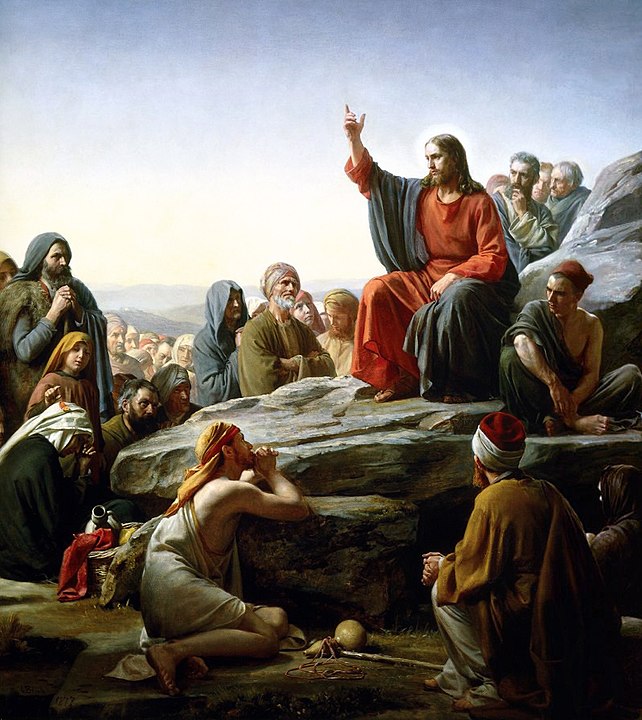
Jesus teaching, Carl Bloch (1877)

Address given at St Mary's Nenagh on Sunday 4th September 2022, the 12th after Trinity and the 1st in Creation Time

Do you know the difference between supporting a cause and being committed to it?

Well, the next time you sit down to a nice cooked breakfast you might think of this: the hen that laid the egg you’re about to eat was certainly supporting your high-cholesterol breakfast, but the pig from which the rashers came was truly committed to it!

Today’s Gospel reading from Luke (14:25-33) is about commitment – about commitment as a disciple of Jesus. Jesus is telling the crowds travelling with him what it means to be his disciple.

But at first hearing, what he says is really quite shocking, isn’t it? Surely Jesus can’t have insisted that his disciples must hate father and mother, wife and children, brothers and sisters? It sounds as if he wants them to be cold-hearted fanatics!

What I want to do today is to tease out what Jesus really did mean in this passage, and what it might mean to us today.

Would the crowds travelling with Jesus have found his teaching as shocking as we do?

At one level, I think they might have been even more shocked. For a Jew to hate mother or father would be more than shocking – it would be a blasphemy against God himself, a violation of the 5th Commandment given to Moses. If you remember, this reads: ‘Honour thy father and thy mother: that thy days may be long upon the land which the Lord thy God giveth thee’.

And again, although the idea of carrying the cross is a very familiar metaphor to us, two Christian millennia later, it would have been quite repulsive to a Jew at that time. Stoning was the Jewish punishment – crucifixion was a barbaric practice recently introduced by the hated Roman occupiers. To say that disciples must carry the cross would have been like saying today that they must travel in the cattle-trucks to the gas chambers and ovens of Auschwitz.

But at another level, I think they would not have found Jesus’s words at all as strange as we do. There’s a long tradition in the Semitic languages of the Middle East of using over-the-top rhetoric to make a point. It continues to this day – think of Saddam Hussein’s rhetoric about ‘the mother of all battles’ for instance. Here as in many other places in the Gospels, I think that those who heard Jesus’s words would have understood very clearly that they weren’t to be taken completely literally, but that they were used to make his point as vividly as possible.

So what is the point that Jesus is making? Actually, I think there are two.

First, Jesus is warning his followers that to be his disciple, to follow his road to the Kingdom of God, may cost them everything that they hold dear. Everything; absolutely everything.

Matthew (10:37-38) puts different words into his mouth, in what seems to be another report of the same teaching, when he has Jesus say: ‘Whoever loves father or mother more than me is not worthy of me; and whoever loves son or daughter more than me is not worthy of me; and whoever does not take up the cross and follow me is not worthy of me.’ The point is not to hate your family – that is just a rhetorical device – the point is that to be a true disciple of Jesus you must love him - you must love God - more than family, more than anything! And you must be prepared to suffer unjustly because you love God more than anything else.

And Jesus is also warning his followers that before they commit themselves they must ask themselves if they can see it through. Just as they would with any other project. They will be taken for fools if they make a commitment that they can’t live up to. Just as if they were building a tower – the reference is probably to a watchtower which people built in their fields so they could protect their crops. Or just as a wise king would – or any wise leader - before leading his people to war. You cannot make a true commitment without having calculated whether or not you can live up to it.

And second, Jesus is seeking to inspire his followers to make that commitment to be disciples.

Think for a moment about Churchill’s great speech to the British parliament and people when he became Prime Minister early in WW2: ‘I have nothing to offer but blood, toil, tears and sweat’. That speech was calculated to rally the British nation behind a determination to fight on for victory. He went on: ‘You ask, what is our aim? I can answer in one word: Victory. Victory at all costs — Victory in spite of all terror — Victory, however long and hard the road may be, for without victory there is no survival’. Churchill used shocking language in his rhetoric, to draw on the human quality of altruism, in order to rally his people behind him. And he succeeded in this aim. This is also what President Volodymyr Zelenskiy is trying to do when he speaks to Ukrainians today.

Altruism is characteristic of our humanity. No doubt it evolved with our species – but I prefer to see it as a gift God gave us when he made us in his image. Was Jesus drawing on that same quality of altruism when he chose to use his shocking language? I think so. And Jesus offered his disciples a vision even finer than Churchill’s victory, a vision of the kingdom of God, which they would help bring to pass.

I can’t believe that Jesus expected every single person in the crowds that day to feel able to make that great commitment. Perhaps there’s a role for camp-followers, for fellow-travellers, for supporters, as well as for committed disciples in the service of God. And Jesus must surely have known that even those who did commit themselves would at times be unable to carry it through - they would find their courage fail them. Even that great disciple Peter denied his teacher three times!

But Jesus promised those first disciples that he would always be with them, helping those who wavered to renew their commitment. They experienced his resurrection and received the gift of the Spirit at Pentecost. With his help they went the distance. They obeyed his command to ‘go and make disciples of all nations’. And succeeding generations of disciples have continued to do the same. We are here as Christ’s church 2000 years later, to give witness to their success in continuing Jesus’s project of salvation.

We Christians are the crowds travelling with Jesus today.

What should we take from the words he spoke 2000 years ago? Well, just the same things, I believe, that Jesus wanted those who listened to him then to take: warning and inspiration.

Jesus warns us that we must not set out to follow him lightly – he teaches us that his disciples must be prepared to give up everything they hold dear, if that is what is asked of them. And he warns us to consider carefully whether we can pay that price before we commit ourselves to being his disciples.

But if we listen to him, Jesus also inspires us to make that great commitment, and will help us to live up to it, as the first disciples did, and as so many others have done over the centuries. Will we commit ourselves to follow in their footsteps?

St Ignatius Loyola understood this, I think, when he wrote his beautiful prayer, which I shall finish with:

Teach me, Good Lord,
to serve you as you deserve:
to give, and not to count the cost;
to fight, and not to heed the wounds;
to toil and not to seek for rest;
to labour and not to ask for any reward,
save that of knowing that we do your will.
Through Jesus Christ Our Lord. Amen