Monday, 13 May 2024

Reflecting on St Matthias


Today we are celebrating St Matthias, whose feast-day is May 14th.

As we heard in today’s reading from Acts 1:15-26, he was chosen by casting lots to replace Judas, who had betrayed Jesus as the twelfth apostle, and died a wretched death. The story prompts me to ask three questions.


1.       Why did Peter and the other disciples believe they needed a twelfth apostle to replace Judas?

There were twelve historic tribes of Israel. Each was supposed to descend from one of Jacob’s twelve sons, though by Jesus’s time all but two had been dispersed and lost in exile. Jesus himself chose twelve of his disciples to be apostles, perhaps to symbolise that all twelve tribes of Israel would be reunited in the Kingdom of God. The word apostle comes from Greek, and literally means ‘one who is sent off’ – in modern English we might translate it as emissary or ambassador. Jesus sent the twelve apostles off in pairs to proclaim his own message about the kingdom of God, and to heal the sick. It must have seemed obvious to the disciples that Judas needed to be replaced.


2.       Why and how did they cast lots to choose Judas’s replacement?

Peter took the initiative to propose that Judas should be replaced as an apostle, and persuaded the 120 believers that they should choose someone who had been with Jesus from the first. Two people were nominated, Joseph also known as Justus, and Matthias. But they did not want to presume to tell God who should be chosen. So they prayed that God would show them who he preferred by casting lots. We do not know precisely how the casting of lots was done, but it must have involved an element of chance, much as we might toss a coin to decide the winner of a drawn election.


3.       What sort of person was Matthias?

This passage from Acts is the only mention of Matthias in the NT, so we know next to nothing about him, other than that he must have been a faithful disciple from the very start, from Jesus’s baptism by John right through to his resurrection. Though there is a doubtful ancient Greek tradition, that he planted the faith in Cappadocia in modern Turkey near the port of Issus, and on the shores of the Caspian Sea.

Despite his election as an apostle, Matthias does not appear to have played a prominent part in the life of the earliest church. Nevertheless, it is right to remember and admire him, both for his faithfulness, and for his readiness to accept a call to a ministry he did not seek. And, I think, we should also celebrate him as a kind of patron saint of all the countless other faithful Christians through the ages, of whom history has recorded little or nothing, mostly not even their names. Their faithfulness, their names, and their modest lives and examples are all known to God.

Greatness in the Kingdom of Heaven has nothing to do with great deeds or historical memory.


Sunday, 12 May 2024

John's evil cosmos-world

Address given at St Mary's Nenagh and Killodiernan on Sunday 12th May 2024, the 7th after Easter, the Sunday after the Ascension.

“I see trees of green, red roses too, I see them bloom for me and for you, and I think to myself, what a wonderful world.”

I apologise for my singing! But I’m sure you all recognise the song – memorably sung by Louis Armstrong. And it’s true isn’t it - we all know what a truly wonderful world God has made for us to live in - a real Garden of Eden, if only we would learn to look after it and use it rightly.

St John uses the Greek word ‘kosmos’, meaning ‘world’, no less than 13 times in today’s reading from his Gospel (John 17:6-19). But this is not the beautiful material world which God made and saw ‘was very good’, as the 1st chapter of Genesis puts it. I shall call what John has in mind the kosmos-world, to distinguish it from God’s world. The kosmos-world is a dark shadow of God’s good world. It is a place of spiritual death, filled with souls cut off from God: a place where greedy people trample on each other to grab more for themselves; a place where violent people kill and torture other people; a place where cynical people despise what is good and true and beautiful. And we all know the reality of that kosmos-world too, don’t we!

For John the very opposite of the kosmos-world is eternal life, as Jesus tells us through John in the preceding verses, ‘This is eternal life, (to) know you the only true God, and Jesus Christ whom you have sent’.

In the Gospel reading, Jesus prays to his Father for his disciples.

It is the night of the last supper, after he has washed the disciples’ feet. Judas Iscariot, one of Jesus’s twelve closest friends and disciples, has left the room. He has gone to betray Jesus to the authorities. Jesus is speaking to the remaining disciples, in what is known as his ‘farewell discourse’. Afterwards, he will go out with them to the garden of Gethsemane, across the Kidron valley, where he will be arrested by soldiers and police led by Judas, as Peter recalls in our 1st reading (Acts 1:15-17, 21-26).

Jesus is praying for his disciples, but he is also teaching them, for he prays out loud in their hearing. His words are dense with meaning - perhaps because he knows this is his last opportunity to speak to them before he is arrested, tried and executed.

It would take a very long sermon to tease out all the nuances of his prayer. So I shall pick out just three points from Jesus’s teaching about the relationship between his disciples and John’s kosmos-world.

1.       Jesus’s disciples are in the kosmos-world, but they do not belong to it. God has given the disciples to Jesus, in the sense that God has made them able to respond to the word of God which Jesus has given them. They have been brought to know and believe the truth that Jesus is sent from God. That is what sets them apart from the kosmos-world, even while they remain in it.

2.       The kosmos-world has already shown it hates Jesus, and his disciples too, because they do not belong to it. Those mired in evil, in cynicism, violence and greed, cannot co-exist with those who live by God’s values. So Jesus calls on his Father to protect his disciples from evil, when he is no longer there to do so in the flesh.

3.       Jesus does not ask God to take his disciples out of the kosmos-world. Just as God sent Jesus into the kosmos-world, so Jesus sends his disciples into it. God sent Jesus to redeem the kosmos-world from within. Jesus sends his disciples to continue his redeeming work in the kosmos-world.

The kosmos-world is a metaphor for the evil we encounter all around us, day by day.

It’s hard to see evil for what it is in the abstract. It comes in so many disguises. I think it helps to focus on concrete examples. There are so many to choose from - but let’s focus today on the hatred people harbour in their hearts for others they see as different from themselves, as enemies.

Personal hatred wounds the soul of both the hater and the hated. It is often expressed anonymously on social media, as those of us who use it know only too well. Children are particularly vulnerable to online bullying, whether it is aimed at their body form or their gender identity or some other perceived weakness. Vulnerable adults can also be severely affected. It blights lives and in extreme cases leads to suicide.

We may think that we cannot be guilty of such hateful behaviour - but what about old fashioned gossip? How many of us can say that we have never been party to passing on rumours that damage other people?

Group hatred, hatred of others because they belong to a different race or religion, is even more damaging than personal hatred.

Such hatreds are evil. They have been with us since the dawn of the human species, a kind of original sin, to which we are all potentially vulnerable. They fracture communities. And in the extreme they have led perfectly ordinary people, not so very different to you or me, to attempt to exterminate whole populations as dangerous enemies.

The Nazis murdered 6 million Jews between 1941 and 1945, alongside innumerable Roma, Jehovah’s Witnesses and homosexuals. My father as an army chaplain was taken to see one of the extermination camps after its liberation, and he made sure that as a teenager I saw the horrific movies taken at the time so that I would recognise evil when I saw it.

We do well to remember this Holocaust every year in January. But that has not been enough to stop other genocides in my lifetime, such as those in Ruanda and in Bosnia.

Understandably, surviving Jews sought to establish a safe homeland for themselves. But tragically 700,000 Palestinians were driven from their homes as refugees when the state of Israel was founded in 1948. They were never allowed to return to their homes. Palestinians remember it as the Nakba or catastrophe. It is the root of the violence we see in the middle east today. Palestinians hate Israelis, and Israelis hate Palestinians. One group hatred begets another, in a vicious circle of evil. We see the consequences today in the horror of Gaza, in Israel, the West Bank, and other countries still hosting refugees from the Nakba and subsequent wars.

Lest we think that we cannot be caught up in such events, let us reflect on the cycle of violence in the North of our island. The Good Friday Agreement was meant to break the cycle, and we have had peace there for many years. But the hatreds still fester. And let us not forget the continuing prejudice in our communities against Travellers.

So to sum up:

The wonderful world God has placed us in is good. We should rejoice in it and give thanks for it. But as Jesus’s disciples, we must always be on guard against the evil that spoils it.

As disciples we live amidst evil, but we do not belong to it, because God has given us to Jesus.

Jesus confronted evil and refused to collude with it, at the cost of his death on the cross.

Our task as disciples is to continue Jesus’s redeeming mission. God has set us apart to confront and defeat evil wherever it is found, and that includes evil hatreds, whatever that may cost us personally.

We can and we should take comfort that Jesus intercedes for us. He asks God to protect us from something much worse than suffering or death – that is, from being drawn into doing evil ourselves.

As Jesus’s friend and disciple Judas was.


Sunday, 14 April 2024

He rose from the dead on the 3rd day


Peace be with you!

Address given at St Mary's Nenagh and Killodiernan Church on Sunday 14th April 2024, the 3rd of Easter

We believe that Jesus Christ rose from the dead on the 3rd day.

We profess this faith every Sunday, whether we say the Apostles’ or the Nicene Creed. But why do we believe it?

Luke gives us one reason in today’s reading from his Gospel (Luke 24:36-48). It is the testimony of the disciples. While scholars tell us he was writing some 45-50 years after the events he describes, Luke clearly draws on earlier sources and traditions, derived from the first disciples.

The scene is the upper room in which the disciples shared the Last Supper with Jesus. It is the night of the first Easter Sunday, the 3rd day after Jesus’s crucifixion, death and burial. His disciples know that Jesus has been executed. They fear they will be too. Now they are gathered together, anxious, but mulling over the amazing reports that Jesus, has appeared alive to Simon, and to Cleopas and his friend on the road to Emmaus.

Then, ‘Jesus himself stood among them and said to them, “Peace be with you”’.

Luke is at pains to report that this is no spirit or ghost, but Jesus in the flesh. “Look at my hands and my feet”, says Jesus, – the disciples would have seen the wounds of his crucifixion - “see that it is I myself. Touch me and see; for a ghost does not have flesh and bones as you see that I have”. And Jesus goes on to eat a piece of grilled fish in their presence.

It is all rather mysterious. Jesus appears suddenly out of nowhere, just as he does in the other accounts of people meeting him after the resurrection. But these accounts are a powerful testimony to the first disciples’ certainty, not just that Jesus rose from the dead, but that this was how it had to be. Luke reports the risen Jesus teaching them, “Thus it is written, that the Messiah is to suffer and to rise from the dead on the third day”.

Jesus the risen Messiah goes on, “Repentance and forgiveness of sins is to be proclaimed in his name to all nations, beginning from Jerusalem. You are witnesses of these things”.

Notice that Jesus does not want his disciples to remain in the upper room looking inward – instead they are to go out into the wide world to proclaim to everyone the call to repentance and forgiveness which was always at the centre of his teaching.

And this is just what Jesus’s disciples did, as we read in the Acts of the Apostles.

The rabble of disciples who deserted Jesus in the Garden of Gethsemane, the bewildered, terrified disciples of that first Easter day, will be transformed by the Holy Spirit 50 days later at Pentecost into a body of believers, a church, a church which proclaims Jesus’s message of repentance and forgiveness, and continues his mission.

In today’s 1st reading (Acts 3:12-19), Peter has just healed a man lame from birth in the name of Jesus Christ, to the astonishment of the crowd of bystanders at the gate of the Temple. And he uses this as an opportunity to preach the good news of Jesus Christ.

‘Why do you wonder at this’, he says, ‘or why do you stare at us, as though by our own power or piety we had made him walk? … The faith that is through Jesus has given him this perfect health in the presence of all of you… Repent therefore, and turn to God so that your sins may be wiped out.’

A rabble of disciples is transformed into a church. A tiny church at first, it grows rapidly. Despite persecution and internal bickering, over the centuries it extends and multiplies across the world to all peoples. It carries on Jesus’s mission and preaches his message of hope. This congregation and our parish today, 2000 years on, is one tiny part of it.

For me this transformation of Jesus’s disciples from a rabble into a church is another, perhaps stronger reason to believe in the reality of the resurrection.

St Paul had the insight to see that the Church is like the body of Christ, who is its head.

We Christians are the flesh and bones and sinews of Jesus Christ.

We meet him when we come together as a Christian congregation - not just in this Nenagh Union of parishes, but in every gathering of Christians, of every tradition, everywhere.

He calls us to go out into the world to proclaim his message of repentance and forgiveness.

He calls us to continue his saving, healing mission to all we encounter, wherever we find ourselves, and throughout the world.

Like the first disciples, we need to abandon our fears and answer Jesus’s call!

I shall finish in prayer with the Collect of the Word set for today.

Lord of life,
by submitting to death, you conquered the grave:
by being lifted upon the cross, you draw all peoples to you;
by being raised from the dead, you restore to humanity all that was lost through sin:
be with us in your risen power,
that in word and deed we may proclaim
the marvellous mystery of death and resurrection:
for all praise is yours, now and throughout eternity. Amen

Tuesday, 9 April 2024

Reflecting on the Annunciation


Ecce Ancilla Domini (The Annunciation)
Dante Gabriel Rossetti

Reflection for Morning Worship with the Community of Brendan the Navigator, Monday 8 April 2024, the Feast of the Annunciation (transferred)

The reading from Luke (1:26-38) we have just heard is the one set for the Feast of the Annunciation.  At the Annunciation, the Virgin Mary is surprised by the angel Gabriel with a message from God, saying that she will conceive in her womb and bear a son, whom she will name Jesus.

I know I’m treading on somewhat dangerous ground here! I’m part of the 50% of the human race that is less qualified to say anything about pregnancy and childbirth than the other 50%. But I’ve been closely associated with two pregnancies and three births, so I know that pregnancy is a time of expectation, great expectation. So much so, that when we say a woman is ‘expecting’, it is a euphemism for her being pregnant – ‘a baby’ is simply understood.

Mary was probably quite a young girl - a teenager even – and unmarried, when the angel came to tell her that she will be pregnant by the action of the Holy Spirit. How shocked she must have been. But nevertheless, she says to the angel, ‘Here am I, the servant of the Lord; let it be with me according to your word’. She willingly accepts the unimaginable privilege of forming her son Jesus in her body. Jesus, the Son of the Most High, the eternal Word of the Father, God from God, Light from Light, true God from true God, takes human flesh in and from Mary. Jesus will quite literally be formed in her. While she is ‘expecting’, Christ is forming in her.

Our vocation as Christian disciples is to be ‘expecting’ just as Mary was. You might say we are all called to be pregnant! Whether we are young or old, male or female, single or married, we are called to let Christ be formed in us, just as he was formed in the womb of Mary.

All pregnancies end in the fullness of time. In around 9 months Mary gave birth to Jesus. Which is why we celebrate the Annunciation now, around 9 months before we celebrate his birth at Christmas. But as disciples in whom Christ is being formed, our pregnancy will last a lifetime. Stretching the analogy, it is on our deathbed that we will be finally delivered of the Christ we have nurtured within us, as an example to others of a Christian life, well lived, in the hope of resurrection to eternal life.

So, on this Feast of the Annunciation, let each one of us accept the call to be disciples. Let us be ‘expecting’ as Christ takes form within us. And let us pray that the Christ-seed the Holy Spirit has planted in us will grow to full term, perfectly formed in every way.

I shall finish with St Paul’s prayer for Christ to dwell in us, from his letter to the Ephesians 3:14-21:

Loving Father,

from whom every family in heaven and on earth takes its name,

According to the riches of your glory

grant that we may be strengthened in our inner being

with power through your Spirit,

that Christ may dwell in our hearts through faith,

as we are being rooted and grounded in love.

May we have the power to comprehend, with all the saints,

what is the breadth and length and height and depth,

and know the love of Christ that surpasses knowledge,

so that we may be filled with all the fullness of God.

By your power at work within us

you accomplish abundantly far more than all we can ask or imagine,

to you be glory in the church and in Christ Jesus to all generations,

for ever and ever. Amen.

(adapted)


Wednesday, 27 March 2024

Betrayal

The Last Supper, Simon Ushakov, 1685

Reflection given at Compline in Killodiernan, Wednesday in Holy Week, 27 March 2024

Betrayal is the theme of the Gospel reading we’ve just heard (John 13:21-32).

‘Very truly, I tell you, one of you will betray me’, says Jesus to his disciples. Few things hurt as much as to be betrayed by someone who is close to you, someone you love.

Jesus loved and trusted Judas. Jesus had chosen Judas to be one of his inner-circle of twelve closest disciples. Jesus had appointed him to be treasurer of the little group – he held the common purse. And Jesus and Judas are about to share food together in a very special Eucharistic way – what we now call the Last Supper.

Yet Jesus knows quite well Judas is going to betray him. He looks Judas in the eye and says to him, ‘Do quickly what you are going to do’. And Judas goes out, out into the night. When they meet again a few hours later, Judas has brought a detachment of soldiers and police to arrest Jesus in a garden just outside the city.

How it must have broken Jesus’s heart to be betrayed by the friend he loved!

But that is not the only betrayal Jesus suffers that night.

We know that his disciples cannot wait and watch for even 1 hour, as Jesus wrestles with his feelings in prayer. We know that the disciples run away when the soldiers come to arrest Jesus. And we know that Simon Peter, who is brave enough to follow Jesus and his captors back to the High Priest’s house, denies three times he even knew Jesus, before the cock crowed.

‘Lord, who is it?’ says the disciple Jesus loved, at the prompting of Simon Peter. Who will betray you? ‘It is the one to whom I give this piece of bread when I have dipped it in the dish’, replies Jesus.

The truth surely is that Jesus gave each and every one of his disciples a piece of bread at his Last Supper. They will all betray him, each in their own way.

Would I have behaved any better than the disciples? I don’t think so. I would have sworn blind I did not know Jesus to avoid arrest myself. I’m not as brave as Peter - I would not even have followed to the High Priest’s house – I would have run away like the other disciples. I too would have fallen asleep as my friend and teacher wrestled in prayer. As I did, as I sat while somebody I loved lay dying.

How often has each one of us betrayed Jesus, just as the disciples did!

We may not have sold our Lord and Master for 30 pieces of silver, like Judas. But how often have we failed to respond when Jesus asks something of us? How often have we run away, like cowards, from doing what we know is right? How often have we denied our faith when others challenge us?

Yet Jesus knows our human frailty and loves us all despite it, just as he loved his disciples - just as he loved Judas. He will forgive the pain our betrayals cause him if we turn to him in penitence and faith.

I shall finish by asking you to pray with me the prayer of Richard, Bishop of Chichester in the 13th century:

Thanks be to Thee, Lord Jesus Christ
for all the benefits Thou hast given me,
for all the pains and insults
Thou hast borne for me.
O most merciful Redeemer,
Friend, and Brother,
may I know Thee more clearly,
love Thee more dearly,
and follow Thee more nearly,
day by day. Amen.

Sunday, 17 March 2024

Remembering St Patrick


Address given at Borrisokane Church on Sunday 17th March 2024, the Feast of St Patrick

Today we remember St Patrick, our patron saint, whose feast day this is.

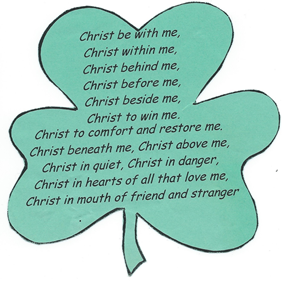
In the secular world, this is a day for us to celebrate all that is right and true and beautiful in our communities and in the homeland we share, whatever else may divide us. Many of us I’m sure, wear a shamrock with pride, take part in or attend St Patrick’s Day parades, and raise a glass to toast our nation. It’s allowed, you know, even if you’ve pledged to abstain during Lent - the Prayer Book marks only weekdays in Lent as days of discipline and self-denial. Some no doubt will over-indulge and get up to all sorts of ‘shamroguery’, but we shouldn’t be afraid to join in decent, patriotic celebration.

But as Christians, I suggest we should go further. We should seek to find the real St Patrick behind all the picturesque and fanciful legends that have grown up about him over the last 1500 years. And we should reflect on what St Patrick’s life and mission has to say to us in Ireland today.

Much of what I was told about St Patrick as a child is not true – it is much later legend.

Patrick did not teach about the Trinity using the trefoil leaf of a shamrock, charming though the story is. It first appears in writing in 1726, though it may be somewhat older.

Patrick did not banish all the snakes from Ireland. That story is first mentioned by Gerald of Wales in the 13th Century, although he didn’t believe it himself. The truth is that Ireland was separated from Britain by rising sea levels after the last ice age, which prevented snakes from reaching Ireland from Britain.

Patrick was not the first to convert the pagan Irish to Christianity. The narrow seas between Britain and Ireland, particularly between what is now northern Ireland and southwest Scotland, were a trading highway in Roman times. Archeology shows that many Irish settled on the west coasts of Britain, and no doubt British Christians settled here. Irish chroniclers tell us that Pope Celestine consecrated a Gaul named Palladius to be the first bishop for Irish Christians in 431AD, a little before St Patrick. And there are traditions that there are other Irish saints who preceded Patrick, including St Kieran of Seir Keiran, Co Offaly, St Declan of Ardmore, Co Waterford and St Ailbe of Emly, Co Tipperary.

Most of what we know about the real St Patrick comes from his own writings.

The main source is his Confessio, or Confession, in which Patrick gives a short account of his life and mission.

Patrick tells us, ‘My father was Calpornius. He was a deacon; his father was Potitus, a priest, who lived at Bannavem Taburniae.’ We do not know exactly where Bannavem Taburniae was, but it may have been in Cumbria in England, or Strathclyde in southwest Scotland, or in Wales. So Patrick came from a Christian family of Romano-British clergy. His native language would have been primitive Welsh, and no doubt he was educated in Latin.

He tells us he was taken prisoner by an Irish raiding party, along with thousands of others, and taken as a slave to Ireland, where he was put to work as a shepherd. Here his love and awe of God grew, until after 6 years captivity a voice in a dream urged him to run away and escape back to Britain, which he did.

After his return to Britain, Patrick heard a call to ordination. There is a tradition that he studied in Europe, in particular Auxerre in modern France, where he was ordained by St Germanus.

In another dream, Patrick heard the voices of the Irish among whom he had lived calling to him, ‘We appeal to you, holy servant boy, to come and walk among us.’ Acting on this vision he returned to Ireland as a missionary.

He was aware of the work of other Christian missionaries in the south and east – Patrick was not alone. But his focus seems to have been in the north and west, where the Christian faith had not yet penetrated.

Patrick gives little detail of his work, but tells us that he baptised thousands of people, ordained priests to lead the new Christian communities, converted wealthy women, some of whom became nuns, and converted the sons of kings. No doubt those he encountered were attracted by his distinctive spirituality, expressed in St Patrick’s Breastplate, the famous hymn attributed to him. We shall pray a verse of it, an invocation of Christ’ presence with us and around us, at the end of the service.

His mission was not always easy, for he tells us he met opposition. He was, beaten, robbed, put in chains and held captive. But Patrick is undaunted. He rejoices in the results of his mission, declaring that ‘the sons and daughters of the leaders of the Irish are seen to be monks and virgins of Christ.’

Finally, Patrick was a modest man. He finishes his Confessio with these words, addressed to us, to you and me: ‘I pray for those who believe in and have reverence for God. Some of them may happen to inspect or come upon this writing which Patrick, a sinner without learning, wrote in Ireland. May none of them ever say that whatever little I did or made known to please God was done through ignorance. Instead, you can judge and believe in all truth that it was a gift of God. This is my confession before I die.’

What can we as Christians today take from the life and mission of the real St Patrick?

1st, St Patrick was passionately dedicated to sharing his Christian faith with the pagan Irish. He saw it as a blessing, a gift from God. He echoes the words of Tobit in today’s 1st reading (Tobit 13:1b-7): ‘Bless the Lord of righteousness, and exalt the King of the ages. In the land of my exile I acknowledge him, and show his power and majesty to a nation of sinners.’ We should be like him, eager to share our faith in the public square in our own times, when so many find it difficult to do so.

2nd, St Patrick knew all about economic and social oppression from an early age. He challenged these evils and faced persecution for it. To quote from St Paul’s words in today’s epistle (2 Corinthians 4:1-12), he was ‘afflicted in every way, but not crushed; perplexed, but not driven to despair; persecuted, but not forsaken; struck down, but not destroyed’. When we in our times see oppression, or suffer it ourselves, we should confront it as St Patrick did, and persevere against those who seek to perpetuate it.

Lastly, in today’s reading from John’s Gospel (John: 4:31-38), Jesus tells his disciples, ‘Look around you, and see how the fields are ripe for harvesting. The reaper is already receiving wages and is gathering fruit for eternal life, so that sower and reaper may rejoice together … I sent you to reap that for which you did not labour. Others have laboured, and you have entered into their labour.’ St Patrick reaped a harvest sown by others, as he was not the only, nor the first Christian missionary to come to Ireland. In later times the Irish Church found unity around his bishopric of Armagh. In the same way, Christians of different traditions in Ireland today should surely rejoice in the truly important things that we have in common, rather than cling to the little things that separate us. Only then can we ‘gather in the fruit for eternal life’ that Jesus desires us to reap.

I shall finish in prayer.

Hear us, most merciful God,
for that part of the Church
which through your servant Patrick you planted in our land;
that it may hold fast the faith entrusted to the saints
and in the end bear much fruit to eternal life:
through Jesus Christ our Lord. Amen


Tuesday, 12 March 2024

Wait for the Lord - Psalm 27

Reflection at Morning Worship with the Community of Brendan the Navigator, 12th March 2024

In the book of Psalms we find expressions of almost every human emotion we could possibly experience, from joy and exaltation, through disappointment, to despair and depression. In this psalm, Psalm 27, we encounter the emotions of someone who has been disappointed in life, but who resolves to put it behind him or her, and trust in the goodness of God.  

The first 6 verses of Psalm 27 are a triumphant song of confidence in the Lord our God. ‘The Lord is my light and my salvation; whom shall I fear? The Lord is the stronghold of my life; of whom shall I be afraid?’.

But the next 6 verses express the pain of disappointment. ‘Do not hide your face from me.

Do not turn your servant away in anger, you who have been my help. Do not cast me off, do not forsake me, O God of my salvation!’. They are the cry of someone disappointed and despairing.

I am quite sure that every one of us has experienced numbing disappointments at some time or another. I certainly have. I can remember my feelings of inadequacy when a project I led was cancelled, and I and my team were suspended for a while on administrative leave. And I can recall my feelings of anger and bitterness when my first marriage broke down, when I feared I was losing not just my wife, but my children and my home. In my disappointment that life was not going to plan as I wished, I was in danger of drowning in despair. Thank God, I sought treatment for depression, and after a while it dissipated.

Looking back on these experiences now, this psalm tracks my emotional path dealing with disappointment, and recovering from despair. My life resumed its course. My career moved forward on new and satisfying lines. Eventually I found love, happiness, and a home with the love of my life. And to my joy my children share in that too.

The psalmist speaks for me when he declares in the final 2 verses, ‘I believe that I shall see the goodness of the Lord in the land of the living. Wait for the Lord; be strong, and let your heart take courage.’, because that has been my lived experience.

May this also be the experience of any of us who suffer disappointment and despair.