Showing posts with label Lord's Prayer. Show all posts

Sunday, 24 July 2022

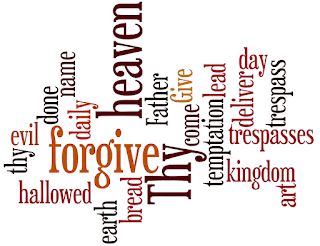
Reflecting on the Lord's Prayer

May the words of my lips and the meditations of my heart be acceptable in your sight, my strength and my redeemer. Amen

You may have found today’s 3rd reading (Luke11:1-13) both familiar and strangely different.

It begins with a translation from the Greek of St Luke’s version of the Lord’s Prayer, set for today in the common lectionary, which is slightly different from St Matthew's version, and the version we have in the BCP. The prayer is deceptively simple, while at the same time encapsulating all that we ought to ask of God. I’m going to share with you some reflections upon it.

Jesus teaches his disciples to pray what we call the Lord’s prayer. We continue to do so whenever we come together as a Christian congregation. It is a prayer we are meant to say together publicly, not just on our own. We pray in the plural number, and Matthew’s version of it, records Jesus calling us to pray together to ‘our Father’, not individually to ‘my Father’.

But notice, there is nothing explicitly Christian about the prayer. It can be said in good conscience by anyone who believes in a loving, almighty God, including Muslims and Jews - both Jesus and his disciples were of course Jews.

When we pray ‘Father, hallowed be your name’, we express our reverence for the nature and character of God.

God is holy, God is good and God loves all his creatures, just as an ideal father of a household loves all the members of his household. That includes you and me, but others too. Not just Christians, but people of other faiths and none. And not just human beings, but all the wonderful diversity of living creatures we share our planet with, because God sees all his creation to be good.

When we pray ‘Your kingdom come’, what are we saying?

I believe that God’s kingdom is a state of peace and justice where we and all his creatures flourish. This is not the broken world that we see around us, beset with war, dangerous climate change, and collapsing biodiversity – that is the antithesis of God’s kingdom. But I also believe we can glimpse his kingdom, even enter into a small part of it, at any time and place where we do God’s will. Our prayer is saying that despite the brokenness, we look to the future in hope.

Jesus invites us to pray ‘Give us each day our daily bread’.

Notice he does not invite us to pray for more than our daily needs, and nor should we. If I greedily take all I desire, if I hoard it for the future, others will surely get less than they need. We are to share what we have so that all have enough. It is ok for us to ask God for what we devoutly wish for ourselves and for others – if we can’t ask God, who can we ask? But we ought always add as an afterthought, ‘Nevertheless, not my will, but yours be done’, as Jesus did in the Garden of Gethsemane. The purpose of prayer is to align our wishes with God’s wishes, not to badger him into doing what we want.

‘And forgive us our sins, for we ourselves forgive everyone indebted to us’.

Our sins are our failures to do God’s will, either by doing what we ought not to do, or by failing to do what we know we should. Very often these take the form of disobeying Jesus’s commandment to treat our neighbour as ourself. Every one of us has failed many times in our duty to God or to our neighbour. I ask God to forgive my failures, but the sting in the tail is this: that God will forgive my failures only in proportion to my forgiving the failures of others. We must forgive to be forgiven.

Finally, we pray ‘Do not bring us to the time of trial’.

Our time of trial may take many forms. Someone else, even someone I love, may seek to persuade me to do what I know is wrong, what is against God’s will. Or a character flaw in myself may give evil an opening it is hard to resist. Or cruel events may make me doubt the goodness and love of God. So we ask God to spare us such trials. But when we must face them, we need to seek God’s help to resist them, as Jesus did when Satan tempted him in the wilderness.

Evil is real. We see it all around us in the violence humankind does to this beautiful planet. We see it in the way people exploit other people for their own ends. And we see it in the death and destruction of war. We see it in the suffering not only of the people of Ukraine, but also of misled Russian soldiers, and of those whose lives are upended by shortages of food and energy as a result of sanctions. We are starting to feel the consequences here in Ireland as many struggle to pay the bills and fear food and energy poverty this coming winter. We surely need to pray that we may not be brought to the time of trial.

People often find it difficult to pray, to be intimate with God.

We may feel shy. We may find it hard to find the words to say what we want to say – I know I do. Or we may be ashamed of how unworthy we are and so try to avoid meeting God in prayer – we would much rather not think of our unworthiness. But Jesus reassures his disciples – and us - that it is always right to engage with God in intimate prayer:

‘So I say to you’, he says, ‘ask, and it will be given to you; search, and you will find; knock, and the door will be opened for you. For everyone who asks receives, and everyone who searches finds, and for everyone who knocks, the door will be opened.’

Let us take Jesus’s words to heart and unreservedly open ourselves up to God, our loving Father. And when our own words fail us, Jesus has given us his own words to fall back on.

I shall finish with a Collect of the Word:

Father in heaven,

in your goodness

you pour out on your people all that they need,

and satisfy those who persist in prayer.

Make us bold in asking,

thankful in receiving,

tireless in seeking,

and joyful in finding,

that we may always proclaim your coming kingdom

and do your will on earth as in heaven. Amen

Tuesday, 8 March 2022

Praying the Lord's Prayer


 Reflection at Morning Worship with the Community of Brendan the Navigator on Tuesday 8th March 2020

You may find today’s reading both familiar and strangely different – it is the NRSV translation from the Greek of St Matthew’s version of the Lord’s Prayer, set for today in the common lectionary. It is deceptively simple, while at the same time encapsulating all that we ought to ask of God. I’m going to share with you some reflections upon it.

First, Jesus’s introduction makes me a bit uncomfortable because I fear I all too often ‘heap up empty phrases’ in intercessions that are too long and wordy. But I take comfort that God, our Father in heaven, ‘knows what I need before I ask him’.

Jesus taught his disciples to pray what we call the Lord’s prayer, as we continue to do whenever we come together as a Christian congregation. But there is nothing explicitly Christian about it. The Lord’s prayer can be said in good conscience by anyone who believes in a loving, almighty God, including Muslims and Jews - both Jesus and his disciples were of course Jews. Notice that Jesus calls us to pray together to ‘our Father’, not individually to ‘my Father’ – it is a prayer to be said together, not a private prayer.

When we pray ‘Our Father in heaven, hallowed be your name’, we express our reverence for the nature and character of God, who is holy, who is good and who loves all his creatures, just as an ideal father of a household loves all the members of his household. That includes you and me, but others too - not just Christians, but people of other faiths and none – and not just human beings, but all the wonderful diversity of living creatures we share our planet with, because God sees all his creation to be good.

We pray ‘Your kingdom come. Your will be done, on earth as it is in heaven’. I believe that God’s kingdom is a state of peace and justice where we and all his creatures flourish. This is not the damaged world that we see around us, beset with war, dangerous climate change, and collapsing biodiversity – that is the antithesis of God’s kingdom. But I believe we can glimpse his kingdom, even enter into a small part of it, at any time and place where we do God’s will on earth as it is done in heaven. Our prayer is an invitation to look to the future in hope.

Jesus invites us to pray ‘Give us this day our daily bread’. Notice he does not invite us to pray for more than our daily needs, and nor should we. If I greedily take all I desire, hoarding it for the future, others will likely get less than they need. We are to share what we have so that all have enough. It is ok for us to ask God for what we devoutly wish for ourselves and for others – if we can’t ask God, who can we ask? But we ought always add, ‘Nevertheless, not my will, but yours be done’, as Jesus did in the Garden of Gethsemane. The purpose of prayer is to align our wishes with God’s wishes, not to badger him into doing what we want.

‘Forgive us our debts, as we also have forgiven our debtors’. The Lord’s prayer in the BCP speaks of sins or trespasses, rather than debts. But they amount to the same thing – a failure to pay what is due, a failure of duty to God or our neighbour, a failure to do what is God’s will. Every one of us has failed many times in our duty to God or to our neighbour. I ask God to forgive my failures, but the sting in the tail is that God will forgive my failures only in proportion to my forgiving the failures of others. We must forgive to be forgiven.

Finally, we pray ‘Do not bring us to the time of trial, but rescue us from the evil one’. Our time of trial may take many forms. Someone else, even someone I love, may seek to persuade me to do what I know is wrong, what is against God’s will. Or a character flaw in myself may give evil an opening it is hard to resist. Or cruel events may make me doubt the goodness and love of God. So we ask God to spare us such trials and temptations. But when we must face them, we ask God to help us resist them, as Jesus did when Satan tempted him in the desert, as we heard in last Sunday’s Gospel reading.

Evil is real. We see it all around us in the violence humankind does to this beautiful planet. We see it in the way people exploit other people for their own ends. And we see it in the death and destruction of war. We see it in the suffering not only of the people of Ukraine, but also of misled Russian soldiers, and those whose lives are upended by sanctions, which will include many here in Ireland.

Now more than ever, we need to pray to our Father in heaven to rescue us from the evil one.

Sunday, 30 July 2017

Finding the Kingdom of Heaven

Address given in At Mary's Nenagh on Sunday 30th July 2017, the 7th after Trinity, year A

Today’s reading from Matthew’s Gospel (13:31-33, 44-52) is about the Kingdom of Heaven.
The Kingdom of Heaven is a central part of Jesus’s teaching for Matthew. At the very start of his ministry Jesus proclaimed, ‘Repent, for the kingdom of heaven has come near’ (Matt 4:17). And when Jesus sent out the Twelve he instructed them, ‘As you go, proclaim the good news, “The kingdom of heaven has come near”’ (Matt 10:7). In Mark and Luke ‘the Kingdom of God’ is used to mean the same thing.

So, just what is this Kingdom of Heaven? As a skilful teacher, Jesus uses parables based on everyday experience to teach those who follow him. I think he wants his disciples to work out the truth for themselves, not just learn it parrot fashion without properly understanding it. He gives us clues in parables about the kingdom of heaven, which we are meant to think about deeply, and share what we find between us.

So let me reflect a bit on what I find in these parables.
The parables of the mustard seed and the yeast tell us how the Kingdom of Heaven grows.
·         God does not bring the Kingdom of Heaven into existence suddenly, fully formed, in a kind of spiritual ‘big bang’. Rather it grows organically, bit by bit, just as the tiny mustard seed grows almost imperceptibly into a tree, or a tiny quantity of yeast works to leaven a loaf.
·         Sometimes it may seem as if nothing is happening at all. Then suddenly we notice a new shoot bursting, or the dough expanding. And when we come back later we see whole new branches, or the dough rising above its container.
·         If we search for the Kingdom of Heaven we will find it really has come near. It grows all around us.

The parables of the hidden treasure and the pearl of great value tell us what it feels like to find the Kingdom of Heaven.
·         It is like a farmer finding treasure in a field, or a merchant the most perfect pearl. When they find it they joyfully trade everything else they value to obtain it.
·         We are so used to calculating what a thing is worth that it is hard to imagine something that is beyond price. Yet there are some things that are worth infinitely more than money or possessions. The Kingdom of Heaven is literally priceless. To live as part of it, by its values, as it grows, will bring us more real joy than anything else possibly could.

The parable of the net tells us what happens if we don’t live by the values of the Kingdom of Heaven.
·         We live in a world full of people of every kind, good and bad, just as the sea holds fish that are good to eat and not so good. But it is not for us to decide which is which. Just as in the parable of the tares we heard last Sunday, it is for God and his angels at the end of the age to separate the evil from the righteous.
·         God’s generosity is stupendous, isn’t it? In God’s creation we have been given enough and more than enough for all to flourish, both the good and the bad. If you eliminate the fish that are not good to eat you damage the whole eco-system, and those that are good to eat will also suffer. If we exclude those we don’t like from our community, from our church, we impoverish it and ourselves. And I don’t know about you, but I’m not entirely certain whether God’s angels will find me evil or righteous – or most likely a bit of both.
·         Our task is to seek out the Kingdom of Heaven, to help it grow, and to live by its values. But part of these values is to be inclusive and leave judgement to God.

So far, so good. But these parables don’t by themselves answer one crucial question, I think.
It is this: How are we to recognise the Kingdom of Heaven when we find it?

I think the Lord’s Prayer fills the gap. Jesus teaches us to pray to our heavenly Father, ‘your kingdom come, your will be done, on earth as it is in heaven’.

We can recognise the Kingdom of Heaven because God’s will is done there. And Jesus shows us how to discern God’s will. To find the Kingdom of Heaven is to align our will with God’s will.
·         When any one of us does God’s will, in no matter how small a way – when we do what is right, or don’t do what is wrong - the Kingdom of Heaven grows accordingly. It is a bit like Pinocchio’s nose in reverse – in the children’s story, remember, his nose grew longer every time he told a lie.
·         When we experience the life and growth of the Kingdom of Heaven we feel a joy which encourages us to change our way of life for the better. That is what it means to repent.
·         We live more as part of the Kingdom of Heaven, we do more of God’s will, and we become better people. Our example may inspire others to do so too, and the Kingdom of Heaven grows some more.
·         Finally, at the end of the age, God’s angels will have less work to do to separate the evil from the righteous, there will be less weeping and less gnashing of teeth.

That is how God saves us through Jesus.

Let me finish in prayer:
O God, the fount of wisdom,
you have revealed to us in Christ
the hidden treasure and the pearl of great price:
grant us your Spirit’s gift of discernment,
that, in the midst of the things of this world,
we may learn to value the priceless worth of your kingdom,
and be ready to renounce all else
for the sake of the precious gift you offer.
We ask this through Jesus Christ our Lord,
who lives and reigns with you and the Holy Spirit,
one God, now and for ever. Amen