Showing posts with label Matthew 3:13-17. Show all posts

Sunday, 8 January 2023

The Baptism of Christ


Today the Church asks us to remember the Baptism of Christ.

Picture again, in your minds eye, the moments after John baptised Jesus, as described by Matthew in his gospel (3:13-17).

Here is Jesus, a man in the prime of his life, about 30 years old. He is glistening wet from receiving John’s baptism of repentance, as he walks up out of the river Jordan. Then, suddenly, the heavens burst open. The Spirit of God descends like a dove to alight on him. And the voice of God declares from heaven, ‘This is my Son, the Beloved, with whom I am well pleased’.

What a strikingly vivid and dramatic scene – it’s easy to imagine being there, isn’t it?

Matthew describes an event – an epiphany - in which God reveals Jesus to be his Son and anoints him with his Spirit.

The same epiphany, bringing together Jesus at his baptism, the dove and a voice from heaven, is also described by Mark, Luke and John. It must have been part of the common tradition of the earliest Christians on which Matthew and the other evangelists drew when writing their gospels.

For Christians by the 4th Century these baptism passages were seen as supporting and illustrating the doctrine of the Trinity, the idea that the one God consists of three persons, Father, Son and Holy Spirit. They are the only passages in the NT where we encounter all three persons together at the same time, in the same place.

Matthew would have known the book of Isaiah well, like all educated Jews of his time. He would have seen the parallels with today’s OT reading (Isaiah 42:1-9), in which God declares, ‘Here is my servant, whom I uphold, my chosen, in whom my soul delights; I have put my spirit upon him’. But there is this crucial difference: for Isaiah, God identifies his chosen one as just a servant; whereas for Matthew, God identifies Jesus as his beloved Son.

What did John the Baptist make of Jesus’s baptism?

John recognised Jesus when he came to ask for baptism - not surprisingly since they were cousins close in age. John says to Jesus, ‘I need to be baptised by you, and do you come to me?’ What’s going on here?

John proclaimed ‘a baptism of repentance for the forgiveness of sins’ (Mark 1:4). He called people to repent, and baptised them as a sign that God forgave their sins. John knew that he needed baptism, repentance and forgiveness himself. But I think he must have believed that Jesus was such a good and holy man that he had no need of baptism, repentance and forgiveness.

John would also have recalled Isaiah’s description of God’s chosen servant in today’s reading, ‘He will not cry or lift up his voice, or make it heard in the street; a bruised reed he will not break, and a dimly burning wick he will not quench; he will faithfully bring forth justice. He will not grow faint or be crushed until he has established justice in the earth.’ Perhaps John recognised the Jesus he knew in Isaiah’s description - softly spoken, filled with compassion for the damaged and the weak, yet determined and passionate for justice.

Despite John’s reluctance to baptise him, Jesus insists, and John consents. Then John experiences the epiphany described by Matthew: When Jesus had been baptised, just as he came up from the water, suddenly the heavens were opened to him’ – that is, to John – ‘and (John) saw the Spirit of God descending like a dove and alighting on (Jesus). And a voice from heaven said, “This is my Son, the Beloved, with whom I am well pleased”.’

Only then does John realise the full truth, that his cousin Jesus is the promised Messiah, the incarnate Son of God, not just a remarkably holy man.

I wonder what his baptism meant for Jesus himself.

Jesus very deliberately chooses to ask John for baptism, and insists on it – it must have been very important for him.

Matthew gives us a clue when he records Jesus saying to John, ‘it is proper for us in this way to fulfil all righteousness’. For Jews, righteousness meant obeying God’s law and doing God’s will. Jesus clearly believes God wishes him to be baptised by John. But for what purpose?

Perhaps God wanted Jesus to seek John’s baptism at the very start of his ministry in order to demonstrate publicly that Jesus was God’s incarnate Son, not just a good man like Isaiah’s servant. This was certainly the effect on John. But Jesus himself surely also needed to be certain who he was before beginning his ministry. Is it possible this is also the very moment when Jesus finally understands that he is Christ the Messiah, the Son of God?

Whatever the truth of this, Jesus clearly associates himself quite deliberately with John’s proclamation, ‘Repent, for the kingdom of heaven has come near’ (Matt 3:2) - he went on to proclaim it in his own ministry (Matt 4:17). And I like to think that Jesus chose to be baptised by John because he wanted to show his solidarity with sinful human beings like you and me, who desperately need to repent and be forgiven, even if he had no such need himself.

So what does Jesus’s baptism mean to you and me, 2000 years on?

Well, no doubt there are many answers. But this one strikes me.

The epiphany at the baptism of Jesus marks a great new insight into the nature of God as the Trinity of Father, Son and Holy Spirit. As God says through Isaiah, ‘See the former things have come to pass, and new things I now declare’.

Before it, Jewish religious thinkers could only conceive of the relationship between God and a human being as that between a remote master and a terrified servant. After it, Christians could see the relationship as one in which God takes our human nature upon himself, to be incarnate as a human being, like you or me.

Everything is changed, everything is made new. God ceases to be a remote figure and we are no longer afraid. God comes near to us, as close to us as our own skin. We feel his presence to be like a loving Father, to be like Jesus his Son, our friend and brother, to be like the Holy Spirit which inspires all that is good and true in us.

Let us thank God for Jesus’s baptism, most particularly for the insight it gives us into God’s intimate and loving nature as Father, Son and Holy Spirit.

I finish in prayer with a Collect of the Word:

Almighty God,
who anointed Jesus at his baptism with the Holy Spirit
and revealed him as your beloved Son:
inspire us, your children,
who are born of water and the Spirit,
to surrender our lives to your service,
that we may rejoice to be called your children;
through Jesus Christ our Lord. Amen

Sunday, 12 January 2020

The Baptism of Christ

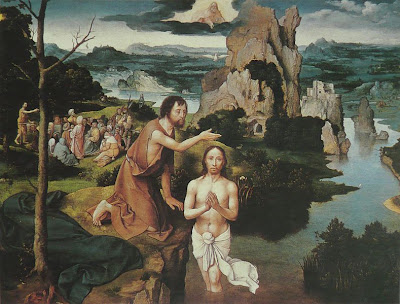
The Baptism of Christ, Joachim Patinir, Kunst Historiches Museum, Vienna

Address given at St Mary's Nenagh on Sunday 12th January 2020, the 1st Sunday after Epiphany, the Baptism of Christ.


Today the Church asks us to remember the Baptism of Christ.
Picture again, in your minds eye, the moments after John baptised Jesus, as described by Matthew in his gospel (3:13-17).

Here is Jesus, a man in the prime of his life, about 30 years old. He is glistening wet from receiving John’s baptism of repentance, as he walks up out of the river Jordan. Then, suddenly, the heavens burst open. The Spirit of God descends like a dove to alight on him. And the voice of God declares from heaven, ‘This is my Son, the Beloved, with whom I am well pleased’.

What a strikingly vivid and dramatic scene – it’s easy to imagine being there, isn’t it?

Matthew describes an epiphany, in which God reveals Jesus to be his Son and anoints him with his Spirit.
The same epiphany, bringing together Jesus at his baptism, the dove and a voice from heaven, is also described by Mark, Luke and John. It must have been part of the common tradition of the earliest Christians on which Matthew and the other evangelists drew when writing their gospels.

For Christians by the 4th Century these baptism passages were seen as supporting and illustrating the doctrine of the Trinity, the idea that the one God consists of three persons, Father, Son and Holy Spirit. They are the only passages in the NT where we encounter all three persons together at the same time, in the same place.

Matthew would have known the book of Isaiah well, like all educated Jews of his time. He would have seen the parallels with today’s OT reading (Isaiah 42:1-9), in which God declares, ‘Here is my servant, whom I uphold, my chosen, in whom my soul delights; I have put my spirit upon him’. But there is this crucial difference: for Isaiah, God identifies his chosen one as just a servant; whereas for Matthew, God identifies Jesus as his beloved Son.

What did John the Baptist make of Jesus’s baptism?
John recognised Jesus when he came to ask for baptism - not surprisingly since they were cousins close in age. John says to Jesus, ‘I need to be baptised by you, and do you come to me?’ What’s going on here?

John proclaimed ‘a baptism of repentance for the forgiveness of sins’ (Mark 1:4). He called people to repent, and baptised them as a sign that God forgave their sins. John knew that he needed baptism, repentance and forgiveness himself. But I think he must have believed that Jesus was such a good and holy man that he had no need of them.

John would also have recalled Isaiah’s description of God’s chosen servant in today’s reading, ‘He will not cry or lift up his voice, or make it heard in the street; a bruised reed he will not break, and a dimly burning wick he will not quench; he will faithfully bring forth justice. He will not grow faint or be crushed until he has established justice in the earth.’ Perhaps John recognised the Jesus he knew in Isaiah’s description - softly spoken, filled with compassion for the damaged and the weak, yet determined and passionate for justice.

Despite John’s reluctance to baptise him, Jesus insisted, and John consented. And we know John then experienced the epiphany described by Matthew, since John’s Gospel records him saying: “I saw the spirit descending from heaven like a dove, and it remained on him. I myself did not know him, but the one who sent me to baptise with water said to me, ‘He on whom you see the Spirit descend and remain is the one who baptises with the Holy Spirit.’ And I myself have seen and have testified that this is the Son of God. 

Only then does John realise the full truth, that his cousin Jesus is the promised Messiah, the incarnate Son of God, not just a remarkably holy man.

I wonder what his baptism meant for Jesus himself.
Jesus very deliberately chose to ask John for baptism, and insisted on it – it must have been very important for him.

Matthew gives us a clue when he records Jesus saying to John, ‘it is proper for us in this way to fulfil all righteousness’. For Jews, righteousness meant obeying God’s law and doing God’s will. Jesus clearly believed God wished him to be baptised by John. But for what purpose?

Perhaps God wanted Jesus to seek John’s baptism at the very start of his ministry in order to demonstrate publicly that Jesus was God’s incarnate Son, not just a good man like Isaiah’s servant. This was certainly the effect on John.

But Jesus himself surely also needed to be certain who he was before beginning his ministry. Is it possible this is also the very moment when Jesus finally understood that he was Christ the Messiah, the Son of God?

Whatever the truth of this, Jesus clearly associated himself quite deliberately with John’s proclamation, ‘Repent, for the kingdom of heaven has come near’ (Matt 3:2) - he went on to proclaim it in his own ministry (Matt 4:17). And I like to think that Jesus chose to be baptised by John because he wanted to show his solidarity with sinful people like you and me, who desperately need to repent and be forgiven, even if he had no such need himself.

So what does Jesus’s baptism mean to you and me, 2000 years on?
Well, no doubt there are many answers. But this one strikes me.

The epiphany at the baptism of Jesus marks a great new insight into the nature of God as the Trinity of Father, Son and Holy Spirit. As God says through Isaiah, ‘See the former things have come to pass, and new things I now declare’.

Before it, Jewish religious thinkers could only conceive of the relationship between God and a human being as that between a remote master and a terrified servant. After it, Christians could see the relationship as one in which God takes our human nature upon himself, to be incarnate as a human being, like you or me.

Everything is changed, everything is made new. God ceases to be a remote figure and we are no longer afraid. God comes near to us, as close to us as our own skin. We feel his presence to be like our loving Father, to be like Jesus, his Son, our friend and brother, to be like the Spirit which inspires all that is good and true in us.

Let us thank God for Jesus’s baptism, most particularly for the insight it gives us into God’s intimate and loving nature as Father, Son and Holy Spirit.

I finish in prayer with a Collect of the Word:
Almighty God,
who anointed Jesus at his baptism with the Holy Spirit
and revealed him as your beloved Son:
inspire us, your children,
who are born of water and the Spirit,
to surrender our lives to your service,
that we may rejoice to be called your children;
through Jesus Christ our Lord. Amen

Sunday, 8 January 2017

God comes close to us - as close as our own skin

Address given at Templederry, Nenagh and Killodiernan on Sunday 8th January 2017, the 1st after Epiphany, celebrated as the Baptism of Christ.

Today the Church asks us to remember the Baptism of Christ.
So I take this opportunity to reflect on what Jesus’s baptism means, both to those at the time, and to you and me 2000 years later.

But first I invite you to picture again, in your minds eye, the moments after John baptised Jesus, as described by Matthew in his gospel (3:13-17).

Here is Jesus, a man in the prime of his life, about 30 years old. He is glistening wet from receiving John’s baptism of repentance, as he walks up out of the river Jordan. Then, suddenly, the heavens burst open. The Spirit of God descends like a dove to alight on him. And the voice of God declares from heaven, ‘This is my Son, the Beloved, with whom I am well pleased’.

What a strikingly vivid and dramatic scene – it’s easy to imagine being there, isn’t it?

Matthew describes an epiphany, in which God reveals himself to be the Father of Jesus and sends Jesus his Spirit.
The same epiphany, bringing together Jesus at his baptism, the dove and a voice from heaven, is also described by Mark, Luke and John. It must have been part of the common tradition of the earliest Christians on which Matthew and the other evangelists drew when writing their gospels.

For Christians by the 4th Century these baptism passages came to be seen as supporting and illustrating the doctrine of the Trinity, the idea that the one God consists of three persons, Father, Son and Spirit. They are the only passages in the NT where we encounter all three persons together at the same time, in the same place.

Matthew would have known the book of Isaiah well, like all educated Jews of his time. He would have seen the parallels with today’s OT reading (Isaiah 42:1-9), in which God declares, ‘Here is my servant, whom I uphold, my chosen, in whom my soul delights; I have put my spirit upon him’. But there is this crucial difference between Isaiah and Matthew: for Isaiah, God identifies his chosen one as just a servant; whereas for Matthew, God identifies Jesus as his beloved Son.

What did John the Baptist make of Jesus’s baptism?
John recognised Jesus when he came to ask for baptism, not surprisingly since they were cousins close in age. John says to Jesus, ‘I need to be baptised by you, and do you come to me?’ What’s going on here?

John proclaimed ‘a baptism of repentance for the forgiveness of sins’ (Mark 1:4). He called people to repent, and baptised them as a sign that God forgave their sins. John knew that he needed baptism, repentance and forgiveness himself. But I think he must have believed that Jesus was such a good and holy man that he had no need of them.

John would also have recalled Isaiah’s description of God’s chosen servant in today’s reading, ‘He will not cry or lift up his voice, or make it heard in the street; a bruised reed he will not break, and a dimly burning wick he will not quench; he will faithfully bring forth justice. He will not grow faint or be crushed until he has established justice in the earth.’ Perhaps John recognised the Jesus he knew in Isaiah’s description - softly spoken, filled with compassion for the damaged and the weak, yet determined and passionate for justice.
Despite John’s reluctance to baptise him, Jesus insisted, and John consented. And we know John then experienced the epiphany described by Matthew, since John’s Gospel records him saying: “I saw the spirit descending from heaven like a dove, and it remained on him. I myself did not know him, but the one who sent me to baptise with water said to me, ‘He on whom you see the Spirit descend and remain is the one who baptises with the Holy Spirit.’ Only then does John realise the full truth, that his cousin Jesus is the promised Messiah, the incarnate Son of God, not just a remarkably holy man.

I wonder what his baptism meant for Jesus himself.
Jesus very deliberately chose to ask John for baptism, and insisted on it – it must have been of great significance to him.

Matthew gives us a clue when he records Jesus saying to John, ‘it is proper for us in this way to fulfil all righteousness’. For Jews, righteousness meant obeying God’s law and doing God’s will. Jesus clearly believed God wished him to be baptised by John. But for what purpose?

Perhaps God wanted Jesus to seek John’s baptism at the very start of his ministry in order to demonstrate that Jesus was God’s incarnate Son, not just a good man like Isaiah’s servant. This was certainly the effect on John. But perhaps Jesus himself needed to be certain who he was before beginning his ministry. Is it possible this is also the very moment when Jesus finally understood that he was Christ the Messiah, the Son of God?

Whatever the truth of this, Jesus clearly associated himself quite deliberately with John’s proclamation, ‘Repent, for the kingdom of heaven has come near’ (Matt 3:2) - he went on to proclaim it in his own ministry (Matt 4:17). And I like to think that Jesus chose to be baptised by John because he wanted to show his solidarity with sinful people like you and me, who desperately need to repent and be forgiven, even if he had no such need himself.

So to finish, what does Jesus’s baptism mean to you and me, 2000 years on?
Well, no doubt there are many answers. But this one strikes me.

The epiphany at the baptism of Jesus marks a great new insight into the nature of God as the Trinity of Father, Son and Holy Spirit. As God says through Isaiah, ‘See the former things have come to pass, and new things I now declare’.

Before it Jewish religious thinkers could only conceive of the relationship between God and a human being as that between a remote master and a terrified servant. After it Christians could begin to see the relationship as one in which God is incarnate in a human being like you or me.

Everything is changed and made new. God ceases to be a remote figure and we are no longer afraid. God comes near to us, as close to us as our own skin. We feel his presence to be like our loving Father, to be like Jesus, his Son, our friend and brother, to be like the Spirit which inspires all that is good and true in us.


Let us thank God for Jesus’s baptism, most particularly for the insight it gives us into God’s intimate and loving nature as Father, Son and Holy Spirit.

Sunday, 9 January 2011

God has come close to me, as close as my own skin

Today the Church asks us to remember the Baptism of Christ.
So I take this opportunity to reflect on what Jesus’s baptism means, both to those at the time, and to you and me 2000 years later.

But first I invite you to picture again, in your minds eye, the moments after John baptised Jesus, as described by Matthew in his gospel (3:13-17).

Here is Jesus, a man in the prime of his life, about 30 years old. He is glistening wet from receiving John’s baptism of repentance, as he walks up out of the river Jordan. Then, suddenly, the heavens burst open. The Spirit of God descends like a dove to settle on him. And the voice of God declares from heaven, ‘This is my Son, the Beloved, with whom I am well pleased’.

It is a striking and dramatic scene which engages our senses – it’s easy to imagine being there, isn’t it? And artists have painted many beautiful images of it over the centuries.

The Baptism of Christ, Joachim Patenir, c. 1480-1524, Kunsthistorische Museum, Vienna

I don’t believe Matthew the Evangelist was an eyewitness to Jesus’s baptism.
Nor is he likely to be the same person as Matthew the Apostle, the tax-collector Jesus called to be one of the twelve, a while later.

Whoever he was, Matthew is describing an epiphany, in which God reveals himself to be the Father of Jesus and sends his Spirit to Jesus. The very same epiphany, bringing together Jesus at his baptism, the dove and a voice from heaven, is also described by Mark, Luke and John. It must have been part of the common tradition of the earliest Christians on which Matthew and the other evangelists drew when writing their gospels.

For Christians by the 4th Century AD these baptism passages came to be seen as supporting and illustrating the doctrine of the Trinity, the idea that the one God consists of three persons, Father, Son and Spirit. They are the only passages in the NT where we encounter all three persons together at the same time, in the same place.

Matthew, like any educated Jew of his time, would have known the prophesy of Isaiah well. He would surely have noticed the parallels with today’s OT reading (Isaiah 42:1-9), in which God declares, ‘Here is my servant, whom I uphold, my chosen, in whom my soul delights; I have put my spirit upon him’. But there is this crucial difference: for Isaiah, God identifies his chosen one as just a humble servant; whereas for Matthew, God identifies Jesus as his beloved Son.

What did John the Baptist make of Jesus’s baptism?
John recognised Jesus when he came to ask for baptism, not surprisingly since they were cousins close in age. John says to Jesus, ‘I need to be baptised by you, and do you come to me?’ What’s going on here?

John proclaimed ‘a baptism of repentance for the forgiveness of sins’ (Mark 1:4). He called people to repent, and baptised them as a sign that God forgave their sins. I think John must have believed Jesus was such a good man that he had no need of baptism, repentance and forgiveness. But John knew he did need them himself.

The gospels tell us next to nothing about Jesus before he started his ministry. However Luke (2:41-52) does tell us that Jesus amazed the teachers in the Temple with his understanding when only twelve, and that afterwards Jesus ‘increased in wisdom and years, and in divine and human favour’. John’s reaction confirms Luke’s picture of Jesus as a man widely seen to be remarkably holy and charismatic.

John would also have recalled Isaiah’s description of God’s chosen servant in today’s reading, ‘He will not cry or lift up his voice, or make it heard in the street; a bruised reed he will not break, and a dimly burning wick he will not quench; he will faithfully bring forth justice. He will not grow faint or be crushed until he has established justice in the earth.’ Perhaps John recognised the Jesus he knew in Isaiah’s description - softly spoken, filled with compassion for the damaged and the weak, yet determined and passionate for justice.

Despite John’s reluctance to baptise him, Jesus insisted, and John consented. And we know John then experienced the same epiphany described by Matthew, since John’s Gospel records him saying: “I saw the spirit descending from heaven like a dove, and it remained on him. I myself did not know him, but the one who sent me to baptise with water said to me, ‘He on whom you see the Spirit descend and remain is the one who baptises with the Holy Spirit.’ Only then does John realise the full truth, that his cousin Jesus is not just a remarkably holy man, but is in fact the promised Messiah, the incarnate Son of God.

I wonder what his baptism meant for Jesus himself.
Jesus very deliberately chose to ask John for baptism, and insisted on it – it must have been of great significance to him.

Matthew gives us a clue when he records Jesus saying to John, ‘it is proper for us in this way to fulfil all righteousness’. For Jews, righteousness meant obeying God’s law and doing God’s will. Jesus clearly believed God wished him to be baptised by John. But baptised for what purpose?

Perhaps God's Spirit prompted Jesus to seek John’s baptism at the very start of his ministry in order to demonstrate that Jesus was God’s incarnate Son, not just a good man like Isaiah’s servant. This was certainly the effect it had on John. But Jesus himself surely also needed to be certain of his identity before beginning his ministry. Is it possible this is also the very moment when Jesus finally understood that he was Christ the Messiah, the Son of God?

Whatever the truth of this, Jesus clearly associated himself quite deliberately with John’s proclamation, ‘Repent, for the kingdom of heaven has come near’ (Matt 3:2) - because he went on to proclaim this message in his own ministry (Matt 4:17). And I like to think that Jesus did so because he wanted to show his solidarity with sinful people like you and me, who desperately need to repent and be forgiven, even if Jesus had no such need himself.

So to finish, what does Jesus’s baptism mean to you and me, 2000 years on?
Well, no doubt there are many answers. But this one strikes me.

The epiphany at the baptism of Jesus marks a great new insight into the nature of God as the Trinity of Father, Son and Holy Spirit. As God says through Isaiah in the 1st reading, ‘See the former things have come to pass, and new things I now declare’.

Before it Jewish religious thinkers could only conceive of the relationship between God and a human being as that between a remote master and a terrified servant. After it Christians could begin to see the relationship as one in which God is incarnate in a human being like you or me.

Everything is changed and made new. God ceases to be a remote figure and we are no longer afraid. God comes near to us, as close to us as our own skin. We feel his presence to be like that of our loving Father; to be like thst of Jesus, his Son, our friend and brother; to be like that of the Spirit which inspires all that is good and true in us.

Let us thank God for Jesus’s baptism, most particularly for the insight it gives us into God’s intimate and loving nature as Father, Son and Holy Spirit.