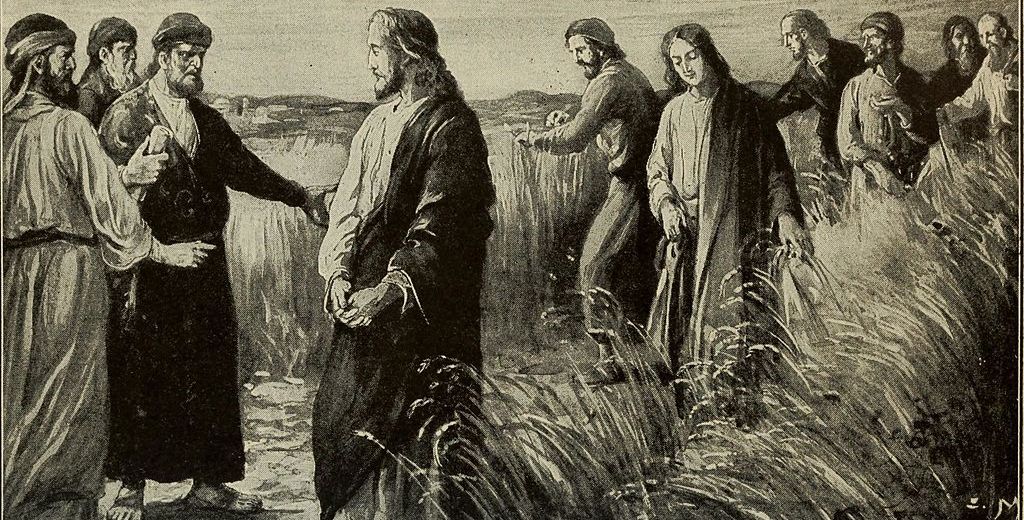
Today’s reading from Luke’s Gospel (Luke 13:10-17) is about what should or shouldn’t be done on the Sabbath.
It reminded me of a surprising experience I had with my wife Marty. We once spent a week on the shores of Lake Maggiore in Italy at Stresa, looking out to the Borromean islands. It is renowned as one of the most beautiful spots on earth. And it is rather fine. Though the River Shannon is just as beautiful, when the sun shines! The lakeshore is lined with rather grand Belle Époque hotels – Ernest Hemingway set part of his novel A Farewell to Arms in one of them. We were in a much more modest place, but we made a point of visiting the posh ones to admire the decor.
One of the hotels had been completely taken over by a large group of orthodox Jews, who were celebrating the end of the Passover holidays. Women and girls dressed just like other modern women, but men all wore black hats with a curl of hair showing, and boys a skull-cap. The place was full of people of all ages, children playing games and grown-ups sitting in the shade and chatting in small groups - everyone just chilling, enjoying quality time with family and friends - a very happy sight.
But nothing electric was working: no automatic doors, no lifts, no espresso coffee machines – absolutely nothing! It was only when I asked if there had been a power-cut that I discovered why – the electricity had been turned off at the mains. It was Saturday, the Sabbath, and for their orthodox Jewish denomination it would break the Sabbath law to use any electrical devices.
So today I want to tease out what the Sabbath has meant to Jews and Christians over the ages, and what it might mean for us today.
Firstly, what does
the Sabbath mean to Jews?
The Hebrew word Shabbat, from which our word comes, literally means ‘ceasing’, implicitly ‘ceasing from work’. Observing the Sabbath has been important to Jews since at least the Exodus. It’s enshrined in the Fourth Commandment brought down from Mount Sinai by Moses (Exodus 20:8-11): ‘Remember the sabbath day, and keep it holy. Six days you shall labour and do all your work. But the seventh day is a sabbath to the Lord your God; you shall not do any work – you, your son or your daughter, your male or female slave, your livestock, or your alien resident in your towns.’ It commemorates God resting on the seventh day of creation in the Genesis story.
The Jewish Sabbath lasts from sunset on Friday to sunset on Saturday. It’s a day of joyful celebration as well as prayer. Many Jews attend synagogue on the Sabbath, to worship and listen to teachers expound the Torah, our Old Testament - as Jesus did in the reading we have just heard. But the emphasis is on the home: candles are lit; all share in a festive meal, with wine which is blessed. The Sabbath is to be honoured, for instance by taking a bath, and by beautifying the home with flowers. And it is to be enjoyed with eating, singing, spending time with the family – and with lovemaking between husbands and wives.
But the Sabbath is also encrusted with prohibitions. Over the millennia rabbinical scholars have elaborated the simple notion of ceasing from work one day in seven, into a complex scheme of prohibited actions. As well as obvious work activities such as sowing, ploughing, spinning and weaving, these include lighting and extinguishing a fire. This is why the orthodox Jews I met in Italy would not use electricity on the Sabbath - they believed that if a switch made a small spark, it was equivalent to lighting a fire, which would be a violation of the Sabbath law. Some orthodox Jews get over the problem with pre-set timers, to turn appliances on and off without human intervention.
To violate the Sabbath has always been a very serious matter for Jews. The ancient punishment was the most severe in Jewish law – stoning to death, though that ceased when the Jewish courts were dissolved after the Temple was destroyed. But there have always been extenuating circumstances. Jews were not just allowed but required to break a Sabbath law, if it was necessary to save a life. And as Jesus pointed out, you were also permitted to water your animals on the Sabbath. The problem the leader of the synagogue had with Jesus healing the crippled woman, was not that he healed her on the Sabbath, but that her condition was not life threatening – she had been crippled for 18 years. Healing her, he believed, should have been left to the next day.
What did Jesus himself
think about the Sabbath?
This wasn’t the only time Jesus got into trouble with the religious authorities over the Sabbath. Elsewhere we hear that he declared ‘The Sabbath is made for man, not man for the Sabbath’ (Mark 2:27). He clearly taught that it is right to do good and to save life on the Sabbath.
On this occasion Jesus was infuriated by the leader of the synagogue, who kept so inflexibly to the letter of the law as to completely destroy the spirit of it. What really matters is whether an action does good or harm, not whether it fits into some abstract scheme of dos and don’ts.
But I am quite sure that Jesus valued the positive side of Sabbath-keeping: the opportunity for all to rest from labour, to enjoy time with family and friends, as well as to pray and worship God.
As Christianity
evolved away from Judaism, Christian views of the Sabbath also changed.
The earliest Christians, the apostles, Paul and the disciples, were Jews, and they kept the Jewish Sabbath on Saturday. But as the years passed, and the increasingly gentile Church split from the Synagogue, the Christian emphasis shifted to Sunday, in part in celebration of the Resurrection, but perhaps also to distance a gentile church from Judaism. So Christian Sabbath observance on Saturday gradually ceased, to be replaced by celebration of the Eucharist on Sunday.
In the year 321, the Roman Emperor Constantine – a Christian convert - decreed that Sunday should be the day of rest throughout the Empire, in these words: ‘On the venerable day of the Sun let the magistrates and people residing in cities rest, and let all workshops be closed. In the country however persons engaged in agriculture may freely and lawfully continue their pursuits’. Note his pragmatic approach to the agricultural economy - I can’t help but think that Jesus would have agreed!
Almost all Christians since then have observed Sunday as the Lord’s Day, a holy day marked by worship and prayers, a holiday from work, a time for rest and recreation with family and friends - like the Jewish Sabbath but without so many prohibitions.
At the Reformation, however, Puritans sought to introduce more rigour to the observance of the Lord’s Day as a Christian Sabbath, and this still persists in many Protestant Churches. Perhaps in doing so, they lost something of the joyful celebration which marked the Jewish Sabbath, for all its prohibitions. I certainly remember the dourness of an Ulster Sunday not so many years ago, when it was quite impossible for a tourist to get a bite of lunch on a Sunday.
So finally, what might
the Sabbath mean to us today?
I invite you to think of Sunday, our Sabbath, our day of rest, as a great gift - a gift our loving-father God has given us, through the traditions of those who have gone before us, right back to the time of Moses. We should cherish it. Through it, God entitles us not just to cease from working to rest, one day in seven, but to take time to enjoy our families and friends. And - if we are so moved - to be still, to worship him and give thanks for the wonderful world he has made us a part of. I think this wise gift is intended to help us to be properly human – humans made in God’s image.
Our society has been changing very rapidly. When I was young, no one worked on Sunday, unless they had animals to see to, or they sold perishable items, or there was some other pressing need. Now supermarkets and many shops are open. Factories and offices often work Sunday shifts. I confess that I’ve worked and shopped on Sundays myself, but I think it is a shame to do so unless it is absolutely necessary. Why has this happened? In this new globalised, materialist Ireland, have we allowed busyness and money-making to distract us from the Sabbath gift of stillness and rest? Whatever the reason, we can choose it to be otherwise. We are entitled – God entitles us – to say ‘No’. If we wish, we can say ‘No’ to dehumanising forces that would deny us one day in seven of stillness, to rest, to enjoy our families and friends, and to worship as we wish. Such forces can only prevail if we allow them to.
But at the same time,
we must be careful not to interpret the letter of the law so inflexibly that
we destroy its spirit, in the matter of keeping Sunday as in so much else, so
that we may not hear Jesus say ‘You hypocrites!’ to us, as he
did to the leader of the synagogue.