Showing posts with label light. Show all posts

Sunday, 11 February 2024

Transfiguration

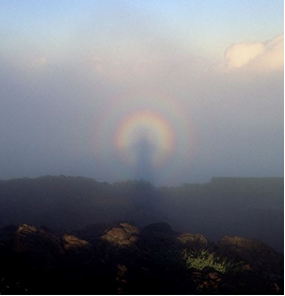
The Brocken Spectre – if you are interested in more of the physics
see https://atoptics.co.uk/blog/brocken-spectre/
Address given at St Mary's Nenagh and Killodiernan on Transfiguration Sunday 11th February 2024, the last before Lent

Mountain tops are special places, places where we feel awed by the immensity of God’s creation.

When the weather is good, the distant views reveal how puny we really are. When the clouds close in, we experience isolation from all that is familiar. And when the wind blows rain or hail or snow in our face, we understand our own frailty and vulnerability.

Like most of us, I suppose, I’ve loved walking and climbing in mountains, though I’m less able for it nowadays, sadly. I have vivid memories of many climbs. Climbing Keeper Hill as a child with my parents, each time I thought I was near the top another ridge revealed itself, until at the final summit half of Ireland was laid out in front of me. Climbing a peak called Le Dent du Chat near Annecy in France as a teenager, Mont Blanc and the snow peaks of the alps began to rise above the opposite ridge as I neared the top. And climbing Lugnaquilla by myself in my 40s - on a whim, unsuitably prepared – the cloud closed in after 5 minutes on the summit, and it grew cold, very cold – I was lucky to fall in with a soldier with a compass walking from the Glen of Imaal to Glenmalure, who showed me the right way down.

In today’s Gospel (Mark 9:2-9), Mark tells the story of Peter, James and John’s very special mountain top experience with Jesus.

High on the mountain, Peter, James and John see Jesus ‘transfigured before them, and his clothes became dazzling white’ – his appearance is changed: the Greek word translated as ‘transfigured’ is from the same root as ‘metamorphosis’. Alongside him they see two figures talking to him, whom they recognise as Moses and Elijah, the two preeminent figures of Judaism, representing the Law and the Prophets.

Peter, always the impulsive one, says, ‘Rabbi, it is good for us to be here; let us make three dwellings, one for you, one for Moses, and one for Elijah’. Peter does not want this emotional moment to end – such a human response!

Then the cloud closes in around them.  They are terrified. And they hear a voice saying, ‘This is my Son, the Beloved, listen to him!’ When the cloud clears, they look around, and they see only Jesus, who orders them not to tell anyone what they have experienced, ‘until the Son of Man (has) risen from the dead’.

Their experience, which we call the Transfiguration, reveals Jesus to be the Christ, the Son of God. It must have been very important to them, because they remembered it and passed on their story after the Resurrection, so that it could be told to us not just by Mark, but also by Matthew and Luke.

There is a possible scientific explanation for what Peter, James and John saw.

High on a mountain, with cloud around, is precisely when we may encounter an optical effect called a ‘glory’. In this effect sunlight is scattered back from water droplets in a mist, as a glowing halo - the technical term for it is Mie scattering.

The most famous example is the ‘Brocken Spectre’, so named because of sightings on the Brocken, the highest peak of the Harz Mountains in Germany. This appears when a low sun is behind a climber who is looking downwards into mist from a ridge or peak. The spectre is the shadow of the observer projected onto the mist, and it is surrounded by the glowing halo of a glory. On the sheet you should have you can see a photo of one, and if you’re interested you can follow the web link to find out more.

You might be lucky enough to see a glory yourselves, as I have. I saw it when I looked down from a plane at the shadow it cast on a cloud. The shadow was surrounded with a halo of light – this was the glory.

I imagine Peter and James and John close together on the mountain, with Jesus praying a little bit away, as the clouds swirl around them. Where Jesus has been standing, they each suddenly see a glowing figure – it’s a shadow, their own shadow, cast on a cloud, wrapped in a glory. And the two other shadows beside it are those of their companions, whom they take to be Moses and Elijah.

This possible scientific explanation of the Transfiguration should not disturb our faith.

I find that it helps me to believe that the Transfiguration really did take place. It was not invented by the Gospel writers to serve their own artistic or theological needs.

Their experience of hearing a voice from heaven also rings very true to me. When human beings suddenly realise something of vital importance, something which changes everything, we often talk of having a ‘flash of inspiration’ or ‘hearing a voice’. There are many such reports of deeply emotional religious experiences, not only within our own Christian tradition, but also from other faiths.

I believe that God is present in and works through the laws of the universe he created. The disciples accurately reported what they saw, even if they could not understand the physics. The true wonder and glory of the Transfiguration is how the subtle working out of the natural laws of God’s creation testify to its goodness, and God’s love for it, and for us.

If this physical explanation is correct, it should not change one whit our awe and wonder at God’s power and glory.

What matters, surely is what the Transfiguration reveals to Peter, James and John - and to us too - about the nature of Jesus and his relationship with God.

They saw Jesus transfigured, as ‘the light of the Gospel of the glory of Christ, who is the image of God’, in St Paul’s words from today’s 1st reading (2 Corinthians 4:3-6). The voice they heard told them to listen to him, and this they did. From then on Jesus intensified his teaching to them, preparing them for their role as apostles after his death.

I believe the Transfiguration was the moment on their long road when Peter, James and John realised their complete commitment to Jesus and his teaching. Starting from their call in Galilee, this road led them ultimately to Jerusalem, to the Cross, to the Resurrection, to the Ascension, and on to Pentecost, where they started to blossom as Christ’s Church.

And as Christians it should inspire each one of us to make our own commitment to follow Jesus as his disciples. ‘For it is the God who said, ‘Let light shine out of darkness’, who has shone in our hearts to give the light of the knowledge of the glory of God in the face of Jesus Christ’.

I finish in prayer.

Holy God, mighty and immortal,
you are beyond our knowing,
yet we see your glory in the face of Jesus Christ,
whose compassion illumines the world.
Transform us into the likeness of the love of Christ,
who renewed our humanity so that we may share in his divinity,
the same Jesus Christ, our Lord,
who lives and reigns with you and the Holy Spirit. Amen.

Sunday, 8 January 2012

The Wise Men's Quest

Epiphany sermon preached at Templederry & Killodiernan on Sunday 8th January 2012.

At Epiphany, in our Western Church tradition, we remember the Wise Men from the East.
As Matthew tells us in the reading we’ve just heard (Matthew 2:1-12), they follow a star which leads them to find and adore the baby Jesus. But the tradition in the Eastern Church is different - they remember a different Epiphany - the Baptism of Christ, when the Holy Spirit descends like a dove, and a voice from heaven says 'This is my beloved Son in whom I well pleased'. That's nice to recall on this joyful day when we baptise Hollie Linda Clarke.

The story of the Wise Men is so familiar to us, ever since we first heard it as children. Over the centuries it has grown with the telling, as the best stories always do. Story-tellers and artists have embellished it from their imaginations. Matthew’s unspecified number of Wise Men became three kings, riding on camels and bearing expensive gifts for the Christ-child. And the kings acquired names unknown to Matthew along the way - Caspar, Balthazar and Melchior - beautiful, exotic names.

It happened this way, I suppose. Matthew’s Wise Men were foreigners bringing gifts. People remembered OT texts referring to foreign kings who bring gifts. We have heard some today. Psalm 72 says: ‘The kings of Tarshish and of the isles shall pay tribute; the kings of Sheba and Seba shall bring gifts’. Today’s reading from Isaiah (60:1-6) says: ‘Nations shall come to your light, and kings to the brightness of your dawn… A multitude of camels shall cover you, the young camels of Midian and Ephah; all those from Sheba - Sheba again - shall come. They – the kings that is - shall bring gold and frankincense, and shall proclaim the praise of the Lord’. At first people must have thought Matthew’s Wise Men were rather like these OT kings. Later they came to the conclusion they were just the same. The number of the gifts the Wise Men brought no doubt explains why there are three of them. I’ve no idea where the names came from, though.

Leaving aside these embellishments, it’s not easy to see Matthew’s simple tale as plain history. The idea of a star which moves and then stands still seems absurd to us today. So is it any more than just a pretty story for children? Let’s examine it a little more closely to find out.

Matthew’s Wise Men are on a quest.
A quest is a kind of story in which heroes follow a long, hard and dangerous journey to find an object of great value before returning home. Such stories have been told since time immemorial. An ancient example is Homer’s Odyssey; Tolkien’s Lord of the Rings is a more modern one.

The object of great value the Wise Men are looking for is a rather special human child: ‘Where is the child who has been born king of the Jews?’ they ask in Jerusalem, ‘For we observed his star at its rising, and we have come to pay him homage’. We are not told why they associated this star with a king of the Jews, but no doubt as learned astrologers they were led to do so by their sacred scriptures

The learned people in Jerusalem, the chief priests and scribes of the people, similarly draw on their ancient scriptures, from the prophecy of Micah, to answer the Wise Men’s question. They suggest the Wise Men look in Bethlehem for ‘a ruler who is to shepherd my people Israel’. But it's strange, isn't it, the chief priests and scribes are strangely indifferent to the Wise Men's quest – they don’t even bother to send someone with them to report back what if anything they find.

King Herod, however, ominously asks the Wise Men to let him know when they have found the child, ‘so that I may also go and pay him homage’.

The light of the star is what leads the Wise Men on their quest.
This light leads them to the Christ-child with Mary his mother. There, at the culmination of their quest, they are overwhelmed with joy. They kneel in homage and present their gifts, signifying that the royal king they seek is in fact - this baby. Now that’s amazing, isn’t it? They have travelled so far, suffered such hardships, to find what? A tiny, vulnerable, human child, just like so many they could have found without stirring from home!

One great truth buried in Matthew’s mystical story is this, I believe - the Wise Men’s quest is our quest too. If we have the tenacity they had to follow the light of their star, like them we will find that baby, who is, as St John puts it, ‘the true light, which enlightens everyone’.

Light represents all that is good and true and beautiful, all that is worthy of God. This, surely, is what light means to Isaiah, when he addresses God’s people the Israelites, saying, ‘Arise, shine; for your light has come, and the glory of the Lord has risen upon you’. I believe that Isaiah’s words are addressed to us just as much as to the Israelites - we too are God’s people. ‘Our light has come, and the glory of the Lord has risen upon us’. We too should be overwhelmed by joy, like the Wise Men!

After finding what they seek, the Wise Men return home – the proper end of any quest.
No doubt they were changed by all that had happened to them, perhaps unsettled by it. They would surely be better able to appreciate what was good in their homelands, but be less tolerant of the bad.

But notice this dark note: Matthew tells us that ‘having been warned in a dream not to return to Herod, they left for their own country by another road’.

They had good reason - Herod had form. He had already executed a wife and several sons he suspected of disloyalty. Now Matthew goes on to tell us he orders the massacre of every child under 2 years old in Bethlehem, because he fears that the child found by the Wise Men might usurp his throne. Jesus only escapes their fate because Joseph was also warned in a dream to flee with Mary and Jesus to Egypt.

The characters in Matthew’s story illustrate three ways in which people respond to the good news of Jesus Christ.


  • First there is Herod. He reacts with hatred and murderous hostility – just as some people do to this day.


  • Then there are the chief priests and scribes of Jerusalem. There reaction is one of complete indifference. They are so engrossed in their own affairs that they completely ignore the good news. How like so many people today!


  • But the Wise Men respond with adoring worship, seeking to lay at the feet of the Christ-child the finest gifts they can bring.

The story of the Wise Men is surely much more than just a pretty tale for children
It is an adult fable which shows us how to respond to the good news of Jesus Christ.


To ‘follow your star’ has entered our very language as a description of single-minded determination to be the very best we can be.


Let us pray that, through God’s grace, we may follow the same star that led the Wise Men to the Christ-child - to be the very best that we can be - for him!