Sunday, 9 January 2011

God has come close to me, as close as my own skin

Today the Church asks us to remember the Baptism of Christ.
So I take this opportunity to reflect on what Jesus’s baptism means, both to those at the time, and to you and me 2000 years later.

But first I invite you to picture again, in your minds eye, the moments after John baptised Jesus, as described by Matthew in his gospel (3:13-17).

Here is Jesus, a man in the prime of his life, about 30 years old. He is glistening wet from receiving John’s baptism of repentance, as he walks up out of the river Jordan. Then, suddenly, the heavens burst open. The Spirit of God descends like a dove to settle on him. And the voice of God declares from heaven, ‘This is my Son, the Beloved, with whom I am well pleased’.

It is a striking and dramatic scene which engages our senses – it’s easy to imagine being there, isn’t it? And artists have painted many beautiful images of it over the centuries.
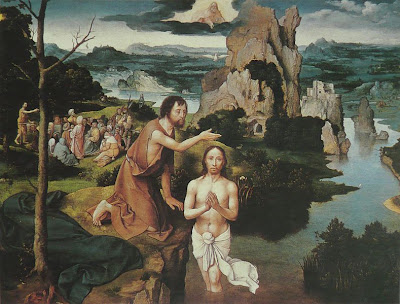
The Baptism of Christ, Joachim Patenir, c. 1480-1524, Kunsthistorische Museum, Vienna

I don’t believe Matthew the Evangelist was an eyewitness to Jesus’s baptism.
Nor is he likely to be the same person as Matthew the Apostle, the tax-collector Jesus called to be one of the twelve, a while later.

Whoever he was, Matthew is describing an epiphany, in which God reveals himself to be the Father of Jesus and sends his Spirit to Jesus. The very same epiphany, bringing together Jesus at his baptism, the dove and a voice from heaven, is also described by Mark, Luke and John. It must have been part of the common tradition of the earliest Christians on which Matthew and the other evangelists drew when writing their gospels.

For Christians by the 4th Century AD these baptism passages came to be seen as supporting and illustrating the doctrine of the Trinity, the idea that the one God consists of three persons, Father, Son and Spirit. They are the only passages in the NT where we encounter all three persons together at the same time, in the same place.

Matthew, like any educated Jew of his time, would have known the prophesy of Isaiah well. He would surely have noticed the parallels with today’s OT reading (Isaiah 42:1-9), in which God declares, ‘Here is my servant, whom I uphold, my chosen, in whom my soul delights; I have put my spirit upon him’. But there is this crucial difference: for Isaiah, God identifies his chosen one as just a humble servant; whereas for Matthew, God identifies Jesus as his beloved Son.

What did John the Baptist make of Jesus’s baptism?
John recognised Jesus when he came to ask for baptism, not surprisingly since they were cousins close in age. John says to Jesus, ‘I need to be baptised by you, and do you come to me?’ What’s going on here?

John proclaimed ‘a baptism of repentance for the forgiveness of sins’ (Mark 1:4). He called people to repent, and baptised them as a sign that God forgave their sins. I think John must have believed Jesus was such a good man that he had no need of baptism, repentance and forgiveness. But John knew he did need them himself.

The gospels tell us next to nothing about Jesus before he started his ministry. However Luke (2:41-52) does tell us that Jesus amazed the teachers in the Temple with his understanding when only twelve, and that afterwards Jesus ‘increased in wisdom and years, and in divine and human favour’. John’s reaction confirms Luke’s picture of Jesus as a man widely seen to be remarkably holy and charismatic.

John would also have recalled Isaiah’s description of God’s chosen servant in today’s reading, ‘He will not cry or lift up his voice, or make it heard in the street; a bruised reed he will not break, and a dimly burning wick he will not quench; he will faithfully bring forth justice. He will not grow faint or be crushed until he has established justice in the earth.’ Perhaps John recognised the Jesus he knew in Isaiah’s description - softly spoken, filled with compassion for the damaged and the weak, yet determined and passionate for justice.

Despite John’s reluctance to baptise him, Jesus insisted, and John consented. And we know John then experienced the same epiphany described by Matthew, since John’s Gospel records him saying: “I saw the spirit descending from heaven like a dove, and it remained on him. I myself did not know him, but the one who sent me to baptise with water said to me, ‘He on whom you see the Spirit descend and remain is the one who baptises with the Holy Spirit.’ Only then does John realise the full truth, that his cousin Jesus is not just a remarkably holy man, but is in fact the promised Messiah, the incarnate Son of God.

I wonder what his baptism meant for Jesus himself.
Jesus very deliberately chose to ask John for baptism, and insisted on it – it must have been of great significance to him.

Matthew gives us a clue when he records Jesus saying to John, ‘it is proper for us in this way to fulfil all righteousness’. For Jews, righteousness meant obeying God’s law and doing God’s will. Jesus clearly believed God wished him to be baptised by John. But baptised for what purpose?

Perhaps God's Spirit prompted Jesus to seek John’s baptism at the very start of his ministry in order to demonstrate that Jesus was God’s incarnate Son, not just a good man like Isaiah’s servant. This was certainly the effect it had on John. But Jesus himself surely also needed to be certain of his identity before beginning his ministry. Is it possible this is also the very moment when Jesus finally understood that he was Christ the Messiah, the Son of God?

Whatever the truth of this, Jesus clearly associated himself quite deliberately with John’s proclamation, ‘Repent, for the kingdom of heaven has come near’ (Matt 3:2) - because he went on to proclaim this message in his own ministry (Matt 4:17). And I like to think that Jesus did so because he wanted to show his solidarity with sinful people like you and me, who desperately need to repent and be forgiven, even if Jesus had no such need himself.

So to finish, what does Jesus’s baptism mean to you and me, 2000 years on?
Well, no doubt there are many answers. But this one strikes me.

The epiphany at the baptism of Jesus marks a great new insight into the nature of God as the Trinity of Father, Son and Holy Spirit. As God says through Isaiah in the 1st reading, ‘See the former things have come to pass, and new things I now declare’.

Before it Jewish religious thinkers could only conceive of the relationship between God and a human being as that between a remote master and a terrified servant. After it Christians could begin to see the relationship as one in which God is incarnate in a human being like you or me.

Everything is changed and made new. God ceases to be a remote figure and we are no longer afraid. God comes near to us, as close to us as our own skin. We feel his presence to be like that of our loving Father; to be like thst of Jesus, his Son, our friend and brother; to be like that of the Spirit which inspires all that is good and true in us.

Let us thank God for Jesus’s baptism, most particularly for the insight it gives us into God’s intimate and loving nature as Father, Son and Holy Spirit.

Sunday, 5 December 2010

Remembering Prophets

An address given on the 2nd Sunday of Advent 5th December 2010 at Nenagh (it would have been given in Templederry too, but the service there was cancelled due to the icy conditions).

Today we lit the 2nd candle in the advent wreath to remember the prophets.
And today’s readings are concerned with two of the greatest of them: Isaiah in the Old Testament (Isaiah 11:1-10) and John the Baptist in the New (Matthew 3:1-12). Christians see their prophetic words as referring to the incarnation of God in Jesus, and the coming of Christ’s kingdom.

We shouldn’t see prophets, I think, as being like weather forecasters, or racing tipsters, who foretell the future without engaging in it. Rather a prophet is someone who expresses a vision of the way things are, and the consequences that flow from this, which powerfully influences those who listen, so that they act to make that prophetic vision a reality. Prophets change history through their words!

Let me try to tease out what these prophets’ words say to me.

Let’s start with Isaiah’s vision of a world of peace and justice.
‘The wolf shall live with the lamb, the leopard shall lie down with the kid, the calf and the lion and the fatling together, and a little child shall lead them.’

A beautiful image - but we all know, don’t we, that the strong prey on the weak; the natural world is all about survival of the fittest. ‘Nature, red in tooth and claw’ – the phrase comes from Tennyson's long poem ‘In Memoriam’ (canto 56). In it the poet contrasts the idea of a good and loving God with the terrors of an uncaring Nature. He talks about a person of faith,
Who trusted God was love indeed
And love Creation's final law-
Tho’ Nature, red in tooth and claw
With ravine, shriek'd against his creed

Surely Isaiah’s vision of predator and prey at peace together can be nothing more than a fairytale? That’s not the way the world works. What’s going on here?

The context is important, I think.
Isaiah is writing in Jerusalem, the capital of Judah, at a time of great danger. The Assyrians have just conquered Judah’s twin kingdom of Israel and carried the people off as captives, and now they threaten Judah. Isaiah believes that the social and political collapse of Israel was caused by its failure to live up to the spirit of the law given in Sinai – and he sees the same thing happening to Judah. Isaiah has just prophesied that Judah too will be overthrown, but he can’t believe that a God who is faithful will desert his chosen people completely – once the Assyrians have purged those who have broken the covenant, surely a faithful remnant will be left.

So in today’s reading Isaiah prophesies that from the root of Jessie, a new shoot will rise up. From the ruins of Jerusalem, of the kingdom of Jessie’s son David, a new kingdom of justice and peace will arise, worthy of God’s favour. It will be marked by ‘the spirit of wisdom and understanding, the spirit of counsel and might, the spirit of knowledge and fear of the Lord’. Its ruler – from the stock of Jesse – ‘with righteousness … shall judge the poor, and decide with equity for the meek of the earth’.

It is a vision of the kingdom of heaven. In such a society the powerful will not prey on the weak. Isaiah’s vision is about people, not nature. Survival of the fittest should not – must not - apply in human society, however much it does in the natural world.

Isaiah was wrong in his belief that Judah would fall to the Assyrians.
The Assyrians mysteriously abandoned their attack on Jerusalem. When destruction came, 100 years later, it was the Babylonians, not the Assyrians who laid waste to Jerusalem and carried its leaders into exile.

But Isaiah’s vision was not forgotten. His words were remembered by the exiles. His vision inspired them to hold firm in their traditional faith, to keep their identity as a people, and to return home when conditions allowed.

Over the centuries that followed, Isaiah’s words were studied and elaborated. By Roman times, religious Jews felt quite certain that God would send his Messiah – his anointed one – of the stock of Jesse, who would rule over the Jewish people, as Isaiah had prophesied, with righteousness and faithfulness.

John the Baptist believed in Isaiah’s prophecy and expected God to send his Messiah.
As Matthew reports, he told his followers ‘one who is more powerful than I is coming after me, I am not worthy to carry his sandals’. Matthew also believed that John himself was the messenger that Isaiah said would announce the Messiah, ‘the voice of one crying out in the wilderness: “Prepare the way of the Lord, make his paths straight”. John called the people to, ‘Repent,’ – to make a new start, to change their lives – ‘for the kingdom of heaven is at hand’ – the kingdom of Isaiah’s vision.

Jesus surely pondered Isaiah’s words too. I believe he came to the conclusion that they were to be fulfilled in him. But God gave Jesus the insight that as the Messiah he must come not in physical power and glory like a king, but as a suffering servant, leading his people – all people, Jews and gentiles – by his example, to the kingdom of heaven which his loving father God willed.

The early Christians, steeped in the Jewish Messiah tradition, were convinced that Jesus is the shoot from the stock of Jesse in Isaiah’s prophesy. The spirit of the Lord rested upon him. He preached the kingdom of heaven. He died that we might be saved, he rose from the dead, and he ascended to God. Surely, they said, he will return to rule with righteousness and faithfulness over God’s kingdom of justice and peace.

So what of us today? Do we believe in Isaiah’s vision?
In our own time, as in Isaiah’s, we are faced with danger and uncertainty. But we must never give up hope.

Isaiah’s vision is in front of us – the world can be like the kingdom of heaven, filled with justice and peace. John’s call echoes in our ears, to make a new start because the kingdom of heaven has come near. Jesus has shown us the way as God incarnate. He has sent us the Spirit to lead us, and fire to drive us forward, just as John said he would. Our task as Christians is to do our bit to make his kingdom, the kingdom of heaven, a reality.
God is faithful to his faithful people.

‘They will not hurt or destroy
on all my holy mountain;
for the earth will be full of the knowledge of the Lord
as the waters cover the sea.’


Isaiah’s vision is not a fairytale, because for God all things are possible!

Sunday, 14 November 2010

Remembering - and the kingdom of God

An address given on Sunday 14th November 2010, the 2nd before Advent, Remembrance Sunday, at Templederry & Killodiernan.

They shall grow not old, as we that are left grow old:
Age shall not weary them, nor the years contemn.
At the going down of the sun and in the morning
We will remember them.

Rev F A O (Derick) Sanders CF(EC) in battledress

Today I wear a poppy in my father’s memory.
He was dragged - unwillingly - into the maelstrom of the 2nd World War. As a Chaplain to the Forces he landed in Normandy on D-day, he was there at the crossing of the Rhine, and he ended up in the ruins of Berlin. He spoke little about his experiences, not to me or to most others I think - but he was marked by them. He felt it right to wear the emblem of a poppy on Remembrance Day, in memory of his comrades who died, and in memory of the scenes of murderous destruction he had witnessed. I thank God that my life has not been scarred by war in the same way his was.

Many people choose to wear a poppy today, but not all do. And we should be mindful of the sensitivities of others, particularly here in Ireland. It is surely right to remember our family and friends who have suffered in war – for they are part of us. It is right to remember the horrors of war – lest by forgetting we allow them to happen again. And it is also right to support the charitable work of the Earl Haig Fund.

But how we remember is important, I think. Jesus proclaims, ‘the kingdom of God has come near, repent and believe in the good news’ (Mark 1:15). War is the very opposite of the kingdom of God. Our remembering should be mingled in equal measure with repentance. We need to repent the very human tendency - which we all share - to hate those not of our tribe, to treat them as enemies, who all too often we seek to kill and maim in war. And we should not let others manipulate our remembering to reinforce the tribal instincts that promote war.

Let us join together in faith and penitence in a minute’s silence, in remembrance of all those who have died, been maimed or suffered in war; men, women and children; whether military or civilian; on whichever side, and on no side.

Ever-living God, we remember those whom you have gathered from the storm of war into the peace of your presence; may that same peace calm our fears, bring justice to all peoples and establish harmony among the nations, through Jesus Christ our Lord. Amen.

What a beautiful vision of the kingdom of God Isaiah (65:17-25) paints in today’s OT reading!
The Lord is ‘about to create new heavens and a new earth’, says Isaiah. ‘No more shall the sound of weeping be heard in it, or the cry of distress.’ It will be a place of peace, in which, ‘the wolf and lamb shall feed together, the lion shall eat straw like the ox’. ‘They shall not hurt or destroy on all my holy mountain, says the Lord’.

For the Jews of Jesus’s time, the holy mountain was Mount Zion, one of the hills on which Jerusalem is built, with the Temple at its summit. Herod the Great had extended, adorned and beautified the Temple in the years before Jesus was born. Judging by the remains excavated by archaeologists and descriptions from the time, it must have been a stunning building.

I imagine that visitors must have seen the Temple as like a foretaste of Isaiah’s new creation, a model of what the kingdom of God would be like when it was realised on earth, a monument to peace and plenty for all.

But Jesus did not see the Temple in this way, as the NT reading (Luke 21:5-19) tells us.
For Jesus the kingdom of God that he cares so passionately about – his kingdom – is not built of stones, no matter how magnificent. His kingdom is not of this world, as he later tells Pilate at his trial. He recognises that the Temple with all its sacrifices, priests and temple-taxes is an unsustainable burden on God’s people. And he knows, as we do, that all material things turn to dust in the end. So when he hears some people admiring the magnificence of the Temple, ‘how it was adorned with beautiful stones and gifts dedicated to God’, he publicly foresees its utter destruction. And of course he is proved right – some 40 years later it is indeed destroyed in the course of a Jewish rebellion against Roman rule.

Some who were listening to Jesus miss his point completely. They ask him to tell them how to know exactly when this destruction will happen. Many people in Jesus’s time were just as consumed with apocalyptic fears about the end-times as some folk are today. But Jesus will have nothing to do with it - he does not feed their fears. Instead he warns them not to believe people who claim to be able to forecast such things. And he tells them not to fear that the end is imminent, even when they hear of awful events, such as ‘wars and insurrections’, ‘earthquakes’, ‘famines and plagues’.

Then with amazing frankness, Jesus uses the occasion to teach his disciples what is in store for them, and in a strange way to reassure them.

Jesus knows that the political and religious authorities are determined to get rid of him, to put him out of the way. The end game is upon him – in just a few days he will be seized, tried and executed on the cross. And then the authorities will turn on his disciples. ‘Before all this occurs’, he says, ‘they will arrest you and persecute you; they will hand you over to synagogues and prisons, and you will be brought before kings and governors because of my name’.

But Jesus promises to help them to hold on, to stand firm and testify to the values of the kingdom of God which he has taught them – that is what matters, whatever may befall them. ‘For I will give you words and a wisdom that none of your opponents will be able to withstand or contradict’, he says. ‘You will be betrayed even by parents and brothers, by relatives and friends; and they will put some of you to death. You will be hated by all because of my name. But not a hair of your head will perish. By your endurance you will gain your souls’.

I put it to you that Jesus’s disciples in all ages – including us – should be reassured by his words. Jesus will help us to proclaim the values of the kingdom of God. It may be that in Ireland today we're not likely to be killed for sticking up for the kingdom of God, though we may very well suffer in other ways. But that is our duty as disciples. Desertion in the face of the enemy is shameful. By our endurance we will gain our souls.

To suffer or die for the kingdom of God is not the worst thing that can happen to us.

Vines & Grapes

A talk for children at the Family Service on Sunday 14 November 2010 in St Mary's, Nenagh. The theme was The Vine.

Children, I’m going to talk to you today about vines, because that is the theme of the service.

Perhaps those of you at the back could come up to the front with the girls choir, because I have something to give you.

The grown-ups can listen in if they want to, or go to sleep, but they should be very good and quiet as mice.

What is this? (hold up a bunch of grapes) - Grapes

What kind of plant do grapes grow on? – Vines

Do you like to eat grapes? – Yes! Well here they are for you to share.

Grapevines are wonderful plants.
Here is a picture of a grapevine.


Grapevines like to grow in countries that are much drier and hotter in summer than Ireland is, so they don’t grow very well here. To get really good sweet grapes in Ireland you have to grow them in a glasshouse. But they grow well in Palestine where Jesus lived, and everyone there then knew as much about vines and grapes as we do about apple trees and apples, because you could find them in every garden.

A vine grows from a big old trunk every year. It has roots that go down a long way to find every drop of water and all the nutrients it can. The water and the nutrients make a rich sap which the trunk pushes up to feed its new growth. In spring and summer the vine grows branches and leaves, and produces flowers which turn into tiny grapes. During the autumn, the tiny grapes swell and ripen until they are the sweet juicy fruit we can buy in the shops. And all the time the vine-grower has to tend it. He has to cut out any branches or twigs that break. And he carefully prunes any branches and twigs that aren’t growing as they should. If he doesn’t tend it properly, the vine won’t produce a big harvest of good fruit.

How are those grapes, by the way? Are they sweet and juicy? Yes! So the vine-grower has done his job well!

In today’s reading (John 15: 1-8), Jesus tells us a story about vines.
Jesus uses the picture of a vine to show us what our relationship should be with him – as his followers – and with God – his and our loving Father.

‘I am the true vine’, he says. Have you noticed these words written in our beautiful stained-glass East window? They are there to remind us of Jesus’s story.

And he goes on to say, ‘my Father is the vine-grower’ - that's God, and ‘you are the branches’ - that's you here, everyone over there, and me too.

If I were a vine branch, I’d want to produce good fruit – and I’m sure you would too. In the same way, we all would like to be the good people that God wants us to be.

That means we must hold tightly to Jesus like branches to a vine trunk. Just as the vine branch needs rich sap from the vine trunk to produce good grapes, so we need the kind of spiritual food which only Jesus can feed us with, to be as good as God wants us to be.

We grow and learn throughout our lives, not just as children, but as grown ups. We learn from our experience. As we live and learn, we must expect God to teach us hard lessons sometimes. God, our loving Father, is like a skilful vine-grower. We must let him prune out any bad bits in us, so that the good bits in us will produce good fruit. That is what learning from experience is all about, and we should rejoice in it.

So, every time that you eat a really juicy grape, and every time that you look at that beautiful stained-glass window, I want you to remember Jesus’s story about the vine:


  • Jesus is the true vine that feeds us

  • You and I are like branches of the vine

  • God, our loving Father, is like a skilful vine-grower

  • If we hold tightly to Jesus and we trust in God, we can and we will produce good fruit to please him - as sweet and juicy as any bunch of grapes!

Sunday, 17 October 2010

Harvest in the wilderness

Address given at the Lockeen Harvest Festival, Sunday 17th October 2010. It was a great privilege to be invited back, three years after the last Harvest I attanded there. Year A readings (Deuteronomy 8:7-18 and Luke 17:11-19)

We all love Harvest Festivals, don’t we?
Looking around us at this beautifully decorated church, filled with harvest bounty, how can we fail to feel thankful? The decorators have every right to be proud of their skilful arrangements, and those who have grown the produce have every right to be proud that the best of it should be displayed here in God’s house! We all enjoy the colours and the smells of the fruit and the vegetables and the flowers, the familiar harvest hymns, and the cheerful people, filled with a sense of accomplishment, now that the year’s work has been crowned with success.

And it’s not just human beings who feel thankful, I fancy. Have you come across John Betjeman’s well known poem, The Diary of a Church Mouse? The Church Mouse has a lean diet for most of the year, nibbling on old service books, floor polish and the stuffing of hassocks. He doesn’t care much for Christmas or Easter or Whitsun, but he dines like a king at Harvest:
For me the only feast at all
Is Autumn’s Harvest Festival,
When I can satisfy my want
With ears of corn around the font.
I climb the eagle’s brazen head
To burrow through a loaf of bread.
I scramble up the pulpit stair
And gnaw the marrows hanging there.

My farming neighbour tells me it’s been a good harvest this year – and if he says so it must be true, because he’s not usually so positive! His grain yield is a bit down, due to the dry summer, but the harvest was easier than last year, moisture is low, and he’s anticipating a good price. Dairy farmers are also happy, he tells me, though dry-stock folk a bit less so. Sheep farmers are pleased too. And those of us like me with gardens are delighted with our excellent crops of fruit and vegetables.

We really do have so much to be thankful for. In the OT reading from Deuteronomy (8:7-18), Moses speaks to the children of Israel as they wait to cross into the Promised Land. ‘The Lord your God is bringing you into a good land’, he says, ‘a land with flowing streams, with springs and underground waters welling up in valleys and hills, a land of wheat and barley’. Well, God has already placed us in just such a land: Ireland is well-watered; our yields of wheat and barley are among the highest in the world. Instead of ‘vines and fig trees and pomegranates’, we have cherries and plums, apples and pears, raspberries and currants. We may not have olive trees, but we have rape-seed for oil. It is ‘a land where we may eat bread without scarcity, where we lack nothing’. It is surely right for us to ‘eat our fill and bless the Lord our God for the good land that he has given us’.

But we are not all farmers, and in other respects we are suffering a hard, bitter season.
We are shocked and angered by revelations of financial mismanagement by so many of our leaders. The actions of bankers, developers and politicians here have made the global crash worse than in other countries. Many have lost their jobs, many more have had their take-home pay cut, the old find their pensions are not what they expected. Services are being pared; people are struggling to pay mortgages on homes now worth just a fraction of what they paid for them. And we are being told that we face four more years of increasing pain to bring our public finances back into balance.

It is also slowly – too slowly – dawning on us that our modern consumer lifestyle is not sustainable. To feed this lifestyle, human beings are over-exploiting the Earth’s resources of fossil energy, minerals, water and fertile land. If this continues God’s planet which nurtures us will be damaged, and we will suffer with the rest of creation.

Our lifestyle is also unjust. Everyone can’t enjoy the high consumption that we do in the developed world – there are simply not enough resources to go round. The rich unjustly take the lions share, and so deprive the poor of their aspirations to development.

We know we will have to make changes, but we do not yet understand what and how. We are anxious; we are frightened. And for many people it is difficult to feel thankful.

How is it that we find ourselves in this position?
The root cause of the problems we face is surely that old fashioned sin of greed, to which human beings have always been liable – greed for money, greed for possessions, greed for a lifestyle richer than our neighbour has.

Could it be that we have been forgetting God, and saying to ourselves, ‘My power and the might of my own hand have gained me this wealth’?

Our situation is a bit like that faced by the children of Israel as Moses led them out of Egypt into the Sinai desert, long before they ever get to the Promised Land.

God is leading us ‘through the great and terrible wilderness, an arid waste-land with poisonous snakes and scorpions’. We are being humbled. We are being tested. God has given us a task on our journey - to build a sustainable and just society, more like the kingdom of heaven than the one we know today, the kind of society in which all can flourish. We are journeying through a wilderness - but in the end the journey will be good for us – we will enter the Promised Land.

We need cleansing just as much as the lepers that Jesus met on the way to Jerusalem. (Luke 17:11-19)
We need to be cleansed of sinful greed. Without that we cannot be successful in the task God entrusts us with. And we can be sure that Jesus will cleanse us, if we recognise our sin for what it is, and call out to him, as the lepers did, ‘Jesus, Master, have mercy on us!’

But let us not be like the nine lepers who failed to show their gratitude. Let us be like the one who turned back, praising God, to thank Jesus. It is against the grain of society today, it is counter-cultural. But if we praise God and show our gratitude, Jesus will bless us, as he did that Samaritan, saying, ‘Get up and go on your way; your faith has made you well’.

Others will notice the change in us. Our positive, unselfish, grateful attitude will attract them. They will be inspired to work with us to build that sustainable, just society in which all will flourish.

God will look after us on our journey in the wilderness; he will make ‘water flow from flint rock’ and he will feed us ‘with manna that our ancestors did not know’; in fact he will continue to bless us with good harvests. Enough to meet our needs if not our unreasonable wants. And we must give thanks for them, as we are doing today, because our joy will bring others to join us.

Betjeman’s Church Mouse was surprised at harvest time to be joined in the church by so many field mice from outside. The poem finishes:
But all the same it's strange to me
How very full the church can be
With people I don't see at all
Except at Harvest Festival.

As Christians we must go forward confidently, certain that God will bring us into a good land:
  • There will be economic recovery – thank God!
  • We will build a sustainable and just society, more like the kingdom of heaven – thank God!
  • And like the children of Israel we must ‘remember the Lord our God, for it is he who gives us power to get wealth, so that he may confirm his covenant that he swore to our ancestors, as he is doing today’thank God for that promise too!

Sunday, 10 October 2010

Foreigners & Exiles

‘Blow, blow, thou winter wind, thou art not so unkind as man’s ingratitude.’
These words came to my mind as I read today's passage from Luke's Gospel (17:11-19). They come from Shakespeare’s As You Like It, sung by a character who is an exile in the Forest of Ardenne.

Luke tells us that Jesus healed ten lepers, and only one came back to show his gratitude. ‘Were not ten made clean?’, says Jesus, ‘But the other nine, where are they?’

I fear I’m more like the nine ungrateful than the tenth grateful leper – and I dare say you are too. How many of us do not owe an immense debt to someone else? Perhaps to a friend, a teacher, a doctor, who has done something for us that we could not possibly repay. Or to our parents - a week’s neglect on their part would have killed us when we were new born. Yet how often do we forget to express our gratitude, how often do we not even bother to say thank you?

And we are often ungrateful to God as well. He has blessed us with so much: he has given us a wonderful world so perfectly made to meet our needs for food, clothing, shelter and beauty; he has given us the capacity to form deep loving relationships as parents and children, as friends and lovers; and God has even given us his only Son to show us the way to his kingdom, the way of self-sacrifice which leads through the cross. When times are bad we may pray to God with desparate intensity, but when times are good we are inclined to forget to be grateful. On Sundays we recite automatically the words ‘Almighty God, we thank you for feeding us’, but how many of us ever offer even a silent grace before meals, I wonder?

Jesus saw that the one who came back was a Samaritan. ‘Was none of them found to return and give praise to God except this foreigner?’, he says.

As an ethnic group the Samaritans were heretics - they did not behave, or believe, or worship as the Jews did – they were ritually unclean. They were disliked and despised by their Jewish neighbours – somewhat as many Irish people dislike and despise immigrants or travellers today. But Jesus teaches his disciples a lesson by drawing their attention to this particular outsider, who was the only one to turn back, praise God for his healing and thank Jesus. And Jesus publicly blessed him, saying, ‘Get up and go on your way; your faith has made you well’.

Jesus is never dismissive of people who are different in race, culture or faith, and we should not be either, if we are to claim the right to call ourselves Christians. We can have much to learn from those who are different – those of us who were at Monday’s celebration of Creation Flourishing might reflect on the lesson about joy in worship which Suma and Priya from India taught us in their traditional dance of praise and thanksgiving.

Jeremiah (29:1,4-7) gives the exiles in Babylon some good advice in today’s OT reading.
Let me summarise it. Get on with your lives; build houses and live in them, plant gardens and eat what they produce, marry and have children. But also, seek the welfare of the city where you find yourself, and pray for it, because in its welfare you will find your welfare.

Others at the time were stirring up the Jewish people to rebel against the Babylonians. But history shows that Jeremiah was wise. It seems the Jews did as he advised, they prospered in Babylon and retained their identity, so that some 70 years later, after Babylon in turn had been overthrown by the Persians, their descendents were able to return to Jerusalem and restore the Temple.

It is good advice for migrants everywhere. It is good advice for the New Irish that we have brought to our country. And it is good advice for the many Irish people who will likely be forced by the economic crash to emigrate over the next few years. Our children and young relatives may well be among them - how heartbreaking it will be for them and for us. But let us pray that they may build good lives in their new communities and work for them to flourish, because if their new communities flourish, so will they.

The majority of us, though, will stay in Ireland to cope with what looks likely to be a long recession. We are shocked and angered by recent revelations of economic mismanagement. The economic landscape has changed. The future will not be one of ever-growing material prosperity as we expected just 2 or 3 years ago. We know much will have to change, but we do not yet see clearly what and how. We are scared by the uncertainty. And we risk falling into a communal psychological depression which would prevent us addressing the real problems we face.

In a way we are like internal exiles in our own country.
Jeremiah’s advice is good for us as well:
  • Get on with your lives, he says. We must not look back at what we feel we have lost, but instead look forward.
  • Build houses and live in them, he says. Well, we won’t need to build much soon, but what we should do is to seek new uses for the ghost estates, the offices, the commercial properties and factories lying empty all over Ireland. We must adapt them for fruitful purposes.
  • Plant gardens and eat what they produce, he says. We are blessed in Ireland with bountiful renewable resources: our land and seas, energy from wind, ocean and geothermal heat, skilled people and vibrant culture. Let us use them productively – they will feed us like gardens.
  • Marry and have children, he says. Ordinary human life can and must continue – let us use our capacity for deep loving relationships as parents, children, friends and lovers, to support and care for one another.
  • But also, says Jeremiah, seek the welfare of the city where you find yourself, and pray for it, because in its welfare you will find your welfare. Let us strive to build a just and sustainable society for the future, because only in such a society can we all flourish.
And as recovery comes - which it will, thank God - let us behave like the grateful Samaritan and remember to turn back, to praise God, and to give thanks for all he has given us.

Sunday, 3 October 2010

Faith & Duty

Address given on Sunday 3rd October 2010, the Eighteenth after Trinity, in Nenagh.

In today’s NT reading, Luke (17:5-10) records two short sayings of Jesus.
They are memorable, because Jesus, as he always does, paints vivid pictures in simple everyday language.

But they are also paradoxical, I think, because although they seem simple on the surface, it is only after pondering them for a while that we can begin to grasp their true implications.

In these two sayings, Jesus is giving his followers – then and now – two important rules for living as God’s beloved children: a rule of faith, and a rule of duty. Let's look more closely at them.

First, the rule of faith
The apostles said to Jesus, ‘Increase our faith’. Jesus replied ‘If you had faith the size of a mustard seed, you could say to this mulberry tree, “Be uprooted and planted in the sea”, and it would obey you.’

I wonder whether the apostles felt when they heard this that Jesus was exasperated by their request? Was he criticising them for not having even the merest smidgeon of faith? Because of course they knew very well they couldn’t expect a tree to obey their command!

But once they thought about it they would realise that he was simply telling them the truth, in his typically vivid way.

Surely what Jesus really meant is this. They mustn’t use the excuse of too little faith to avoid doing what God asks of them. If they have any faith at all, no matter how small, they must act on it. They must trust that God will work his purpose out through them - and get on with it. They will find that they can do things they never thought they could – miraculous things.

And I think, perhaps, that we have experienced the truth of this in our own parish, in a small way. When we discovered that St Mary’s needed a new roof which would cost hundreds of thousands of euros, we didn’t at first believe that we could raise the money. But when we overcame our fears, when we trusted that God would not let us down, when we acted on our little faith, then we discovered that by God’s grace, with the help of our neighbours and the wider community, we could perform a little miracle. We raised enough money to complete the roof in a little over a year, and we have gone on to replace two more!

The rule of faith that Jesus gives us is this: do not fear that you have too little faith; instead trust in God and obey the promptings of his Spirit; you will discover that you have faith enough to do things that might seem impossible.

Second, there’s the rule of duty
Jesus asks his followers to imagine that they are slave owners. A slave owner wouldn’t dream of thanking a slave for doing what he is ordered to do, says Jesus – that’s just what a slave is meant to do! But then he asks them to imagine their role reversed, with them in the role of slaves in relation to God. ‘So you also, when you have done all that you were ordered to do, say, “We are worthless slaves; we have only done what we ought to have done!”’

Now, we’re not at all comfortable today with the idea of slavery – thank God! Slavery was abolished largely because Christian men and women came to realise that it contradicted the biblical conviction that every human being is created in the image of God – though shamefully, not until nearly 2000 years after Jesus’s death. I doubt that many of Jesus’s disciples owned slaves themselves – they weren’t rich folk – but slavery then was part of everyone’s common experience – they would have understood what Jesus was talking about very well.

If Jesus were making the same point today, he might say something like this.

‘Imagine you’re a multi-millionaire, who employs a housekeeper, a personal assistant and other staff. When they do their job, you don’t go out of your way to thank them, or give them a bonus, because you pay them well to work for you – doing their job is only what you expect of them.

Now, put yourself in God’s shoes. He employs you to serve him by doing good, doing his will. He has given you this wonderful world and all its resources to meet all your reasonable needs. You don’t expect God to give you any special reward just because you have done what he asks of you, do you? You’ve only done your duty!’

The rule of duty that Jesus gives us is this: behave like servants of God; the Holy Spirit will tell you what God wants of you if you listen for it in prayer; your Christian duty is to do what he asks. But you should not expect to earn any special favour from God for doing it – it is no more than what is your duty to God.

We have no right to expect good things in this life, nor a place in heaven, just because we have done a few good deeds – and inevitably failed in many others. Yet Jesus reveals to us a God who is like a loving Father. He assures us that God will forgive our failures if we ask him to, and that he has prepared a place in his kingdom for his faithful servants. But it is a matter of God’s grace and not our own merit.

Let us then resolve to live our lives according to Jesus’s rules of faith and duty:
  • Let us trust in God, and believe that though our faith is little it will be enough to achieve God’s purposes.
  • Let us be servants of God, doing what is right and our duty, not because we expect to be rewarded for it, but just because it is right and our duty.
St. Ignatius Loyola captures this beautifully in his prayer

Teach us, Good Lord, to serve you as you deserve:
to give, and not to count the cost;
to fight, and not to heed the wounds;
to toil and not to seek for rest;
to labour and not to ask for any reward,
save that of knowing that we do your will.
Through Jesus Christ our Lord,
Amen