Sunday, 10 April 2022

Remove this cup from me

Agony in the Garden by Andrea Mantegna, 1458-60

Reflection on Christ's prayer in the Garden, given at St Mary's, Nenagh and Killodiernan on Palm Sunday, 10th April 2022

That was a long reading (Luke 22:14-23:56), wasn’t it! But I am certain it is good for us to hear the whole story of Christ’s Passion from beginning to end at least once a year, to better appreciate the enormity of those events.

You will be glad to know that I’m not going to preach an equally long sermon too! Instead, I ask you to reflect with me for just a moment on Jesus’s prayer before his arrest: ‘Father, if you are willing, remove this cup from me; yet, not my will but yours be done’

Jesus is distressed and agitated. In his anguish, he is certain that what he is doing is the will of God, his loving Father. He knows what is likely to happen next – his execution as a dangerous agitator, perhaps even the agonising death of crucifixion. And he does not want to die – he is a man in the full strength and vigour of his early 30s, he loves life, he loves his friends, and he loves his ministry to those who need healing and forgiveness. So he prays to his loving Father for himself, that his death may be averted – ‘remove this cup from me’.

But that is only half his prayer. Even more important for Jesus than his own distress at the prospect of death is that his loving Father’s will should be done. So he finishes his prayer with ‘yet, not my will but yours be done’.

This prayer of Jesus should be a model for our own prayers when we pray for something we want. When I desperately wish for something, it is right and proper for me to pray to God for it. If I cannot ask God for it, who can I ask? But I must never forget how much more important it is for God’s will to be done, than for my wish to be granted. So I should always finish a prayer for myself with Jesus’s words, ‘yet, not my will but yours be done’.

In the end, like Jesus, we must trust that our loving Father knows what is best for us.

The purpose of Christian prayer is not to badger God into doing what we wish for, but to align our wishes with God’s will.


Sunday, 13 March 2022

On the road to Jerusalem

photo by Alain Rouiller, under Creative Commons licence

Address given at St Mary's Nenagh and Killodiernan church on Sunday 13 March 2022, the 2nd of Lent

Jesus always likes to use vivid, familiar images to catch the attention of his audience.

In today’s Gospel reading (Luke 13:31-35), he uses images of animals - the fox, and the mother hen brooding her chicks.

Jesus has set his feet on the road to Jerusalem, to the Temple at the heart of Jewish religious life, where he knows that he must confront his opponents. He is not rushing, but wending his way slowly through the towns and villages on the way, where he continues to teach his followers, and to heal those who come to him.

Let us travel in our imaginations with him, standing close to him, where we can hear him speak.

Jesus is in the territory of Herod Antipas, the ruler of Galilee, a client state of the Roman Empire.

His family has form. Herod Antipas is the son of King Herod the Great, who had ordered the slaughter of the children of Bethlehem after Jesus’s birth there. And Herod Antipas ordered the beheading of Jesus’s cousin John the Baptist, at the behest of his wife Herodias. He is a violent and dangerous petty ruler.

Some Pharisees come to Jesus to warn him ‘Get away from here’, they say, ‘for Herod wants to kill you’. The Pharisees in the Gospels are often portrayed as bitter enemies of Jesus, as many were. Perhaps these Pharisees have been sent by Herod to threaten Jesus, or maybe they just want to get Jesus off their own patch. But I prefer to think that they came to warn Jesus because they admired and respected him. We know that some Pharisees did: Nicodemus, for instance, who came to Jesus by night to discuss his teaching, and who helped to bury him after the Crucifixion.

Jesus replies to them with the first vivid image. ‘Go and tell that fox for me’, he begins. People then saw foxes as both sly and destructive, as those who keep chickens still do today. But they also saw them as dirty, impure, because they scavenged in rubbish tips for dead, rotting meat. To call Herod a fox in public is a great insult – perhaps a bit like a Russian in Red Square today loudly describing Putin as a vulture. Imagine your shock, and the shock running through the crowd, when you hear Jesus’s words!

With his eyes wide open to the danger Herod represents, Jesus refuses to run away from his ministry. ‘Listen’, he says, ‘I am casting out demons and performing cures today and tomorrow, and on the third day I finish my work.’ Then, says Jesus, ‘I must be on my way, because it is impossible for a prophet to be killed away from Jerusalem.’ He will reach Jerusalem in time for Passover, when the city will be crowded with people, both up from the country, and from across the Roman Empire.

By the time Jesus’s words are reported back to Herod, it will be too late for Herod to send his men to arrest and kill him. Jesus will have left Herod’s domains, walking the road to Jerusalem with his disciples, in obedience to his loving Father’s will. There he will confront the religious and political leaders, with his prophetic message. We are following him on that road this Lent. It leads to his crucifixion on Good Friday, and resurrection on Easter morning.

Jesus knows what he must expect when he reaches Jerusalem. He laments: ‘Jerusalem, Jerusalem, the city that kills the prophets and stones those who are sent to it!’

Jerusalem is the seat of Jewish political and religious power, and a headquarters of Roman imperial rule in Judea. Those who speak truth to power never receive a welcome, but that is what Jesus is going to do when he gets there.

In the OT story, time and again the children of Israel go astray from God’s ways and reject the prophets, sent by God to bring them back to the right path. Jesus knows himself to be sent by God in that same tradition. He has already suffered rejection on a previous visit to Jerusalem. But still Jesus yearns for the people to come to his call, where he can nurture them, and teach them the ways of God’s kingdom.

‘How often’, he exclaims, ‘have I desired to gather your children together as a hen gathers her brood under her wings, and you were not willing!’

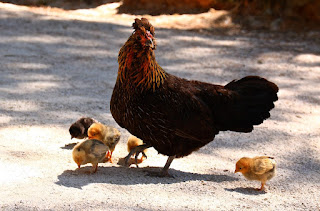
Jesus employs a second lovely image – that of a mother hen brooding and protecting her chicks. Can’t you just see these little balls of fluff, so tiny, so fragile, so vulnerable to predators?

Surely this must be how God sees us - like curious little chicks, scattering this way and that, wandering in the farmyard and even out the gate, wandering far from our mother hen, far from Jesus, far from God’s love, easy prey for foxes.

We are not so very different from the pious Jews of Jerusalem in Jesus’s time, I think.

It seems so in our nature to wander wilfully. We often ignore God’s call to love him as he loves us, and to love our neighbour as ourselves, which makes us easy prey for many evils. The evil of selfishness that hurts other people. The evil of greed that wounds the beautiful, bountiful world we have been placed in. The evil of hatred that causes war and oppression. Evil is real. We see it in the war in the Ukraine. We can see it all around us.

Many today are just as oblivious to the dangers as the pious Jews of Jesus’s day were. To them, Jesus says, ‘I tell you, you will not see me until the time comes when you say, “Blessed is the one who comes in the name of the Lord”’. When Jesus finally enters Jerusalem riding on a donkey, Luke (19:38) tells us that a multitude of his disciples greeted him in these very words. But not the pious Jews of Jerusalem.

By his life and teaching, death and resurrection, Jesus has shown his disciples – those who have seen him – that’s you and me - how to resist and defeat evil. He tells us that he will be with us always, and he sends his Holy Spirit to guide us, to be like a mother hen to us, gathering us under the shelter of her wings.

But Jesus does not give up on those who have yet to see him. He also tells us that we are to go out and make disciples of all nations, to gather all people under those protective wings. 


Tuesday, 8 March 2022

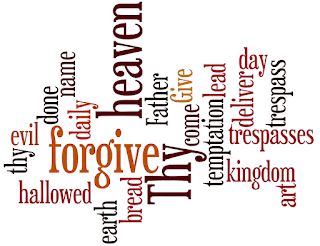
Praying the Lord's Prayer


 Reflection at Morning Worship with the Community of Brendan the Navigator on Tuesday 8th March 2020

You may find today’s reading both familiar and strangely different – it is the NRSV translation from the Greek of St Matthew’s version of the Lord’s Prayer, set for today in the common lectionary. It is deceptively simple, while at the same time encapsulating all that we ought to ask of God. I’m going to share with you some reflections upon it.

First, Jesus’s introduction makes me a bit uncomfortable because I fear I all too often ‘heap up empty phrases’ in intercessions that are too long and wordy. But I take comfort that God, our Father in heaven, ‘knows what I need before I ask him’.

Jesus taught his disciples to pray what we call the Lord’s prayer, as we continue to do whenever we come together as a Christian congregation. But there is nothing explicitly Christian about it. The Lord’s prayer can be said in good conscience by anyone who believes in a loving, almighty God, including Muslims and Jews - both Jesus and his disciples were of course Jews. Notice that Jesus calls us to pray together to ‘our Father’, not individually to ‘my Father’ – it is a prayer to be said together, not a private prayer.

When we pray ‘Our Father in heaven, hallowed be your name’, we express our reverence for the nature and character of God, who is holy, who is good and who loves all his creatures, just as an ideal father of a household loves all the members of his household. That includes you and me, but others too - not just Christians, but people of other faiths and none – and not just human beings, but all the wonderful diversity of living creatures we share our planet with, because God sees all his creation to be good.

We pray ‘Your kingdom come. Your will be done, on earth as it is in heaven’. I believe that God’s kingdom is a state of peace and justice where we and all his creatures flourish. This is not the damaged world that we see around us, beset with war, dangerous climate change, and collapsing biodiversity – that is the antithesis of God’s kingdom. But I believe we can glimpse his kingdom, even enter into a small part of it, at any time and place where we do God’s will on earth as it is done in heaven. Our prayer is an invitation to look to the future in hope.

Jesus invites us to pray ‘Give us this day our daily bread’. Notice he does not invite us to pray for more than our daily needs, and nor should we. If I greedily take all I desire, hoarding it for the future, others will likely get less than they need. We are to share what we have so that all have enough. It is ok for us to ask God for what we devoutly wish for ourselves and for others – if we can’t ask God, who can we ask? But we ought always add, ‘Nevertheless, not my will, but yours be done’, as Jesus did in the Garden of Gethsemane. The purpose of prayer is to align our wishes with God’s wishes, not to badger him into doing what we want.

‘Forgive us our debts, as we also have forgiven our debtors’. The Lord’s prayer in the BCP speaks of sins or trespasses, rather than debts. But they amount to the same thing – a failure to pay what is due, a failure of duty to God or our neighbour, a failure to do what is God’s will. Every one of us has failed many times in our duty to God or to our neighbour. I ask God to forgive my failures, but the sting in the tail is that God will forgive my failures only in proportion to my forgiving the failures of others. We must forgive to be forgiven.

Finally, we pray ‘Do not bring us to the time of trial, but rescue us from the evil one’. Our time of trial may take many forms. Someone else, even someone I love, may seek to persuade me to do what I know is wrong, what is against God’s will. Or a character flaw in myself may give evil an opening it is hard to resist. Or cruel events may make me doubt the goodness and love of God. So we ask God to spare us such trials and temptations. But when we must face them, we ask God to help us resist them, as Jesus did when Satan tempted him in the desert, as we heard in last Sunday’s Gospel reading.

Evil is real. We see it all around us in the violence humankind does to this beautiful planet. We see it in the way people exploit other people for their own ends. And we see it in the death and destruction of war. We see it in the suffering not only of the people of Ukraine, but also of misled Russian soldiers, and those whose lives are upended by sanctions, which will include many here in Ireland.

Now more than ever, we need to pray to our Father in heaven to rescue us from the evil one.

Sunday, 13 February 2022

Am I blessed, or am I cursed?

Address given at St Mary's Nenagh and Killodiernan Church on Sunday 13th January 2020, the 3rd before Lent.

There’s a lot about blessing and cursing in today’s readings, isn’t there? And that prompts me to ask myself, ‘Am I blessed or am I cursed?’

In the OT reading, Jeremiah (17:5-10), contrasts blessings for those who trust in God, with curses for those who trust in mere mortals, whose hearts turn away from God. Those who trust in God will flourish. ‘They shall be like a tree planted by water… in the year of drought it is not anxious, and it does not cease to bear fruit’. But those whose hearts turn away from God will struggle. ‘They shall be like a shrub in the desert… they shall live in parched places of the wilderness, in an uninhabited salt land’.

In the appointed psalm, Psalm 1, we see the same contrast, between the righteous who shall be ‘like a tree planted by streams of water bearing fruit in due season, with leaves that do not wither’, and the wicked who shall perish.

In the NT reading (Luke 6:17-26), Luke tells us how Jesus came down from the Judaean hills to a level place where a great crowd came to hear him and to be healed by him. Then Jesus begins to teach his disciples in what is traditionally called the ‘Sermon on the Plain’. It is a clear parallel to Jesus’s teaching in Matthew’s Gospel which is traditionally called the ‘Sermon on the Mount’. They may well be recalling one and the same event, although the details remembered by Luke and Matthew differ.

In Luke’s account, Jesus begins the ‘Sermon on the Plain’ by proclaiming four blessings, or beatitudes, and by warning of four corresponding woes. In Matthew, Jesus begins the ‘Sermon on the Mount’ by proclaiming 8 beatitudes. He leaves the corresponding woes unsaid, but perhaps implicit.

Notice that Jesus does not proclaim any curses. It is not in his nature. Woes are not curses - they are warnings. It is we who bring curses on ourselves if we ignore his warnings.

Let us look more closely at Luke’s blessings and woes.

Jesus points to those who are blessed, those who are included in the Kingdom of God. But he also warns others of the consequences of their choices in life. The paired blessings and warnings are:

·         to the poor - and to the rich;

·         to the hungry - and to the ‘full’;

·         to those who weep - and to those who laugh;

·         to those who are hated, excluded, reviled and defamed - and to those held in esteem.

Most of us here in Ireland are rich, we have more than enough to eat, we have happy lives, at least by comparison with the poor of this world. Does that mean that we cannot be included in the Kingdom of God? Surely not. But it matters what we do with our good fortune.

Jesus does not teach us that there can be no blessings for the rich. But he warns those of us who are fortunate that it matters how we respond to the needs of others who aren’t. Woe to us if we do not listen to him!

If I do not use my riches to help those in need and poverty, I bring a curse on myself. If I am so full of myself, and of my own importance, that I trample on those I see as unimportant, I bring a curse on myself. If I am so consumed by my own pleasure that I ignore those who are suffering and in distress, I bring a curse on myself. The curse that I bring on myself is loss of the blessings to be found in God’s Kingdom of justice and peace.

Jesus knew very well that the OT prophets called for social justice.

In his hometown, Nazareth, Luke tells us that Jesus in the synagogue read from the prophecy of Isaiah, ‘He has sent me to proclaim release to the captives and recovery of sight to the blind, to let the oppressed go free, to proclaim the year of the Lord’s favour.’

Jesus knew too that the powers-that-be hate, exclude, revile and defame prophets who speak out, for he experienced that himself. So he warns his disciples that this is what they must expect if they are to follow him.

We have all heard the Beatitudes so many times that we may no longer notice just how shocking and stark Jesus’s teaching is. It completely upends the conventional thinking of the worldly wise. It challenges the world view of those who hate, exclude, revile and defame others - others who are poor or weak, of the wrong gender, sexual orientation, race or religion. In our own time, anyone who stands up in public to proclaim ‘Woe to the rich’, and acts upon it, can expect to be accused of being a communist agitator. Conservative forces of society and state will turn upon them, to hate, exclude, revile and defame them. But if we are true to Jesus, these are the forces that we must be ready to withstand.

It is ultimately up to each one of us individually to answer the question, ‘Am I blessed, or am I cursed’.

But in our human frailty, we will not find the right answer by ourselves, the answer which admits us to God’s kingdom. We need God’s help, and it is right that we should pray for it.

So let me conclude in prayer with this Collect of the Word:

Righteous God,
you challenge the powers that rule this world
and you show favour to the oppressed:
instil in us a true sense of justice,
that we may discern the signs of your kingdom
and strive for right to prevail;
for the sake of Jesus Christ our Lord,
who lives and reigns with you
in the unity of the Holy Spirit,
one God, for ever and ever. Amen


Tuesday, 8 February 2022

Morning Prayer with the Community of Brendan the Navigator from Killodiernan Church on Tuesday 8th February 2022


 https://fb.watch/b2213V3I-l/

Apologies for the dodgy captions!

‘How lovely is your dwelling place, O Lord of hosts!’

·         And it is lovely, isn’t it, to be back in Killodiernan church for Morning Prayer with the Community of Brendan the Navigator this morning.

·         This little rural church is very special for those of us who are part of its accustomed congregation. We come to it Sunday by Sunday – or at least on the 2nd & 4th Sundays a month when services are scheduled. It is special because here we find blessings.

·         Here we chatter with our friends and neighbours as we gather for the service, passing on the news. We sit in our accustomed pews, and remember those who have gone before us.

·         Here we listen to the Word in scripture, and hear it preached. And when words bore us, we look through the windows, contemplating the trees as they change, season by season.

·         Here we are led in prayer for our needs and the needs of the world, and we sing together when we’re allowed to do so.

·         Here we greet our neighbours in the Peace. We eat with them the bread which earth has given and human hands have made, and - when not prevented by Covid – we drink the wine, fruit of the vine and work of human hands. In the great sacramental mystery, we do so in remembrance of our Lord Jesus Christ, whose body and blood it signifies.

·         Here, after the service, we chat some more - and if the weather is clement, we linger outside to admire the handiwork of God in the everchanging sward of wildflowers in the graveyard.

·         ‘Here (our) heart and (our) flesh rejoice in the living God’, as the psalmist says.


The psalmist declares: ‘The sparrow has found her a house and the swallow a nest where she may lay her young: at your altars, O Lord of hosts.’

·         I don’t know about sparrows and swallows, but the bats are back in the roof of Killodiernan church – to my delight, I have recently noticed traces of them once again. They always used to be here, but sadly left after the roof was replaced some years ago, despite the best endeavours of the builders not to disturb them.

·         Yet we must not think that God can ever be constrained to a building, for all the delight we take in our churches, and for all the encounters we have with God in them. God is present everywhere, all the time, not just in this building on Sundays.  God’s altars are to be found everywhere.

·         Much of the time, in our busyness, we do not feel God’s presence, nor notice his altars. But God and his altars are all around us. All we need to do is to stop rushing and still our racing thoughts for a moment, then we can feel God’s presence and see his altars.

·         It may be when we pause our work for a cuppa. It may be when we hear the Angelus bell. It may be when we look up to see a magnificent view, or look down to identify a tiny flower. It may be when we sit down to a meal prepared with care and love.

·         We ought to practice seeking out such moments, focus our attention on being a doorkeeper in God’s house which is the universe all around us, and spend time in the loving presence of our God.

·         Then with the Psalmist we can sing, ‘Blessed are (we) who dwell in your house: (we) will always be praising you’.


Tuesday, 11 January 2022

Morning prayer with the Community of Brendan the Navigator on Tuesday 11th January 2022

 https://fb.watch/at9-E3NBd6/ 

Today, many of us are feeling afraid of what can seem like a threatening, dangerous future. It would be very easy to let ourselves be overwhelmed by pessimism, to feel the future is hopeless. But that would immobilise us. It would prevent us from responding to the real dangers we face. And it would make the bad outcomes we dread more likely.

That is not how we as Christians are called to behave. The future is not hopeless. God has given us a great gift of hope, hope for the coming of God’s kingdom. And surely we must share this gift of hope with others, who may not share our faith, but badly need our hope.

The ground of our hope is our conviction that God loves us.

Nowhere is this more beautifully expressed than in today’s reading from Isaiah (Isaiah 43:1-7). Scholars tell us that this passage was probably written around 540BC. The children of Israel are in captivity in Babylon. They are afraid for their future, on the verge of giving up hope that they would ever be able to return to their homeland. So the poet seeks to encourage them in these words:

‘But now thus says the Lord, he who created you, O Jacob, he who formed you, O Israel:

Do not fear, for I have redeemed you; I have called you by name, you are mine. When you pass through the waters, I will be with you; and through the rivers, they shall not overwhelm you; when you walk through fire you shall not be burned, and the flame shall not consume you.’

And why should the captive children of Israel not fear?

‘Because you are precious in my sight, and honoured, and I love you.

These are beautiful, encouraging and reassuring words, aren’t they?

Do not fear … because you are precious in my sight, and honoured, and I love you’.

Now Isaiah and the ancient Hebrews saw God’s love in exclusive terms: God loved the children of Israel in a special way; they were God’s chosen people, with whom God had established a covenant.

The very first Christians, and Jesus Christ himself, were Jews. They drew on that ancient Hebrew tradition, and we have inherited their conviction that God loves us, and with it God’s gift of hope – thanks be to God for the insight of the Jewish people!

But from the very start, with a fresh insight, Christians transformed the conviction of God’s love from being exclusive to being inclusive. We believe as Christians that God loves all people created in his image, not just Jews but gentiles like you and me, not just white people but people of all colours and ethnic origins, not just those who are like us but those we find alien.

This Epiphany season is traditionally a time to reflect on how God reveals himself to us.

So let us ponder God’s loving nature, revealed in Isaiah’s beautiful poetry: Thus says the Lord…, ‘Do not fear … because you are precious in my sight, and honoured, and I love you’.

Let us give thanks for the insight which we have inherited from the ancient Hebrews and the first Christians, that God loves us. The implications are life-changing:

·       Because we believe that God loves us, we live in hope.

·       Because we live in hope, we do not fear the future, no matter how dangerous it may seem.

·       Because we do not fear the future, we have the confidence to work for God’s kingdom.

All this poses a great question to each one of us – and to us all as a body, Christ’s body, the Church. The question is this: What am I going to do, what are we going to do, to make God’s kingdom a living reality?


Sunday, 9 January 2022

Do Not Fear!

Address given at St Mary's, Nenagh and Killodiernan church on Sunday 9th January 2022, the 1st after Epiphany, year C

‘Be afraid. Be very afraid’

I’m sure you’ve heard this popular catch-phrase – it’s used to warn us that something dire is about to happen, in a menacing but slightly jokey way. But do you know where it comes from? It’s from the 1986 remake of the science-fiction horror movie The Fly, in which a mad scientist experimenting with a matter transporter mixes up his DNA with a fly’s, and gradually changes into a horrific creature, half-man and half-fly.

Today, many of us really are feeling afraid, very afraid, about what can seem like a threatening, dangerous future.

  • Think illness and death – due to novel viruses, and growing antibiotic resistance.
  • Think rising sea levels, droughts, and floods - due to catastrophic climate change.
  • Think famine and wars - due to declining soil fertility, water shortage, rising population - and the evil in human hearts that causes us to hate others.

 It would be very easy to let ourselves be overwhelmed by pessimism, to feel the future is hopeless. But that would immobilise us. It would prevent us from responding to the real dangers we face. And it would make the bad outcomes we dread more likely.

That is not how we as Christians are called to behave. The future is not hopeless. God has given us a great gift of hope, hope for the coming of God’s kingdom. And surely we must share this gift of hope with others, who may not share our faith, but badly need our hope.

The ground of our hope is our conviction that God loves us.

This is at the heart of the good news that Jesus preached. But its roots go back much further. The OT tells the story of how over hundreds of years the children of Israel gradually came to understand that God - the terrifying mighty creator - also loves his people. As Psalm 29 which we have just read puts it, the God whose voice ‘breaks the cedar trees’, ‘shakes the wilderness’ and ‘makes the oak trees writhe and strips the forest bare’, is also the God that ‘shall give strength to his people’ and ‘shall give his people the blessing of peace’.

Nowhere is this more beautifully expressed than in today’s 1st reading from Isaiah (Isaiah 43:1-7). Scholars tell us that this passage was probably written around 540BC. The children of Israel are in captivity in Babylon. They are afraid for their future, on the verge of giving up hope that they would ever be able to return to their homeland. So the poet seeks to encourage them in these words:

‘But now thus says the Lord, he who created you, O Jacob, he who formed you, O Israel:

Do not fear, for I have redeemed you; I have called you by name, you are mine. When you pass through the waters, I will be with you; and through the rivers, they shall not overwhelm you; when you walk through fire you shall not be burned, and the flame shall not consume you.’

And why should the captive children of Israel not fear?

‘Because you are precious in my sight, and honoured, and I love you.

These are beautiful, encouraging and reassuring words, aren’t they?

‘Do not fear … because you are precious in my sight, and honoured, and I love you’.

500 years later the Jews of Jesus’s time were utterly convinced that God loved them and this gave them hope for the future, even though their country had been conquered and occupied by the Romans. They believed that God loved the Jewish people, the children of Israel, in a special way; they were God’s chosen people, with whom God had established a covenant; and they lived in hope for the coming of a promised Messiah, the anointed one of God, who would restore the fortunes of his chosen people.

This is the background to Luke’s account of Jesus’s baptism by John in our 3rd reading (Luke 3:15-17, 21-22), in which God marks Jesus out as the Messiah. God as a loving Father sends the Holy Spirit in the form of a dove, and says, ‘You are my son, the beloved; with you I am well pleased’, in an echo of Isaiah’s words. It is the only place in the Bible where we encounter all 3 persons of the Trinity at the same time – God the Father, God the Son and God the Holy Spirit.

Jesus himself and the first Christians were Jews, and we have inherited their Jewish conviction that God loves us, and with it, God’s gift of hope – thanks be to God for the insight of the Jewish people!

With a fresh insight, Christians came to believe that God loves all people created in his image, not just Jews but gentiles like you and me, not just white people but people of all colours and ethnic origins, not just those who are like us but those we find alien.

In this I feel sure we follow Jesus himself. But it is interesting to notice how Jesus’s own self-understanding developed over the course of his ministry. Matthew’s Gospel records him telling the Canaanite woman ‘I was sent only to the lost sheep of the house of Israel’ (Matt 15:24); but by the end of the same Gospel he would say to his disciples, ‘Go therefore and make disciples of all nations’ (Matt 28:19).

The Epiphany season is traditionally a time to reflect on how God reveals his nature to us.

So, I invite you to ponder God’s loving nature, revealed in Isaiah’s beautiful poetry:

Thus says the Lord…, ‘Do not fear … because you are precious in my sight, and honoured, and I love you’.

Let us give thanks for the insight which we have inherited from the ancient Hebrews and the first Christians, that God loves all his people.

The implications are life-changing:

·       Because we believe that God loves us, we live in hope.

·       Because we live in hope, we do not fear the future, no matter how dangerous it may seem.

·       Because we do not fear the future, we have the confidence to work for God’s kingdom.

All this poses a great question to each one of us – and to us all as a body, Christ’s body, the Church. The question is this: What am I, what are we, going to do to make God’s kingdom a living reality?

I shall finish with a Collect of the Word

Spirit of energy and change,
in whose power Jesus was anointed
to be the hope of the nations:
be poured out also upon us
without reserve or distinction,
that we may have confidence and strength
to implant your justice on the earth;
through Jesus Christ our Lord, Amen