Sunday, 14 January 2024

Who does God want you to be?


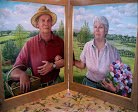
Eli and Samuel by John Singleton Copley, 1780

Address given at St Mary's Nenagh and Killodiernan Church on Sunday 14th January 2024, the 2nd of Epiphany

Today’s readings are mostly about people hearing God’s call and how they respond to it.

I believe that God calls each and every one of us to be the person he means us to be. But how can we be sure that a voice we hear is truly God’s voice? And how can we be sure what he is calling us to be and to do? The technical word for this is ‘discernment’, and discernment is difficult. Most of the time, in our busyness, wrapped up in our own thoughts and desires, we may not even hear God’s voice. If we do, it is often so much easier to ignore it. And sometimes what he asks of us seems so difficult that we try to run away from it.

Today I’m going to reflect a little on the readings, because I think they can help us get to grips with the problem of discernment.

In the OT reading (1Samuel 3:1-10, 11-20) Samuel hears God calling to him.

You may remember that Samuel’s parents Hannah and Elkanah had dedicated him to God as a child, and left him in the guardianship of Eli, the priest at the pilgrimage shrine of Shiloh.

The boy Samuel is confused when he hears God’s call. Three times he hears a voice calling his name. He thinks it is Eli calling for him, but it is not. At last Eli realises the voice Samuel is hearing must be from God. He prompts Samuel to respond, ‘Speak, Lord, for your servant is listening’ – only then can Samuel open himself to God and understand his vocation. He will grow up to be a great prophet and a leader of Israel.

Notice Eli’s role in the story, helping Samuel to understand what is going on. When we are trying to discern what God is saying to us, we often need someone else to encourage, support and guide us, to enable our discernment.

I have experienced this personally. I began to ask myself whether I should offer myself to lead worship, at a time when otherwise there would be no one to lead services. I had watched a diocesan reader I admired and trusted do so. But it was not until a priest recognised that God was calling me, and encouraged and guided me, that I could begin to understand my call to diocesan reader ministry. Fostering discernment is an important role in ministry.

Psalm 139 marvels at how completely God knows and understands us.

In beautiful poetry the psalmist tells us that God comprehends us completely, we cannot escape him, even if we wish we could. This is because God has made us: ‘I thank you for I am fearfully and wonderfully made’, says the psalmist.

Indeed, we are fearfully and wonderfully made. We have been made as souls with conscience and intelligence, capable of love, able to tell good from evil, truth from lies, beauty from ugliness. And it is these innate capacities which enable us to hear God’s call and discern what it is he wants of us.

In the Gospel reading (John 1:43-51) Jesus calls Philip and Nathanael to follow him.

Notice that Jesus calls Philip directly, but it is Philip who then invites his friend Nathanael to meet Jesus. This is the way that many disciples of Jesus were made at the very beginning, by one disciple passing on Jesus’s call to follow him to another. And it is the way that disciples have been made ever since.

Notice also how Nathanael initially resists the call from Jesus, passed on by Philip.  ‘Can anything good come out of Nazareth?’, he asks cynically. I suppose the rivalry between Bethsaida and Nazareth must have been a bit like that between Tipperary and Kilkenny in the hurling! It is only when Nathanael accepts his friend Philip’s invitation to ‘come and see’, and spends time in conversation with Jesus, that he gives in, finally confessing, ‘Rabbi, you are the Son of God’.

How like the way that many of us try to evade God’s call when it comes! But God does not give up on us – he knows us from the inside out, and he will not let go of us easily if he wants us for a purpose.

Philip goes on to be a great apostle, the first apostle to the gentiles, even before St Paul took on the role. Acts tells us that he was the first to bring Samaritans into the Church, and he goes on to baptise an Ethiopian court official. But what of Nathanael? We hear nothing else about him in the Bible - though perhaps he is the same as Nathanael of Cana to whom Jesus appeared at the Sea of Galilee after the Resurrection. We do know that Nathanael responded to Jesus’s call. As Jesus promised, he must have seen ‘heaven opened and the angels of God ascending and descending’. But God calls only a few to great things, and Nathanael may not have been one of them.

I said at the start, I believe God calls every one of us to be the person he means us to be.

There may be some here who are called to be priests, or perhaps even bishops – maybe even prophets or apostles, God help us! But almost all of us are called to much more modest things in ordinary places. Yet these too are things which God needs us for in order to build his Kingdom of peace and justice.

They may be official jobs in the church, jobs like being a church warden, or serving on select vestry. Or they may be specific ministries in the parish - there are so many, aren’t there? - reading, singing, church cleaning, washing linen, helping with flowers or refreshments after services – even volunteering for the Christmas tree festival! God calls different people at different times to different ministries to build up Christ’s body, the Church, to continue his ministry in the world.

But just as important there are tasks of service to others in the secular world. Tasks like being a carer, teaching children, healing the sick as doctors or nurses. Tasks that build and protect community, or conserve the beautiful planet we have been given. Tasks that feed the bodies and nourish the spirits of our neighbours. God needs people who will carry out all these tasks, and so many others, to build his Kingdom.

I suggest that each and every one of us should ask ourselves these questions: How has God called me? and How have I responded? We should do so often, because who it is God wants us to be, and what he wants us to do, is ever changing through the course of our lives. The beginning of a new year is a good time to do so.

And we should pray that God’s Holy Spirit will help us to discern what he wants of us. Because it is precisely when we respond to God’s call, that like Nathanael we will see ‘heaven opened and the angels of God ascending and descending’ and experience the joy of his Kingdom.

Let me finish in prayer with a Collect of the Word

Eternal God,
whose Son, Jesus Christ, is now exalted as lord of all,
and pours out his gifts upon the Church:
grant it that unity which only your Spirit can give,
keep us in the bond of peace,
and bring all creation to worship before your throne;
through Jesus Christ our Redeemer,
who lives and reigns with you in the unity of the Holy Spirit,
one God, for ever and ever. Amen

Monday, 8 January 2024

Reflection for Epiphany on Matthew 2:1-12


Reflection at Morning Worship with the Community of Brendan the Navigator on Tuesday 9th January 2024

Matthew’s Wise Men from the East are on a quest, following a star. In a quest, heroes follow a long, hard and dangerous journey to find an object of great value before returning home. The Wise Men are learned astronomers, who have come to pay homage to the king of the Jews, because they ‘observed his star at its rising’, we’re told. The learned chief priests and scribes of Jerusalem direct them to Bethlehem. The star leads them there, to the Christ-child with Mary his mother.

At the culmination of their quest, they are overwhelmed with joy. They kneel in homage and present their gifts, signifying that the royal king they seek is in fact this baby. Now that’s amazing, isn’t it? They have travelled so far, suffered such hardships, to find what? A tiny, vulnerable, human child, just like so many they could have found without stirring from home!

After finding what they seek, the Wise Men return home – the proper end of any quest. Matthew does not tell us what they made of it. But in his poem ‘The Journey of the Magi’, T S Eliot imagines the response of one of them, years later in old age. I can do no better for a reflection than read it to you.

Journey of the Magi, T. S. Eliot

‘A cold coming we had of it,
Just the worst time of the year
For a journey, and such a long journey:
The ways deep and the weather sharp,
The very dead of winter.’
And the camels galled, sore-footed, refractory,
Lying down in the melting snow.
There were times we regretted
The summer palaces on slopes, the terraces,
And the silken girls bringing sherbet.
Then the camel men cursing and grumbling
And running away, and wanting their liquor and women,
And the night-fires going out, and the lack of shelters,
And the cities hostile and the towns unfriendly
And the villages dirty and charging high prices:
A hard time we had of it.
At the end we preferred to travel all night,
Sleeping in snatches,
With the voices singing in our ears, saying
That this was all folly.

Then at dawn we came down to a temperate valley,
Wet, below the snow line, smelling of vegetation;
With a running stream and a water-mill beating the darkness,
And three trees on the low sky,
And an old white horse galloped away in the meadow.
Then we came to a tavern with vine-leaves over the lintel,
Six hands at an open door dicing for pieces of silver,
And feet kicking the empty wine-skins,
But there was no information, and so we continued
And arrived at evening, not a moment too soon
Finding the place; it was (you may say) satisfactory.

All this was a long time ago, I remember,
And I would do it again, but set down
This set down
This: were we led all that way for
Birth or Death? There was a Birth, certainly,
We had evidence and no doubt. I had seen birth and death,
But had thought they were different; this Birth was
Hard and bitter agony for us, like Death, our death.
We returned to our places, these Kingdoms,
But no longer at ease here, in the old dispensation,
With an alien people clutching their gods.
I should be glad of another death.

I am sure we are to take Matthew’s story as fable, not history. The great truth buried in it is this, I believe - the Wise Men’s quest is our quest too. The light of the star represents all that is good and true and beautiful, all that is worthy of God. If we have the tenacity they had, to follow the light of their star, like them we will find that baby, who is, as St John puts it, ‘the true light, which enlightens everyone’. And like the aged Wise Man, what we have found will change us, we will no longer be at ease with the ways of the world we knew before, the old dispensation.

Sunday, 31 December 2023

Shepherds glorifying God

Adoration of the Shepherds, Annibale Carracci 1560-1609

Address given at Killodiernan Church on Sunday 31st December 2023, the 1st of Christmas

“Let us go now to Bethlehem and see this thing which has taken place, which the Lord has made known to us”.

So say the shepherds who were keeping watch over the flock in fields close to the town, as St Luke tells us in the Gospel reading (Luke2:15-21).

Luke’s is the only Gospel to tell us about the shepherds who visited Mary and Joseph and their new-born son Jesus. His beautiful story, so familiar to us, still resonates today. So let’s try to imagine ourselves in the shoes of the shepherds that night 2000 years ago.

Some of you I’m sure know much more than I do about sheep. Perhaps you’ve kept and tended them. But I doubt if any of you would call yourselves shepherds. Shepherds are few and far between in Ireland these days - but they would have been very familiar to Luke’s readers. The rugged Judean uplands were a pastoral country. Flocks of sheep represented wealth. A shepherd was paid to stay out night and day in all weathers to guard the sheep against wild animals and robbers. It was a hard, dangerous job, but very responsible. Jesus likens himself to the Good Shepherd, who would lay down his life for the sheep.

Luke’s shepherds are ordinary people, much like you and me. They are not self-important rulers or highly educated opinion formers, as Herod and the Wise Men were, in Matthew’s alternative Christmas story. Luke chooses to tell us about how ordinary people responded to the miracle of Christmas, not the great and mighty. And we have much to learn from them.

The shepherds had just experienced a miraculous vision, a vision of angels.

‘The glory of the Lord shone around them’ – I imagine shimmering light, like the Northern lights. An angel announces, ‘To you is born this day in the city of David’ – that is Bethlehem – ‘a Saviour, who is the Messiah, the Lord.’  They are given a sign; they ‘will find a child wrapped in bands of cloth and lying in a manger’. Then the angel is joined by ‘a multitude of the heavenly host, praising God and saying “Glory to God in the highest heaven, and on earth peace among those whom he favours”’

Wow! What an experience! What an exhilarating joy the shepherds must have felt!

Have you ever heard the heavenly host? I have, I think, and you may have too. I can remember my joy and exhilaration after the births of my twin girls. I can remember literally skipping down the wet deserted streets of Guildford at 4am in mid December, on the way back home from the hospital. It was as if the whole universe was laughing and crying and singing with me. And I shared my joy with everyone I met over the following days. Angel voices, indeed – a memory to treasure!

Surely it is an experience of this same kind that Isaiah speaks of in today’s OT reading (Isaiah 61:10-62:3), when he says:

I will greatly rejoice in the Lord,
   my whole being shall exult in my God;
for he has clothed me with the garments of salvation,
   he has covered me with the robe of righteousness,
as a bridegroom decks himself with a garland,
   and as a bride adorns herself with her jewels.

Most if not all of us, ordinary people, experience once in a while that sudden rush of exhilarating joy, as both Isaiah and the shepherds did. It is not just poets and the mad who experience visions of angels. We should not be afraid of them, I think. Rather we should see it as God granting us a glimpse, just a fleeting glimpse, of his loving power and majesty. We should treasure such experiences when we return to the world of normality, and ponder them in our hearts, as Mary did.

The shepherds ‘went with haste and found Mary and Joseph, and the child lying in a manger’.

These shepherds are straight-forward, practical people. They don’t stand around debating and philosophising about what their extraordinary experience means. They go with haste to look with their own eyes. And what they find confirms their experience – it is just as the angel had told them. This little child is special, very special - a Saviour, a Messiah, the Lord. And they can’t stop talking about it! Just as I couldn’t stop telling everyone about the birth of my children.

The real miracle of Christmas is that through his grace our loving Father God makes the first move towards us, to you and me, to all people. He reveals himself to us as Mary and Joseph’s beautiful, helpless baby, their first-born son. This baby grows up to be our Lord Jesus Christ – in St John’s mystic vision, the Word of God, the true light that enlightens everyone – through whose life and teaching, and death and resurrection, we are shown the way to God.

But God’s grace is of no use to us unless we respond to it. We should learn from the shepherds how to respond to the miracle of Christmas. They went with haste to find Jesus, and we must too. Like them, we will not be disappointed.

‘The shepherds returned, glorifying and praising God for all they had heard and seen.’

They don’t hang about. Once they have seen the child Jesus lying in the manger – the Saviour, the Messiah, the Lord – and told their story, they just go back to work, to tend their flocks.

But something has changed - they are changed. They go back ‘glorifying and praising God for all that they had heard and seen.’

And this surely is what we must do too. We are not meant to remain for ever in our visions, no matter how exhilarating they may be. We must come back to earth. Our job is to bring our experience of the love of God back into the everyday world. Let us pray that we too may go about the world as changed people, glorifying and praising God for all we have heard and seen.

So we have indeed a great deal to learn from Luke’s shepherds:

  • We should treasure the glimpses we are granted of the love and majesty of our loving Father God.
  • We should go with haste to find God’s grace in the Christmas miracle of the birth of Jesus.
  • And we should return as changed people to bring God’s loving Spirit out into the world.

Let me finish in prayer with a Collect of the Word

Saving God,
whose Son Jesus was presented in the temple
and was acclaimed the glory of Israel
and the light to the nations:
grant that in him we may be presented to you
and in the world may reflect his glory;
who lives and reigns with you in the unity of the Holy Spirit,
one God, now and for ever. Amen

Tuesday, 12 December 2023

The birth of the universal church

Peter's dream, by Domenico Fetti

Reflection at morning worship with the Community of Brendan the Navigator on 12th December 2023

Today’s reading (Acts 11:1-18) records one of the most important moments in the life of the earliest church, the moment when it began to move from being a purely Jewish sect to being a church which accepted Gentiles as full members. In this moment we witness the birth of the Church Catholic – the universal Church.

In the paragraphs before today’s reading, the author of Acts tells us how Peter had come to associate with Gentiles in Caesarea.

Peter had an extraordinary dream while he was visiting disciples in Joppa, now a suburb of Tel Aviv in Israel. He heard a voice commanding him to kill and eat animals which as a Jew he had been taught to believe were unclean – they disgusted him, they were taboo. And a voice from heaven declared to him, ‘What God has made clean, you must not call profane’. We have our own food taboos in Ireland today. Most people are horrified at the thought of eating horse-meat. But I tried it once in the Netherlands, and I can confirm it is delicious.

Just as Peter was processing this shocking dream, three men arrived at the door asking for him. They had been sent by a Roman Centurion called Cornelius, a pious and God-fearing gentile, who asked Peter to come with them to visit him in Caesarea, about a day’s walk away. Peter felt the Holy Spirit urging him to agree, so the next day he went to see Cornelius. But we should notice that he took the precaution of bringing 6 witnesses along too. Under Jewish tradition if seven people give the same testimony it must be accepted as true.

When Peter arrived at Cornelius’s house, he tells him and the assembled household, ‘You yourselves know that it is unlawful for a Jew to associate with or to visit a Gentile; but God has shown me that I should not call anyone profane or unclean. So when I was sent for, I came without objection’. Clearly Peter has been reflecting on the meaning of his strange vision, as we walked to Caesarea.

Cornelius tells Peter, ‘All of us are here in the presence of God to listen to all that the Lord has commanded you to say’. Peter replies, ‘I truly understand that God shows no partiality, but in every nation anyone who fears him and does what is right is acceptable to him’. And he goes on to proclaim the Gospel to Cornelius’s household.

Cornelius and his household receive Peter’s teaching with great joy. We are told that Peter and his 6 witnesses were amazed at their response. They could see that these Gentiles had received the gift of the Holy Spirit, which they had all received at Pentecost. Seizing the moment, ‘(Peter) ordered them to be baptised in the name of Jesus Christ’.

Now we pick up the story in today’s reading.

When Peter got back to Jerusalem, news of his visit to Cornelius had arrived before him. The Jewish Christians were outraged that Peter had consorted with gentiles, in breach of Jewish law and tradition – and he had even gone so far as to have them baptised. ‘Why’, they ask him, ‘did you go to uncircumcised men and eat with them?’.

Peter then, in front of his 6 witnesses, tells them the whole story we have heard. He concludes saying, ‘If then God gave (Cornelius and his household) the same gift he gave us when we believed in the Lord Jesus Christ, who was I that I could hinder God?’. The critics are silenced, and they praise God, saying, ‘Then God has given even to the Gentiles the repentance that leads to life’.

Let us praise God with the Jewish Church in Jerusalem, because God has given to us as well, as Gentiles, the repentance that leads to life!

Sunday, 10 December 2023

Make Straight the Way

Address given at St Mary's Nenagh and Killodiernan on Sunday 10th December 2023, the 2nd of Advent

Let’s listen again to the prophet Isaiah’s beautiful, poetic words in the 1st reading (Isaiah: 40:1-11):

A voice cries out:
In the wilderness prepare the way of the Lord,
make straight in the desert a highway for our God.
Every valley shall be lifted up,
and every mountain and hill be made low;
the uneven ground shall become level,
and the rough places a plain.

Now, we know a good deal about making highways around here – just think of the building of the M7 motorway some years ago, and the building today of the Killaloe bypass and the new Shannon bridge – I believe the first span was completed in the last week. Isaiah’s words could almost be an anthem for the National Roads Authority! Great cuttings have been blasted through the hills. Giant machines have moved the spoil to make embankments. Bridges have been built over rivers. All to make the road as gentle and smooth as possible.

Road building would not have been so vast in Isaiah’s time, but it would still have been a gigantic community enterprise to make the roads to allow farmers to transport their produce on pack-mules to market in Jerusalem, and to allow pilgrims to travel to the temple on Mount Zion. The roads knit together the Jewish people in the cities of Judah to their holy mountain of Zion, not just in a material way, but also in metaphor as a worshiping community. 

I feel sure that for Isaiah the way of the Lord was not a road for God to travel to his people on, but a road for his people to travel to God on.

Then the glory of the Lord shall be revealed,
and all people shall see it together,
for the mouth of the Lord has spoken.

In our 3rd reading, in the very first words of his Gospel (Mark:1:1-8), St Mark recycles this road building metaphor.

John the Baptist is a wild man, wandering about the Judean desert, clothed in camel’s hair, with only a leather bag at his waist, who ate locusts and wild honey, we are told – the very image of an Old Testament prophet! Mark quotes Isaiah to identify him as: The voice of one crying out in the wilderness: ‘Prepare the way of the Lord, make his paths straight.’ He is the fulfilment of the hope expressed by Isaiah.

John proclaims a baptism of repentance for the forgiveness of sins’. And he is very successful to judge by the crowds he gathers. But John is also the self-effacing herald of the coming of another. Claiming no special position for himself, he says: ‘The one who is more powerful than I is coming after me; I am not worthy to stoop down and untie the thong of his sandals.’ He means Jesus of course. And John continues I have baptised you with water; but he will baptise you with the Holy Spirit.’

When preparing this address, I asked myself, ‘Why have the compilers of the Lectionary chosen this reading for today?’. John’s message of repentance and forgiveness for sin might seem at first sight out of place in this Advent season. In Advent we look forward to Christmas and the great gift that God has given us. God comes to us. He comes in the form of a little child. His parents Mary and Joseph name him Jesus. We rejoice with them at the miracle of his birth. With angels and shepherds and kings we adore him. And we believe he grows up to lead us to God through his loving self-sacrifice. So why spoil all the joy with dismal repentance for sin?

I think the answer lies in the metaphor of road building. 

Yes, God makes the first move. Yes, God comes to us in the person of Jesus. But he does not force himself on us. He does not compel us to accept his love. He made us with free will, and we are free to refuse him. But we cannot share in his kingdom unless we make a move in response. That essential move is like building a road to travel on towards God. Each one of us must ‘prepare the way of the Lord’ and ‘make his paths straight’. And to do so we must each accept John’s baptism for ourselves. We must admit our own sins, we must seek God’s forgiveness, and we must undergo a change of heart to follow God’s way in future. Because that is what repentance means.

So, to sum up:

By the readings they have chosen for us, the compilers of the Lectionary have tried to correct any tendency we may have to be over sentimental in our anticipation of Christmas.

Yes of course we should look forward with joy to Christmas. Let us wonder at the miracle of Mary’s tiny helpless baby. Let us enjoy the stories of the shepherds and the three kings. And let us sing our hearts out with the angels in the beautiful carols we all love so much.

But let us also reflect on this. The love God shows us at Christmas is no use to us - no use at all - unless we choose to act in response, to build a good smooth road on which we may travel to God. John the Baptist has shown us the way by proclaiming his baptism of repentance for the forgiveness of sins. All we need do is to commit ourselves to that baptism, and to build the road.

I finish in prayer with a Collect of the Word:

Merciful God,
you sent your messengers the prophets
to preach repentance and prepare the way for our salvation:
give us grace to heed their warnings and forsake our sins,
that we may greet with joy
the coming of Jesus Christ our Redeemer,
who lives and reigns with you and the Holy Spirit,
one God, now and for ever. Amen


Monday, 27 November 2023

Of sheep and goats

Mozaic of the Last Judgement, Ravenna

Address given at St Mary's Nenagh and Killodiernan church on Sunday 26th November 2023, Christ the King

Am I like a sheep or am I like a goat?

We have just heard Jesus’s vivid and memorable parable of the sheep and the goats from Matthew’s Gospel (Matthew 25:31-46), told privately to his disciples. It prompts me to ask myself this question, as it should each and every one of us, I suggest.

The main message of the parable is clear, isn’t it? God judges each one of us – me and you – according to how we respond to the needs of others. Some will be found to be righteous and go into eternal life. Others will not, and they will go into eternal punishment. Let’s delve into it a bit.

In NT times in the Holy Land, sheep and goats were kept in mixed flocks, as they still are.

But it was sometimes necessary to separate them into their kinds. At shearing time for instance. Or at the approach of hard weather – sheep are hardier than goats and can be left to graze over winter in the uplands, but goats must be brought down and folded in the shelter of the valley. Or to manage grazing – sheep eat only low growing herbs while goats will eat the leaves of bushes so that when forage of one kind is running out the appropriate animals must be moved to other grazing.

This image of separating sheep and goats would have been very familiar to those Jesus was talking to. He uses it as a metaphor for how people can be divided into two kinds. ‘When the Son of Man comes in his glory’, says Jesus, ‘… he will separate people one from another as a shepherd separates the sheep from the goats, and he will put the sheep at his right hand and the goats at the left’.

Those that are righteous will be blessed by God and receive everlasting life, and those that are not will be accursed and receive eternal punishment. ‘Then the king will say to those at his right hand, “Come, you that are blessed by my Father, inherit the kingdom prepared for you from the foundation of the world”, and ‘he will say to those at his left hand, “You that are accursed, depart from me into the eternal fire prepared for the devil and his angels”’.

The test for whether a person is righteous or not – to be blessed or accursed - is how he or she responds to the needs of those they encounter. The king tells those who are blessed, “I was hungry and you gave me food, I was thirsty and you gave me something to drink, I was a stranger and you welcomed me, I was naked and you gave me clothing, I was sick and you took care of me, I was in prison and you visited me”. He tells those who are accursed that they did none of these things.

And when both kinds of people express surprise because they did not recognise him, the king tells them, “Truly I tell you, just as you did it to one of the least of these who are members of my family, you did it to me”.

Jesus confronts those who hear him, then and now, with this great truth. To help those in need is to help him, the Son of Man. Not to help them is to deny him help.

And we can all do our bit to help them. Notice that the help Jesus talks about is not in great world-changing things, things that can only be done by those with great wealth and power. It is in little everyday things we are all capable of – feeding the hungry and thirsty, welcoming strangers, clothing the ill-clad, caring for the sick, visiting those who are lonely.

We know we are made in the image of God, our loving Father. And it is our duty to help our fellow human beings who are his children too, when they are in trouble, need, sickness or any other adversity. Why? Because, like us, they too are brothers and sisters of Jesus Christ the King, the Son of God.

There is also something else we should take away from this reading.

The promise of eternal life for the righteous is not reserved just for those of us who profess to be followers of Jesus Christ.

All the nations will be gathered before (the Son of Man), and he will separate people one from another as a shepherd separates the sheep from the goats.’, says Jesus. That includes not just Christians, but also Muslims and Jews, Sikhs and Hindus, people of other faiths, and people with no faith at all. All of them are subject to the same judgement. Have they tended to the needs of their fellow human beings, ‘the least of those who are members of (God’s) family?’.

Those that have, whatever their faith or lack of it, are blessed. They will inherit eternal life. We must recognise them for what they are, ‘people of good will’, with whom we must work to make this world more like the world God wants it to be. We must never see them as enemies.

And this should be a comfort to those of us with children, family and friends who do not profess our faith, but whom we love and know to be good, and caring people. They are just as likely to be judged worthy of eternal life as we are.

So, what of the question I began with? Am I like a sheep or am I like a goat?

I feel sure that I am a bit of both – we all are, I suggest. Sometimes, helped by the example of Jesus himself, I behave as I ought to behave and do my best to respond to the needs of others. But I know that on other occasions I miss the opportunities I am given to do so, I fail the test, and Jesus weeps.

But I trust in God’s fatherly lovingkindness. I believe that when I repent of my failures, he will forgive me, as Jesus promises. And I pray in the words of today’s Collect of the Word:

Eternal God,
you exalted Jesus Christ to rule over all things,
and have made us instruments of his kingdom:
by your Spirit empower us to love the unloved,
and to minister to all in need,
then at the last bring us to your eternal realm
where we may be welcomed into your everlasting joy
and may worship and adore you for ever:
through Jesus Christ our Lord,
who lives and reigns with you
in the unity of the Holy Spirit,
one God, for ever and ever. Amen

Tuesday, 14 November 2023

A reflection on mortality (Wisdom 2:23-3:9)


Reflection for Morning Worship withn the Community of Brendan the Navigator on Tuesday 14th November 2023

In this season of remembrance, we remember those who have died – the saints who have gone before us, and our loved ones departed. We also remember those who have suffered and died in cruel wars. This year we see again the hatred and cruelty of war, as generations of our ancestors did before us. We watch in horror the hideous death and destruction in Israel and Gaza, and the continuing ugly, grinding conflict in Ukraine.

But we are also prompted to reflect on our own death, which we know will come to us all.

The reading we have just heard from Wisdom (2:23-3:9) contrasts the world-view of the foolish – those who do not trust in God and his love for us – with the world-view of those of us who do. It is a reading recommended in our BCP for funerals, but I think rarely used.

For the foolish, death is a disaster. The dead are gone. They decompose. Their loves and their lives are meaningless. Their sufferings are worthless afflictions, leading to annihilation. Ultimately there is nothing for the foolish to look forward to.

But for we who trust in the love of God, it is different. We perceive, as Wisdom has it, that ‘the souls of the righteous are in the hand of God and no torment will ever touch them’. Even as they suffer, ‘their hope is full of immortality’. Their trials, ‘like gold in the furnace’ will become a blessing. The good they have done in their lives, the love they have shown us, will reverberate after their deaths - ‘in the time of their visitation they will shine forth, and will run like sparks through the stubble’. We understand the truth that at the end we will abide eternally with God, who will watch over us in his grace and mercy.

When the foolish mock us, saying, ‘How can you believe such ancient tosh in this age of science and technology?’, my answer is this: 

"We live our lives from birth to death in Einstein’s 4-dimensional space-time, on lifelines weaving around and touching each other for good and ill along the way. The God of love in whom I trust exists in a higher dimension. He sees you and me and all his creation as a whole, from start to finish. What pleases or displeases God is the quality of the love that I show to those I encounter in my life as our lifelines interact, and also to his good creation.

"God has made me to be an embodied soul, made in his own image, with a conscience through which I can distinguish good from evil, right from wrong, truth from lies, beauty from ugliness, as he does. I know from experience that while I would like to do right, I often do wrong. The good that I do throughout my life will propagate into the future, and so will the evil.

"But I trust in God’s Fatherly lovingkindness, so perfectly embodied in Jesus Christ. Though I may burn with shame for what I have done wrong, and for my failures to do what is right, this is surely no more than God refining me, like gold in a furnace. I trust in God’s grace and mercy, and my hope is to be found worthy when my time comes. I pray for forgiveness so that I may ‘abide with him in love’."