Sunday, 18 September 2022

You cannot serve God and Mammon


Address given at Ballingarry Church on Sunday 18th September 2022, the 14th afterTrinity

I wonder how many of you remember the theme song of the TV series, the Adventures of Robin Hood, back in the 1950s?

Robin Hood, Robin Hood, Riding through the glen,
Robin Hood, Robin Hood, With his band of men,
Stole from the rich, Gave to the poor,
Robin Hood! Robin Hood! Robin Hood!

Today’s reading from Luke’s Gospel (Luke 16:1-13) is all about the right way for Jesus’s disciples - whom he calls ‘the children of light’ – to deal with riches, with wealth. But at first sight, it is very odd, because it looks as if Jesus is commending dishonesty, that he is encouraging his disciples to be like Robin Hood, to steal from the rich to give to the poor.

 Now I don’t for a minute think that is what Jesus is saying. So let me try to tease out what message Jesus really wants us to take from his words.

The story Jesus tells, often called the parable of the dishonest manager, sounds very contemporary, doesn’t it?

A dishonest manager is about to lose his job because he has squandered his employer’s assets. Because he doesn’t want to do manual labour or receive charity, he goes around to all the people who owe his employer money and reduces their debts. He does this so that they will help him after he loses his job. To our surprise, the employer commends the dishonest manager for his shrewdness.

It is a story about as worldly-wise a set of rogues as we might meet anywhere today. The dishonest manager is a rogue who embezzles from his employer. The debtors are rogues, who are quite happy to go along with him. The employer is a rogue too, who admires the shrewd dishonesty of his manager – perhaps he might reconsider sacking him!

Jesus tells his disciples, ‘The children of this age are more shrewd in dealing with their own generation than are the children of light’. In other words, the worldly wise, like the dishonest manager and his employer, rogues who are always ready to pull a stroke to their own advantage, are shrewder than they are. They should ‘make friends for (themselves) by means of dishonest wealth so that when it is gone, they may welcome you into the eternal homes’.

Is Jesus urging his disciples to be like Robin Hood, to steal what is not theirs, to give it to those who will welcome them? I think not. I am reminded of what Jesus said to the twelve disciples he sent out on a training mission as Matthew (10:16) records: ‘See, I am sending you out like sheep into the midst of wolves; so be wise as serpents and innocent as doves’.

What Jesus is saying is surely that they must be shrewd enough to see through the machinations of the worldly wise, so that they do not fall into the trap of imitating their dishonesty. Rather they must use whatever wealth they are blessed with, that they make honestly or receive as a gift, to do good for others, so that they may be eternally welcomed.

John Wesley got it right, I think, when he said in a sermon on the use of money: ‘No more waste! Cut off every expense which fashion, caprice, or flesh and blood demand. No more covetousness! But employ whatever God has intrusted you with, in doing good, all possible good, in every possible kind and degree, to the household of faith, to all men.’

Jesus goes on to clarify for his disciples the proper use of wealth.

He points out to them that faithfulness and honesty in undertaking a small task is the best proof of fitness to be entrusted with a bigger task. This is surely true in earthly matters. No one is likely to gain a high, responsible position until they have proved their faithfulness, honesty, and ability in a lower position - though recent events in Westminster might lead one to doubt that this always applies in the world of politics!

Jesus then extends this principle to eternal matters. ‘If then’, says Jesus, ‘you have not been faithful with the dishonest wealth, who will entrust to you the true riches? And if you have not been faithful with what belongs to another, who will give you what is your own?’

The wealth we have on earth is not really ours, it is loaned to us by God. We may have earned it honestly by hard work, or received it as a gift or by inheritance, but we cannot take it away with us when we die - we are only stewards of it. If we choose to hoard it and use it only for our own pleasure, if we are driven only by the desire to accumulate more, we are being dishonest – in that sense it is dishonest wealth. Even if we have not, God forbid, cheated and exploited other people to get it.

The true riches we should seek are spiritual riches. We will receive these only in as much as we use earthly riches well, as God would have us use them. And if we do not use what God has given us well, how can we expect him to continue to give it to us?

The fact of the matter, Jesus teaches us, is that his disciples cannot serve two masters. ‘You cannot serve (both) God and wealth’.

I finish in prayer with a Collect of the Lord

O God, you are rich in love for your people:
show us the treasure that endures
and, when we are tempted by greed,
call us back into your service
and make us worthy to be entrusted 
with the wealth that never fails.
We ask this through your Son, our Lord Jesus Christ,
who lives and reigns with you in the unity of the Holy Spirit,
one God, for ever and ever. Amen.


Tuesday, 13 September 2022

The earthly and the heavenly harvest

Harvest decorations in Killodiernan Church

Address given at morning worship for the Community of Brendan the Navigator on 13th September 2022

Are you feeling cheerful? I do hope so, because we have so much to give thanks for!

Here in Killodiernan last Sunday we celebrated our Harvest Festival with great joy. Whatever bad news the media are full of, whatever fears we have for the future, we should look at the glass as half full, not half empty! Just reflect for a moment on the breadth and variety of our earthly harvest:

·         We have the staples: we have wheat for bread, barley for beer, oats for porridge, hay for horses and silage for cattle.

·         And there’s so much more than staples for us to enjoy, isn’t there? There’s milk and honey, butter and cheese, beef and pork, lamb and chicken. There are fruits and nuts, blackberries and mushrooms, plums and apples, potatoes and turnips. There are pumpkins and marrows, peas and beans, cabbage and lettuce, and gardens full of flowers!

·         For those who work with animals, there are this year’s foals, and calves and lambs and chicks. And there’s also the fruit of our own bodies - our children and grandchildren born this year, and older ones growing apace as mine are. Thank God for them all!

In this rich corner of the world today, no one will starve because of a poor harvest or recession, as our forefathers so often did. With our God-given cleverness we have invented ways to store food and to transport it, and economic and social systems to distribute it to where it is needed. And if we consume a little less, it will probably be good for our health - and perhaps the whole planet will benefit.

Yet for all our cleverness, the earthly harvest is perishable and uncertain. Why has God not given us perpetually good harvests – and recession free economies? Perhaps to remind us that we are not masters of the universe: God is. God’s laws don’t change. Nature is as God has made it - and what we sow, we shall reap. We remain as we have always been, totally dependent on God’s continuing fatherly goodness.

In the passage from John’sGospel (6:25-35) that we’ve just heard, Jesus asks us to look beyond the earthly harvest, to a different heavenly harvest.

He tells the crowd: ‘Do not work for the food that perishes, but for the food that endures for eternal life, which the Son of Man will give you.’ ‘The bread of God is that which comes down from heaven and gives life to the world’, he says. And finally he makes this great claim: ‘I am the bread of life. Whoever comes to me will never be hungry, and whosoever believes in me shall never be thirsty’

What is Jesus talking about? This teaching is difficult. I find it so - but then so did many of those who first heard his words, as John tells us in the next few verses. One way to look at it, which I find helpful, is this:

Just as God has made us clever, able to till and keep the world of which we are part, so he has made us in his image to be moral beings, to be souls. Souls with the capacity we call conscience to distinguish right from wrong, truth from lies, love from hate - and to prefer good to evil, as he does. If we use our conscience to make the right choices, we sow a heavenly harvest of good for others to reap, which nourishes us for eternal life. As the old saw says, the good we do lives after us.

But we are not masters of our own souls, any more than we are masters of the universe: our souls are as God made them, with free will, vulnerable to temptation, beset by our own greed. So it’s hard to be good. We have to work at it, just as we do for the earthly harvest. It is hard work resisting temptation, putting what is right above our own desires, cultivating generosity. All too often we fail. We name that sin. And when we fail and sin, the evil we do poisons our soul, and that evil too is eternal – a bad deed done can never be undone!

What a mess we are in! How can we possibly be as good as God wants us to be? As good as God has made us want to be, in our best moments.

This is where Jesus’s teaching speaks to me: he promises us all the help we need to reap the heavenly harvest. All we require is the faith to come to him. As the bread of life, he strengthens our souls. He helps us to resist temptation and to do good. And when we fail, he sucks out the evil that poisons the soul – in other words he redeems us. The only cure for a bad deed is to repent and be forgiven!

It is in this sense that Jesus is the bread of life that nourishes us for eternal life.

So to sum up:

·         Let us thank God our loving Father for bountiful earthly harvests. God makes them possible, and we work hard for them, so it is right to celebrate and enjoy them together.

·         But let us work just as hard for the heavenly harvest of goodness, to nourish our souls.

·         Let us also thank God for the gift of his Son Jesus Christ, whose help we need to reap this heavenly harvest.

·         And let us pray that Jesus will transform our selfish natures into the generous natures on which both our earthly and heavenly harvest bounty depends.

·         If we believe in him, if we come to him, we will never be hungry or thirsty for good things.

Sunday, 4 September 2022

Discipleship

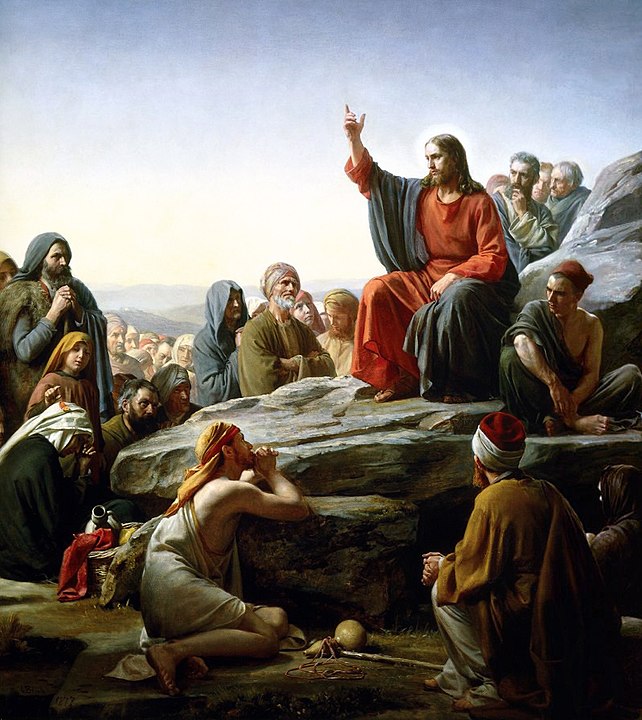
Jesus teaching, Carl Bloch (1877)

Address given at St Mary's Nenagh on Sunday 4th September 2022, the 12th after Trinity and the 1st in Creation Time

Do you know the difference between supporting a cause and being committed to it?

Well, the next time you sit down to a nice cooked breakfast you might think of this: the hen that laid the egg you’re about to eat was certainly supporting your high-cholesterol breakfast, but the pig from which the rashers came was truly committed to it!

Today’s Gospel reading from Luke (14:25-33) is about commitment – about commitment as a disciple of Jesus. Jesus is telling the crowds travelling with him what it means to be his disciple.

But at first hearing, what he says is really quite shocking, isn’t it? Surely Jesus can’t have insisted that his disciples must hate father and mother, wife and children, brothers and sisters? It sounds as if he wants them to be cold-hearted fanatics!

What I want to do today is to tease out what Jesus really did mean in this passage, and what it might mean to us today.

Would the crowds travelling with Jesus have found his teaching as shocking as we do?

At one level, I think they might have been even more shocked. For a Jew to hate mother or father would be more than shocking – it would be a blasphemy against God himself, a violation of the 5th Commandment given to Moses. If you remember, this reads: Honour thy father and thy mother: that thy days may be long upon the land which the Lord thy God giveth thee’.

And again, although the idea of carrying the cross is a very familiar metaphor to us, two Christian millennia later, it would have been quite repulsive to a Jew at that time. Stoning was the Jewish punishment – crucifixion was a barbaric practice recently introduced by the hated Roman occupiers. To say that disciples must carry the cross would have been like saying today that they must travel in the cattle-trucks to the gas chambers and ovens of Auschwitz.

But at another level, I think they would not have found Jesus’s words at all as strange as we do. There’s a long tradition in the Semitic languages of the Middle East of using over-the-top rhetoric to make a point. It continues to this day – think of Saddam Hussein’s rhetoric about ‘the mother of all battles’ for instance. Here as in many other places in the Gospels, I think that those who heard Jesus’s words would have understood very clearly that they weren’t to be taken completely literally, but that they were used to make his point as vividly as possible.

So what is the point that Jesus is making? Actually, I think there are two.

First, Jesus is warning his followers that to be his disciple, to follow his road to the Kingdom of God, may cost them everything that they hold dear. Everything; absolutely everything.

Matthew (10:37-38) puts different words into his mouth, in what seems to be another report of the same teaching, when he has Jesus say: Whoever loves father or mother more than me is not worthy of me; and whoever loves son or daughter more than me is not worthy of me; and whoever does not take up the cross and follow me is not worthy of me.’ The point is not to hate your family – that is just a rhetorical device – the point is that to be a true disciple of Jesus you must love him - you must love God - more than family, more than anything! And you must be prepared to suffer unjustly because you love God more than anything else.

And Jesus is also warning his followers that before they commit themselves they must ask themselves if they can see it through. Just as they would with any other project. They will be taken for fools if they make a commitment that they can’t live up to. Just as if they were building a tower – the reference is probably to a watchtower which people built in their fields so they could protect their crops. Or just as a wise king would – or any wise leader - before leading his people to war. You cannot make a true commitment without having calculated whether or not you can live up to it.

And second, Jesus is seeking to inspire his followers to make that commitment to be disciples.

Think for a moment about Churchill’s great speech to the British parliament and people when he became Prime Minister early in WW2: I have nothing to offer but blood, toil, tears and sweat’. That speech was calculated to rally the British nation behind a determination to fight on for victory. He went on: ‘You ask, what is our aim? I can answer in one word: Victory. Victory at all costs — Victory in spite of all terror — Victory, however long and hard the road may be, for without victory there is no survival’. Churchill used shocking language in his rhetoric, to draw on the human quality of altruism, in order to rally his people behind him. And he succeeded in this aim. This is also what President Volodymyr Zelenskiy is trying to do when he speaks to Ukrainians today.

Altruism is characteristic of our humanity. No doubt it evolved with our species – but I prefer to see it as a gift God gave us when he made us in his image. Was Jesus drawing on that same quality of altruism when he chose to use his shocking language? I think so. And Jesus offered his disciples a vision even finer than Churchill’s victory, a vision of the kingdom of God, which they would help bring to pass.

I can’t believe that Jesus expected every single person in the crowds that day to feel able to make that great commitment. Perhaps there’s a role for camp-followers, for fellow-travellers, for supporters, as well as for committed disciples in the service of God. And Jesus must surely have known that even those who did commit themselves would at times be unable to carry it through - they would find their courage fail them. Even that great disciple Peter denied his teacher three times!

But Jesus promised those first disciples that he would always be with them, helping those who wavered to renew their commitment. They experienced his resurrection and received the gift of the Spirit at Pentecost. With his help they went the distance. They obeyed his command to ‘go and make disciples of all nations’. And succeeding generations of disciples have continued to do the same. We are here as Christ’s church 2000 years later, to give witness to their success in continuing Jesus’s project of salvation.

We Christians are the crowds travelling with Jesus today.

What should we take from the words he spoke 2000 years ago? Well, just the same things, I believe, that Jesus wanted those who listened to him then to take: warning and inspiration.

Jesus warns us that we must not set out to follow him lightly – he teaches us that his disciples must be prepared to give up everything they hold dear, if that is what is asked of them. And he warns us to consider carefully whether we can pay that price before we commit ourselves to being his disciples.

But if we listen to him, Jesus also inspires us to make that great commitment, and will help us to live up to it, as the first disciples did, and as so many others have done over the centuries. Will we commit ourselves to follow in their footsteps?

St Ignatius Loyola understood this, I think, when he wrote his beautiful prayer, which I shall finish with:

Teach me, Good Lord,
to serve you as you deserve:
to give, and not to count the cost;
to fight, and not to heed the wounds;
to toil and not to seek for rest;
to labour and not to ask for any reward,
save that of knowing that we do your will.
Through Jesus Christ Our Lord. Amen

Sunday, 21 August 2022

Sabbath-keeping

Today’s reading from Luke’s Gospel (Luke 13:10-17) is about what should or shouldn’t be done on the Sabbath.

It reminded me of a surprising experience I had with my wife Marty. We once spent a week on the shores of Lake Maggiore in Italy at Stresa, looking out to the Borromean islands. It is renowned as one of the most beautiful spots on earth. And it is rather fine. Though the River Shannon is just as beautiful, when the sun shines! The lakeshore is lined with rather grand Belle Époque hotels – Ernest Hemingway set part of his novel A Farewell to Arms in one of them. We were in a much more modest place, but we made a point of visiting the posh ones to admire the decor.

One of the hotels had been completely taken over by a large group of orthodox Jews, who were celebrating the end of the Passover holidays. Women and girls dressed just like other modern women, but men all wore black hats with a curl of hair showing, and boys a skull-cap. The place was full of people of all ages, children playing games and grown-ups sitting in the shade and chatting in small groups - everyone just chilling, enjoying quality time with family and friends - a very happy sight.

But nothing electric was working: no automatic doors, no lifts, no espresso coffee machines – absolutely nothing! It was only when I asked if there had been a power-cut that I discovered why – the electricity had been turned off at the mains. It was Saturday, the Sabbath, and for their orthodox Jewish denomination it would break the Sabbath law to use any electrical devices.

So today I want to tease out what the Sabbath has meant to Jews and Christians over the ages, and what it might mean for us today.

Firstly, what does the Sabbath mean to Jews?

The Hebrew word Shabbat, from which our word comes, literally means ‘ceasing’, implicitly ‘ceasing from work’. Observing the Sabbath has been important to Jews since at least the Exodus. It’s enshrined in the Fourth Commandment brought down from Mount Sinai by Moses (Exodus 20:8-11): Remember the sabbath day, and keep it holy. Six days you shall labour and do all your work. But the seventh day is a sabbath to the Lord your God; you shall not do any work – you, your son or your daughter, your male or female slave, your livestock, or your alien resident in your towns. It commemorates God resting on the seventh day of creation in the Genesis story.

The Jewish Sabbath lasts from sunset on Friday to sunset on Saturday. It’s a day of joyful celebration as well as prayer. Many Jews attend synagogue on the Sabbath, to worship and listen to teachers expound the Torah, our Old Testament - as Jesus did in the reading we have just heard. But the emphasis is on the home: candles are lit; all share in a festive meal, with wine which is blessed. The Sabbath is to be honoured, for instance by taking a bath, and by beautifying the home with flowers. And it is to be enjoyed with eating, singing, spending time with the family – and with lovemaking between husbands and wives.

But the Sabbath is also encrusted with prohibitions. Over the millennia rabbinical scholars have elaborated the simple notion of ceasing from work one day in seven, into a complex scheme of prohibited actions. As well as obvious work activities such as sowing, ploughing, spinning and weaving, these include lighting and extinguishing a fire. This is why the orthodox Jews I met in Italy would not use electricity on the Sabbath - they believed that if a switch made a small spark, it was equivalent to lighting a fire, which would be a violation of the Sabbath law. Some orthodox Jews get over the problem with pre-set timers, to turn appliances on and off without human intervention.

To violate the Sabbath has always been a very serious matter for Jews. The ancient punishment was the most severe in Jewish law – stoning to death, though that ceased when the Jewish courts were dissolved after the Temple was destroyed. But there have always been extenuating circumstances. Jews were not just allowed but required to break a Sabbath law, if it was necessary to save a life. And as Jesus pointed out, you were also permitted to water your animals on the Sabbath. The problem the leader of the synagogue had with Jesus healing the crippled woman, was not that he healed her on the Sabbath, but that her condition was not life threatening – she had been crippled for 18 years. Healing her, he believed, should have been left to the next day.

What did Jesus himself think about the Sabbath?

This wasn’t the only time Jesus got into trouble with the religious authorities over the Sabbath. Elsewhere we hear that he declared ‘The Sabbath is made for man, not man for the Sabbath’ (Mark 2:27). He clearly taught that it is right to do good and to save life on the Sabbath.

On this occasion Jesus was infuriated by the leader of the synagogue, who kept so inflexibly to the letter of the law as to completely destroy the spirit of it. What really matters is whether an action does good or harm, not whether it fits into some abstract scheme of dos and don’ts.

But I am quite sure that Jesus valued the positive side of Sabbath-keeping: the opportunity for all to rest from labour, to enjoy time with family and friends, as well as to pray and worship God.

As Christianity evolved away from Judaism, Christian views of the Sabbath also changed.

The earliest Christians, the apostles, Paul and the disciples, were Jews, and they kept the Jewish Sabbath on Saturday. But as the years passed, and the increasingly gentile Church split from the Synagogue, the Christian emphasis shifted to Sunday, in part in celebration of the Resurrection, but perhaps also to distance a gentile church from Judaism. So Christian Sabbath observance on Saturday gradually ceased, to be replaced by celebration of the Eucharist on Sunday.

In the year 321, the Roman Emperor Constantine – a Christian convert - decreed that Sunday should be the day of rest throughout the Empire, in these words: ‘On the venerable day of the Sun let the magistrates and people residing in cities rest, and let all workshops be closed. In the country however persons engaged in agriculture may freely and lawfully continue their pursuits’. Note his pragmatic approach to the agricultural economy - I can’t help but think that Jesus would have agreed!

Almost all Christians since then have observed Sunday as the Lord’s Day, a holy day marked by worship and prayers, a holiday from work, a time for rest and recreation with family and friends - like the Jewish Sabbath but without so many prohibitions.

At the Reformation, however, Puritans sought to introduce more rigour to the observance of the Lord’s Day as a Christian Sabbath, and this still persists in many Protestant Churches. Perhaps in doing so, they lost something of the joyful celebration which marked the Jewish Sabbath, for all its prohibitions. I certainly remember the dourness of an Ulster Sunday not so many years ago, when it was quite impossible for a tourist to get a bite of lunch on a Sunday.

So finally, what might the Sabbath mean to us today?

I invite you to think of Sunday, our Sabbath, our day of rest, as a great gift - a gift our loving-father God has given us, through the traditions of those who have gone before us, right back to the time of Moses. We should cherish it. Through it, God entitles us not just to cease from working to rest, one day in seven, but to take time to enjoy our families and friends. And - if we are so moved - to be still, to worship him and give thanks for the wonderful world he has made us a part of. I think this wise gift is intended to help us to be properly human – humans made in God’s image.

Our society has been changing very rapidly. When I was young, no one worked on Sunday, unless they had animals to see to, or they sold perishable items, or there was some other pressing need. Now supermarkets and many shops are open. Factories and offices often work Sunday shifts. I confess that I’ve worked and shopped on Sundays myself, but I think it is a shame to do so unless it is absolutely necessary. Why has this happened? In this new globalised, materialist Ireland, have we allowed busyness and money-making to distract us from the Sabbath gift of stillness and rest? Whatever the reason, we can choose it to be otherwise. We are entitled – God entitles us – to say ‘No’. If we wish, we can say ‘No’ to dehumanising forces that would deny us one day in seven of stillness, to rest, to enjoy our families and friends, and to worship as we wish. Such forces can only prevail if we allow them to.

But at the same time, we must be careful not to interpret the letter of the law so inflexibly that we destroy its spirit, in the matter of keeping Sunday as in so much else, so that we may not hear Jesus say You hypocrites! to us, as he did to the leader of the synagogue.


Wednesday, 10 August 2022

Holy Simplicity

Today’s reading (Luke12: 32-40) has a lot to say to us in our present circumstances.

Jesus understands that people are often selfish and greedy because they are anxious and afraid for the future. So he tells the disciples – and through them, us – that we should put aside such anxiety. God knows what we need, and God will give us all we need when we work for his kingdom – in other words, when we try to be the people God wants us to be, loving God and his wonderful creation, and loving our neighbours as ourselves. ‘Do not be afraid, little flock’, he says, ‘for it is your Father’s good pleasure to give you the kingdom’.

God has given us all that we have so that that we may be generous with it, not hoard it. What we give away, to those who need it more than we do, is ‘an unfailing treasure in heaven, where no thief comes near and no moth destroys’. If we want to be good Christians we must focus on that kind of spiritual wealth, rather than accumulating material wealth, ‘for where your treasure is, there your heart will be also’.

And we must be alert at all times for opportunities to respond generously, as and when God prompts us to do so. As Jesus puts it, ‘Be dressed for action and have your lamps lit’. We should not put off calls on our generosity, waiting perhaps for a better time or a more pressing need to come along. We are mortal – we do not know when God will knock on the door to call us out of this life. ‘You also must be ready, for the Son of Man is coming at an unexpected hour’, says Jesus. And it would be shameful, shameful, when he does come knocking - as we know he will - to admit that we wasted the opportunities he gave us to act like the good people he created us to be.

Jesus calls his disciples to live lives of holy simplicity and generosity.

Jesus asks us to give attention to the birds of the air and the lilies of the field (Luke12:24-28). ‘Consider the ravens: they neither sow nor reap, they have neither store-house nor barn, and yet God feeds them … Consider the lilies, how they grow: they neither toil nor spin; yet I tell you, even Solomon in his glory was not clothed like one of these. But if God so clothes the grass of the field … how much more will he clothe you.’

As Christians we need to live like the birds and the lilies. That doesn’t mean that we should not work and plan for the future. Unlike the birds and lilies, we must sow and reap, build store-houses and barns, toil and spin, and we must do so as a community, because that is what it means to be human. That is how we have evolved to make our living, how God has made us to be - just as the birds and the lilies have evolved to make their different livings. But we must also recover a sense of what it is to have enough. We must resist the temptation always to seek more than we need, more than God has already given us. And we must cultivate a generous spirit.

Today’s globalised world is like an over-wound clockwork toy, in which the spring that drives it is ready to snap. We see signs of that all about us, don’t we. But our example of holy simplicity can show others how together we can release the tension, how we can return to a way of living which will enable everyone to continue to flourish in the wonderful world God has given us, alongside the birds and the lilies.

Holy simplicity is liberating, and our world needs liberating now as much as it has ever done. Let us live simply, so that others can simply live!


Sunday, 24 July 2022

Reflecting on the Lord's Prayer

May the words of my lips and the meditations of my heart be acceptable in your sight, my strength and my redeemer. Amen

You may have found today’s 3rd reading (Luke11:1-13) both familiar and strangely different.

It begins with a translation from the Greek of St Luke’s version of the Lord’s Prayer, set for today in the common lectionary, which is slightly different from St Matthew's version, and the version we have in the BCP. The prayer is deceptively simple, while at the same time encapsulating all that we ought to ask of God. I’m going to share with you some reflections upon it.

Jesus teaches his disciples to pray what we call the Lord’s prayer. We continue to do so whenever we come together as a Christian congregation. It is a prayer we are meant to say together publicly, not just on our own. We pray in the plural number, and Matthew’s version of it, records Jesus calling us to pray together to ‘our Father’, not individually to ‘my Father’.

But notice, there is nothing explicitly Christian about the prayer. It can be said in good conscience by anyone who believes in a loving, almighty God, including Muslims and Jews - both Jesus and his disciples were of course Jews.

When we pray ‘Father, hallowed be your name’, we express our reverence for the nature and character of God.

God is holy, God is good and God loves all his creatures, just as an ideal father of a household loves all the members of his household. That includes you and me, but others too. Not just Christians, but people of other faiths and none. And not just human beings, but all the wonderful diversity of living creatures we share our planet with, because God sees all his creation to be good.

When we pray ‘Your kingdom come’, what are we saying?

I believe that God’s kingdom is a state of peace and justice where we and all his creatures flourish. This is not the broken world that we see around us, beset with war, dangerous climate change, and collapsing biodiversity – that is the antithesis of God’s kingdom. But I also believe we can glimpse his kingdom, even enter into a small part of it, at any time and place where we do God’s will. Our prayer is saying that despite the brokenness, we look to the future in hope.

Jesus invites us to pray ‘Give us each day our daily bread’.

Notice he does not invite us to pray for more than our daily needs, and nor should we. If I greedily take all I desire, if I hoard it for the future, others will surely get less than they need. We are to share what we have so that all have enough. It is ok for us to ask God for what we devoutly wish for ourselves and for others – if we can’t ask God, who can we ask? But we ought always add as an afterthought, ‘Nevertheless, not my will, but yours be done’, as Jesus did in the Garden of Gethsemane. The purpose of prayer is to align our wishes with God’s wishes, not to badger him into doing what we want.

‘And forgive us our sins, for we ourselves forgive everyone indebted to us’.

Our sins are our failures to do God’s will, either by doing what we ought not to do, or by failing to do what we know we should. Very often these take the form of disobeying Jesus’s commandment to treat our neighbour as ourself. Every one of us has failed many times in our duty to God or to our neighbour. I ask God to forgive my failures, but the sting in the tail is this: that God will forgive my failures only in proportion to my forgiving the failures of others. We must forgive to be forgiven.

Finally, we pray ‘Do not bring us to the time of trial’.

Our time of trial may take many forms. Someone else, even someone I love, may seek to persuade me to do what I know is wrong, what is against God’s will. Or a character flaw in myself may give evil an opening it is hard to resist. Or cruel events may make me doubt the goodness and love of God. So we ask God to spare us such trials. But when we must face them, we need to seek God’s help to resist them, as Jesus did when Satan tempted him in the wilderness.

Evil is real. We see it all around us in the violence humankind does to this beautiful planet. We see it in the way people exploit other people for their own ends. And we see it in the death and destruction of war. We see it in the suffering not only of the people of Ukraine, but also of misled Russian soldiers, and of those whose lives are upended by shortages of food and energy as a result of sanctions. We are starting to feel the consequences here in Ireland as many struggle to pay the bills and fear food and energy poverty this coming winter. We surely need to pray that we may not be brought to the time of trial.

People often find it difficult to pray, to be intimate with God.

We may feel shy. We may find it hard to find the words to say what we want to say – I know I do. Or we may be ashamed of how unworthy we are and so try to avoid meeting God in prayer – we would much rather not think of our unworthiness. But Jesus reassures his disciples – and us - that it is always right to engage with God in intimate prayer:

‘So I say to you’, he says, ‘ask, and it will be given to you; search, and you will find; knock, and the door will be opened for you. For everyone who asks receives, and everyone who searches finds, and for everyone who knocks, the door will be opened.’

Let us take Jesus’s words to heart and unreservedly open ourselves up to God, our loving Father. And when our own words fail us, Jesus has given us his own words to fall back on.

I shall finish with a Collect of the Word:

Father in heaven,

in your goodness

you pour out on your people all that they need,

and satisfy those who persist in prayer.

Make us bold in asking,

thankful in receiving,

tireless in seeking,

and joyful in finding,

that we may always proclaim your coming kingdom

and do your will on earth as in heaven. Amen

Tuesday, 12 July 2022

The Good Samaritan

 Reflection for Morning Worship with the Community of Brendan the Navigator on 12 July 2022


We have just heard the Good Samaritan story as Luke tells it (10:25-37).

The story was prompted by a lawyer, we’re told – a learned professional man – who asks Jesus ‘What must I do to inherit eternal life?’ – in other words, how must I behave to be worthy of God’s favour. Jesus bounces the question back at him, saying ‘What does God’s law say?’ When the lawyer answers, ‘Love God, and love your neighbour as yourself’, Jesus agrees with him, saying ‘Do this and you will live.’ After all, as both Matthew (22:37-39) and Mark (12:31) tell us that Jesus had said as much himself when asked what the greatest commandment was.

But then the lawyer chances his arm again, asking Jesus, ‘And who is my neighbour?’ It is in reply to this that Jesus tells the story of the Good Samaritan. In Jesus’s time Samaritans were despised and disliked by orthodox Jews. They were heretics who did not follow Jewish law, untrustworthy, outside the pale. We might compare them to Travellers or Muslims in our society.

The Samaritan in Jesus’s story acts as a good neighbour to the traveller who is robbed and left for dead, but neither the Jewish priest nor the Levite do. When Jesus asks which of the three was a good neighbour, the lawyer replies, ‘The one who helped’ – it seems he can’t bring himself even to utter the word Samaritan. Jesus tells him, ‘Go and do likewise.’

Jews of Jesus’s time understood very well their obligation to protect and care for their neighbours in need. ‘You shall love your neighbour as yourself’, is a quotation from the law given to Moses in Leviticus (19:18) – it is a command from God. But then as now, many people questioned who fell into the category of neighbour. To suggest that a Samaritan could be a neighbour, and a good one, would have shocked them. I can just hear them saying, ‘Surely God doesn’t expect us to love Samaritans! They aren’t good people like us, their beliefs are wrong and their habits disgusting. We don’t like them and they don’t like us’. Jesus must have sensed that the questioning lawyer was someone like that.

Jesus’s own view is quite clear. Through his story Jesus teaches the lawyer - and us too - that every human being is our neighbour – we must love them as we love ourselves, whoever and whatever they are. Even Samaritans. Loving God is not enough; God wants us to love our neighbours too. No doubt the priest and the Levite both loved God. But for whatever reason neither could bring himself to help the robbed man. They passed by on the other side - they did not behave like loving neighbours.

To follow Jesus means we must love every human being as ourselves. This truth has consequences for us today.

The Covid epidemic is still with us. Short-sighted policies have allowed a tragic housing crisis to develop over years. The evil attack by Russia on Ukraine has thrown the global economic system out of balance causing shortages of food and energy. The climate crisis is threatening lives and livelihoods across the world.

In our own country, many, many neighbours are falling into need. Thousands cannot find an affordable home. Tens of thousands of refugees who have lost everything seek safety among us. Hundreds of thousands will suffer fuel poverty and food poverty this winter. And there are the hundreds of millions in other countries in desperate need.

Neither you nor I can meet all their needs as individuals. But if each one of us reflects on what we can do, and we do what we can, however little, alongside millions of others, we will make an immense difference.

As Christians we cannot pass by on the other side of the road. Jesus calls us to practical action to relieve our neighbours’ distress to the best of our ability. He calls us to be Good Samaritans - ‘Go and do likewise’. What will you do? What will I do?